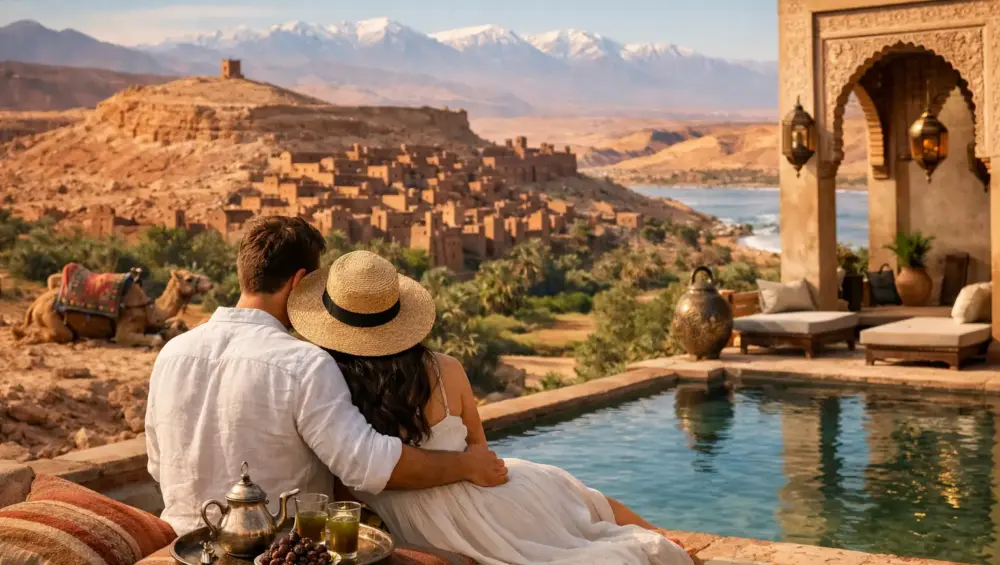
The best Morocco honeymoon itinerary is not the one that squeezes in every famous name on a map. It is the one that gives you time to wake slowly in a beautiful riad, share a long lunch when you find somewhere you love, and arrive at the desert before the light disappears. Morocco has enormous range for a honeymoon, but it also has serious distances. The art is knowing where to linger and what to leave for another visit.
I usually begin planning with one question: what does a perfect day together actually look like? For some couples, it is a rooftop breakfast, a hammam and dinner in Marrakech. For others, it is a quiet mountain walk, a private picnic, then a fire under Sahara stars. Neither answer is more romantic. They simply call for different routes.
Start with pace, not the pinboard
A first Morocco honeymoon can easily become overambitious. Marrakech, Fes, Chefchaouen, the Atlas Mountains, the Sahara and Essaouira all look temptingly close on a screen. In reality, linking them all into one week creates too many check-outs, long driving days and nights spent recovering rather than enjoying each other.
For most couples, I suggest allowing 10 to 12 nights if the Sahara is a priority. This gives Morocco room to unfold: city energy first, then the mountains and desert, before a softer finish. With seven or eight nights, choose either the south and Sahara or a city-and-coast journey. Trying to do both usually turns a honeymoon into a very attractive road rally.
There is also a useful distinction between a holiday that is luxurious and one that is restful. A grand hotel every night can be lovely, but frequent moves are still frequent moves. Often, a smaller characterful riad, a beautiful kasbah and a thoughtfully chosen desert camp create more atmosphere than a parade of interchangeable five-star rooms.
An 11-night Morocco honeymoon itinerary with room to breathe
This route works particularly well for couples who want the iconic Morocco experience without treating the country as a checklist. It connects naturally by road and balances private cultural experiences with proper downtime.
Nights 1 to 3: Marrakech, with one day deliberately unplanned
Marrakech is an excellent beginning because it asks you to be present. The medina is full of turns, sounds, spice stalls, craftspeople and the occasional scooter appearing where a scooter should not possibly fit. A good private guide on your first full day helps make sense of it all, especially if you would rather understand the city than spend half the morning consulting your phone.
Choose a riad where you genuinely want to spend time, not merely somewhere photogenic for a quick bag drop. A courtyard breakfast, a rooftop at sunset and a room quiet enough for an afternoon rest matter on a honeymoon. Use another day for the Majorelle area, a food-focused walk, a hammam, or simply a late breakfast followed by no plan at all.
I would not schedule a major excursion on every Marrakech day. The city rewards curiosity, but it can be intense. Leaving a little blank space means you can follow an impulse: sit with mint tea, return to a shop you noticed, or stay at dinner because the evening is going rather well.
Nights 4 and 5: The Atlas Mountains for a change of rhythm
From Marrakech, the High Atlas offers a dramatic reset. The journey is not only about reaching a mountain property. The road itself changes the mood: dense city gives way to olive groves, red earth and villages rising along the valleys.
This is where I would build in the kind of experiences that feel personal rather than performative. It might be a guided walk tailored to your fitness and appetite for hills, a relaxed lunch with a view, or time by a pool with the mountains doing their best work in the background. In cooler months, this stop can be especially welcome after the bustle of Marrakech; in hotter periods, elevation brings a different feel, though conditions vary by location.
Two nights are better than one. One night gives you the view. Two gives you the feeling of having gone somewhere together.
Night 6: Skoura or the Dades Valley, not just a stopover
The drive south towards the desert is one of the reasons to choose a private journey. You can stop when the landscape changes, take a slower lunch, visit a kasbah or simply stretch your legs where the view insists on it. A fixed coach schedule cannot compete with that freedom.
Skoura suits couples who enjoy palms, historic architecture and a gentler setting. The Dades Valley is a stronger choice if you prefer rock formations, wide valley views and a more dramatic sense of place. Both are far more than beds between Marrakech and the Sahara, provided the overnight stay is chosen well.
This is a practical night, yes, but it should still feel like part of the honeymoon. A lovely dinner in a garden or a quiet terrace at dusk changes the entire character of a journey day.
Nights 7 and 8: The Sahara, with time for the silence to arrive
The Sahara is often the emotional centre of a Morocco honeymoon itinerary. It is also the place where rushing is most obvious. Arriving late, taking a quick camel ride, sleeping one night and leaving at dawn may technically count as seeing the desert, but it misses the point.
Two nights allow you to settle in. You might arrive by 4×4, take a camel ride close to sunset if that appeals, and spend the first evening over dinner and music by the fire. The next day can be as active or as still as you like: a sandboarding session, a visit to a local village, a drive through the dunes, or a long lazy afternoon reading in the shade.
Be honest about the camp style you want. Some couples imagine total isolation, while others prefer comfortable facilities, excellent food and a little atmosphere around dinner. There is no wrong answer, but I would always match the camp to the couple rather than choose by a glamorous photograph alone. Desert nights can be cool outside the hottest months, and the quality of bedding, service and transport makes a real difference.
Nights 9 to 11: Fes for depth, food and a final sense of place
After the open horizons of the Sahara, Fes feels intricate and inward-looking. Its medina is less about spectacle and more about layers: workshops, carved doorways, historic courtyards and food traditions that reward a little guidance.
A knowledgeable local guide is particularly worthwhile here. Fes is not a city I recommend approaching with a rigid list of sights. It is better understood through stories, small details and the rhythm of its neighbourhoods. Plan one guided day, then keep another lighter. A cooking experience, a leisurely meal in a restored home or a calm afternoon at your riad can be a far better honeymoon memory than trying to cover every monument.
For your departure, the practical details depend on flight times and airport choices. Sometimes it makes sense to depart from Fes; sometimes a final transfer or domestic connection is preferable. This is one of those unglamorous decisions that can protect the last day of a beautiful trip from becoming unnecessarily stressful.
When Essaouira is a better honeymoon choice than the desert
Not every couple needs the Sahara. If your idea of romance involves sea air, fresh fish, walks along old ramparts and two or three slow mornings, pair Marrakech with Essaouira instead. It is a wonderful contrast: Marrakech provides colour and energy, while Essaouira asks very little of you beyond choosing a table for lunch.
I often recommend this version for shorter honeymoons, for travellers visiting during very hot weather, or for couples who simply do not enjoy long road journeys. Add the Atlas Mountains if you have enough time, but resist adding Fes and Chefchaouen as well. A calmer route is not a compromise. It is a design choice.
The details that make the route feel effortless
A honeymoon is usually not the time to discover that a beautiful-looking stay is an hour down a rough track, or that a six-hour drive becomes eight once stops, lunch and luggage are included. These are the small calculations I make before suggesting a route.
Private drivers make the journey more flexible, but they do not make roads shorter. I prefer to be transparent about driving days and build them around worthwhile scenery, comfortable stops and sensible overnight points. Similarly, a private guide should add context where it matters, not fill every moment with facts when you would rather have time alone.
At Morocco Genie, I design around the couple first: the places you are excited about, the comforts you value, how much activity feels enjoyable, and whether you want a social camp dinner or near-total quiet. Your wish is my command, within the laws of geography, of course.
Leave one evening unscripted, one morning without an alarm and at least one place where you stay long enough to feel the rhythm of it. Morocco can give you remarkable stories, Habibi, but the best honeymoon moments are often the ones you did not need to schedule.