A wrong turn in the Fes medina is not a disaster. It can lead to a tiny bakery, a carved doorway or a quiet square you would never have planned to find. But after 25 minutes of retracing the same alleyways in summer heat, the question of Morocco private guide versus self-guided travel becomes rather practical. The best choice is rarely about whether you are an adventurous traveller. It is about where your independence adds to the experience, and where local knowledge saves time, energy and avoidable frustration.
I plan private Morocco journeys for people who want the country to feel personal, not pre-packaged. My honest view is that Morocco rewards a hybrid approach more than an all-or-nothing decision. Keep the freedom where it matters. Bring in a guide where context, navigation or access makes the day far richer.
Morocco private guide versus self-guided: the real difference
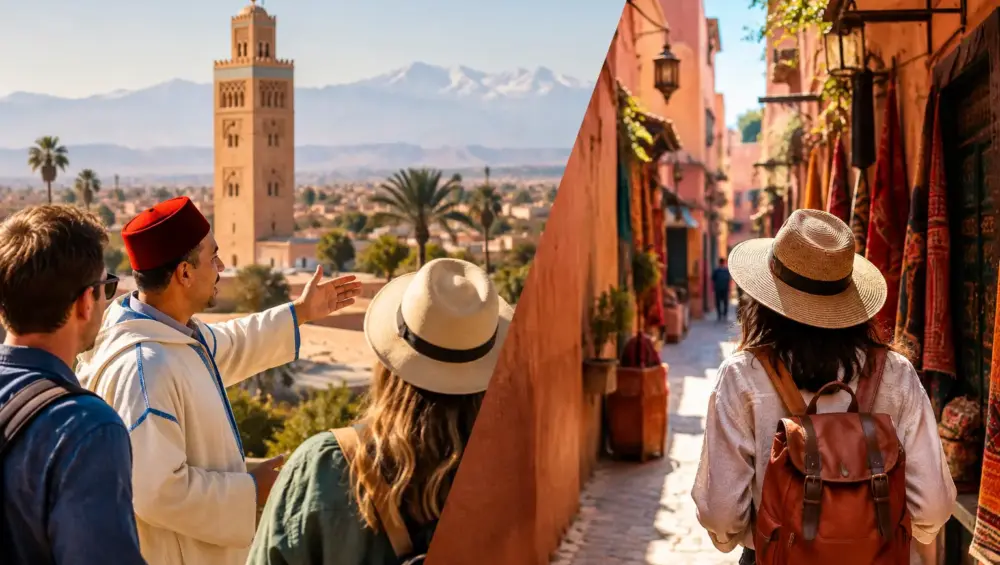
A private guide is not simply someone who walks ahead and points at monuments. A good licensed local guide helps you read a place. In Fes, that may mean explaining why a neighbourhood is organised around a fountain, hammam and mosque, showing you how traditional crafts actually work, and adjusting the route when the souk is especially busy. In Marrakech, it can mean separating the places worth lingering in from the stops designed mainly for hurried visitors.
Self-guided travel gives you something equally valuable: room to follow your own curiosity. You can spend an unplanned hour with mint tea on a rooftop, return to a gallery you noticed the day before, or decide that a slow morning in your riad is more appealing than another museum. For travellers who enjoy researching, walking and making small decisions as they go, this is part of the pleasure.
The trade-off is mental load. Morocco is wonderfully sensory and often straightforward once you are settled, but the country asks more of you than a holiday where every sign, timetable and interaction works in familiar ways. A guide reduces decisions during the part of the trip that can be most intense. Self-guiding preserves flexibility but requires patience, preparation and a willingness to occasionally get it wrong.
When a private guide changes the day
In the medinas of Fes and Marrakech
This is where I most often recommend a guide, particularly for a first visit. The historic medinas are living neighbourhoods, not open-air museums, and their apparent disorder is part of their character. Maps help, but GPS can be unreliable in narrow covered lanes, and the most interesting details are easy to pass without noticing.
A private guide also gives you permission to ask the questions guidebooks cannot anticipate. Why are certain doors painted particular colours? What is being sold in this spice blend? Which hammam is used by local residents rather than visitors? A thoughtful guide responds to your interests, whether that is architecture, food, artisan traditions or everyday life.
That does not mean you need a guide for every minute. I often prefer a guided orientation early in a stay, followed by free time. You will walk with greater confidence afterwards and make better choices about where to return.
In places where stories matter as much as scenery
Volubilis, the Roman site near Meknes, is far more compelling when its streets, mosaics and public buildings are given context. The same applies to kasbahs in the south and historic sites around the Atlas foothills. You can admire the views independently, of course. Yet without interpretation, many visitors see attractive ruins and leave after twenty minutes, having missed the human story that makes them memorable.
For specialist interests
Food-focused walks, photography, mountain trekking and Jewish heritage visits can all benefit from the right local expert. The key word is right. A guide who understands your pace and interests is more useful than a generic script delivered at speed. I always advise travellers to be clear about what they want from the day before it begins: fewer shopping stops, more architecture, gentle walking, child-friendly storytelling, time for photographs, or a particular dish to try.
When self-guided Morocco is better
Some parts of Morocco are made for unstructured time. Essaouira is a fine example. Its medina is compact, walkable and pleasantly easy to navigate, while the harbour, ramparts, cafés and galleries reward wandering. A guide can add cultural depth, but it is not essential for enjoying the town.
The same is often true in Chefchaouen. Its blue lanes are beautiful early in the morning or later in the afternoon, when you can move at your own pace and step aside for a coffee whenever you like. A local guide is useful if you want history, hidden viewpoints or a walk beyond the main lanes, but many travellers are perfectly happy exploring independently.
Self-guided time also works well in Marrakech once you know the basics. Choose one area – the souks, the Mellah, Gueliz or the gardens – rather than trying to conquer the whole city in a day. Leave room for chance. Morocco’s small pleasures are frequently unplanned: a man shaping bread dough at a neighbourhood bakery, the smell of orange blossom after rain, or a quiet courtyard behind a busy street.
The driving question is separate
People sometimes treat driving independently and exploring independently as the same decision. They are not.
Hiring a car can be an excellent choice for confident drivers who enjoy open roads and want a slower route through the north, the Atlantic coast or the foothills of the Atlas. It gives you control over stops and makes a two-night pause in a lesser-known town much easier. On the other hand, city driving, parking, long desert distances and unfamiliar road conditions can turn a carefully planned holiday into a logistics exercise.
For many couples, families and small groups, a private driver is the calmer middle ground. You still choose the route, departure time and stops, but you are not concentrating on road signs after a long lunch or trying to locate a riad down a lane where cars cannot enter. A driver and a local city guide serve different purposes: one coordinates movement between places; the other interprets a destination on foot.
If you are travelling to the Sahara, I would think carefully before self-driving purely for the sake of independence. The distance is significant, and desert experiences involve timings, luggage arrangements and meeting points that are easier when coordinated properly. You can still have plenty of private time once you arrive.
Cost is not just the daily rate
A self-guided itinerary can appear cheaper because you are not paying for a guide or driver. Sometimes it is. If you are staying longer in one town, travelling lightly and happy to research restaurants and activities as you go, you may not need extra support.
But compare the full cost, not only the headline rate. A guide can prevent an expensive detour, help you use limited time well and make one short visit meaningful rather than forgettable. A driver can remove the need for one-way vehicle planning, city parking and the risk of exhausting travel days. Neither is automatically worth it, but both can offer value in ways that do not appear on a spreadsheet.
I would not hire a private guide just because you feel you ought to travel ‘properly’. Nor would I self-guide every day to prove you are independent. Your holiday should suit the way you actually like to travel.
My preferred approach: guided anchors, free space
For a first Morocco journey, I usually favour a few guided anchors within a route that still has breathing room. Perhaps that means a guided morning in Fes, independent time in Chefchaouen, a driver for the journey through the Atlas and to the desert, then a slow self-guided day in Essaouira. This gives you knowledge where it has the greatest return, without scheduling away the pleasure of discovery.
The exact balance changes with the traveller. Families may value a guide who keeps a medina walk engaging and manageable. Food lovers might choose a private culinary experience but wander independently at other times. Repeat visitors may want little formal guiding at all, apart from a specialist day in a region they have not explored before.
At Morocco Genie, I start with those preferences rather than placing every traveller into the same route. Your wish is my command, within the useful limits of driving times, local rhythms and what will make the journey genuinely enjoyable.
Before deciding, ask yourself one simple question: on the days you remember most from past holidays, were you happiest following a plan, understanding a place through someone local, or having nowhere particular to be? Build your Morocco around that answer, then leave a little room for the unexpected. Habibi, that is often where the best moments wait.