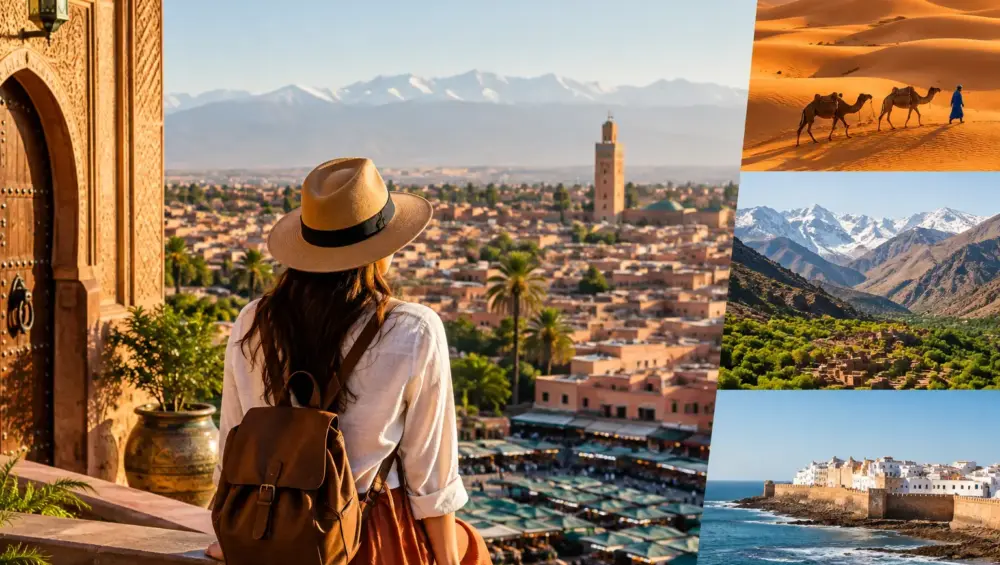
The question is not simply how long should you visit Morocco, but how much travelling you are happy to do between the moments you came for: mint tea on a riad roof, a quiet Atlas valley, the first sight of dunes, or getting happily lost in Fes. Morocco looks manageable on a map, but the country rewards travellers who give its roads, landscapes and cities enough breathing space.
After years of planning journeys here, my honest answer is this: seven to ten nights is the sweet spot for a first visit. Five nights can work if you focus tightly. Two weeks is wonderful if you want the Sahara, the mountains and the coast without treating the holiday like a checklist. Your wish is my command, habibi, but I will always tell you when an itinerary is trying to do too much.
How long to visit Morocco: start with your priorities
A private driver can make Morocco wonderfully easy to explore, but it cannot shorten geography. Marrakech to the Sahara desert is not a quick day trip. Fes and Chefchaouen are both compelling, yet adding them to Marrakech, the Atlas Mountains, Essaouira and the dunes in one week creates more suitcase time than most people expect.
Before deciding on a number of days, I ask travellers what they would miss most if it were left out. For some, it is a night in the desert. For others, it is wandering Marrakech with a knowledgeable local guide, cooking Moroccan food, or slowing down by the Atlantic in Essaouira. There is no universally correct route. There is only the route that reflects your pace.
I also look at arrival and departure points. Flying into Marrakech and home from Fes, for example, can save a long return journey. Arriving and departing from the same city is still perfectly workable, but it may shape which regions are sensible to include.
Is five days enough for Morocco?
Five nights is enough for a memorable introduction, not for the whole country. I would normally keep it to Marrakech and one contrasting area: either the Atlas Mountains, Essaouira, or the desert edge around Ouarzazate and Skoura.
Marrakech plus the Atlas is ideal for travellers who like culture, food and scenery without long drives. Spend two or three nights in Marrakech, then move into the mountains for two nights. You can visit a valley, walk at a comfortable level, meet local communities and return feeling as though you have seen two very different Moroccos.
Marrakech and Essaouira suits couples, families and anyone who wants a gentler rhythm. The medina, souks and energy of Marrakech are followed by sea air, fish grills and a more relaxed place to wander. It is a compact pairing that does not pretend to be something it is not.
Could you reach the Sahara in five nights? Yes, but I would only recommend it if the desert is the non-negotiable reason for your trip. Expect substantial driving over several days, and accept that Marrakech will be more of a taster than a deep stay. The route can be spectacular, particularly through the High Atlas and southern kasbah country, but it is not a slow holiday.
Seven nights: the best first Morocco trip for many people
A week gives a journey its shape. It allows you to experience Marrakech properly, spend a night or two beyond the city, and still avoid a rushed final day.
One of my favourite seven-night structures begins with three nights in Marrakech. That gives you time for a guided introduction to the medina, a free afternoon to follow your own curiosity, and perhaps a hammam, garden visit or food-focused experience. Marrakech is intense at first. Giving it more than one night means you stop reacting to it and start enjoying it.
From there, two nights in the Atlas Mountains creates a real change of scene. The journey itself is part of the experience, but the point is not to tick off a mountain pass and leave. Stay long enough for an unhurried walk, a long lunch with a view, or simply a quiet morning away from the city.
For the final two nights, Essaouira is often the relaxed choice. If the desert matters more, a carefully planned southbound route can replace the coast, though the driving will be fuller. I would not try to add both Essaouira and the Sahara to a seven-night holiday unless you genuinely enjoy long road days.
Ten to twelve nights: enough room for the Sahara
If you have dreamed of sleeping among the dunes, ten to twelve nights is where Morocco starts to feel generous rather than compressed. This timeframe lets the desert be a meaningful part of the route instead of an exhausting detour.
A well-paced journey might include Marrakech, the High Atlas, Ait Ben Haddou or Skoura, the Dades Valley, the Sahara near Merzouga, then Fes. Each place has a different texture: red-earth kasbahs, palm groves, dramatic gorges, changing desert light and the intricate old city of Fes.
The key detail is the overnight stops between Marrakech and the desert. It is tempting to drive straight through, but southern Morocco deserves attention. A night in Skoura or the Dades Valley breaks up the journey and reveals the landscape most people remember long after they have forgotten the number of kilometres travelled.
I also encourage a two-night desert stay where possible. Arrive in the afternoon, experience the dunes and camp or desert lodge, then enjoy the following morning without immediately setting off on another long drive. Desert silence is wasted if it is squeezed between two hurried transfers.
Ten to twelve nights can also accommodate Chefchaouen after Fes, although this depends on your departure airport and tolerance for travel days. Its blue lanes are lovely, but I would not add it merely because every social feed says you should. For travellers who prefer landscapes, food and quieter places, another night in the mountains or desert may be the better choice.
Two weeks in Morocco: the comfortable wide-angle view
Fourteen nights is excellent for travellers who want the iconic route and space to enjoy it. You can combine Marrakech, the Atlas, the southern valleys, the Sahara, Fes and Chefchaouen, perhaps finishing on the coast or allowing extra time in one favourite city.
The benefit is not that you can collect more destinations. It is that delays, leisurely lunches and spontaneous discoveries no longer feel like a problem. You can let a local guide show you the craft workshops of Fes without watching the clock. You can stay an extra night where the view is good. Families especially appreciate this margin, because children rarely experience Morocco on an adult-sized timetable.
A fortnight also makes sense for repeat visitors who have already seen Marrakech. You might focus on Fes and the north, explore the Anti-Atlas and quieter southern towns, or build a journey around walking, food, architecture or photography. Morocco has enough variety to reward a narrower focus.
The itinerary mistake I see most often
The common mistake is treating every destination as a pin on a map rather than a place with a mood. A route may technically fit, but still leave you tired. Every hotel change involves packing, checking out, meeting the driver, settling in again and losing part of the day. On a private journey, the drives can be enjoyable, with stops chosen around your interests, but they are still drives.
I generally prefer at least two nights in major bases such as Marrakech, Fes, Essaouira, the Atlas Mountains and the desert. One-night stops are useful along a longer route, especially in the south, but too many of them make Morocco feel like a relay race.
Season matters too. In warmer months, travellers often enjoy slower mornings and later activity, making fewer hotel changes particularly sensible. In cooler months, the desert and mountains can be magical, but road conditions and daylight hours deserve thoughtful planning. A good itinerary is not just a route drawn on a screen. It is a route designed for the month, the people travelling and the energy they want to have each day.
My practical recommendation
For a first private journey, choose seven nights if you want Marrakech plus one contrasting region, and ten to twelve nights if the Sahara and Fes are priorities. Choose two weeks if you want to travel widely while preserving time to actually be somewhere.
If your holiday is shorter, do less and do it well. Morocco does not need to be conquered in one visit. The country is at its best when there is time for the unplanned tea invitation, the road-side pomegranate stall, and the sunset you were not meant to rush past. That is the kind of journey I design at Morocco Genie: one that fits your real wish, not an arbitrary list of places.