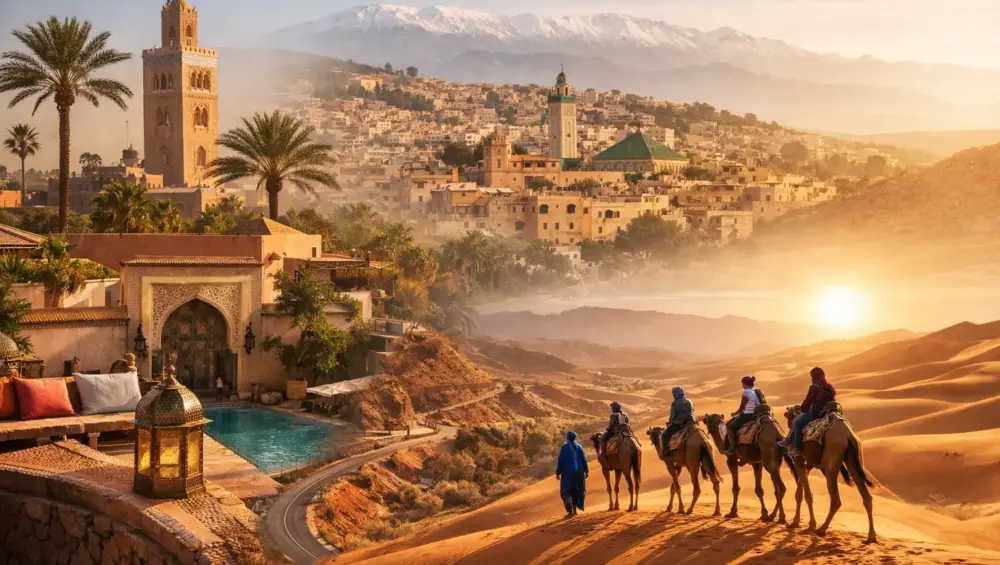
The first time travellers look at a map for a Marrakech Fes desert itinerary, they often underestimate one thing: Morocco is wonderfully varied, but the distances between its headline moments are real. The snowy High Atlas, the ochre kasbah country, the dunes of Erg Chebbi and the labyrinthine streets of Fes do not sit around the corner from one another.
I find that seven days is the minimum for this route if you enjoy a full but rewarding journey. Eight days gives the trip room to breathe – and that extra night can be the difference between merely seeing the Sahara and actually feeling that you were there.
The route that makes sense
The most logical direction is Marrakech to Fes, travelling east through the High Atlas Mountains and south-east towards the desert before turning north to Fes. It prevents unnecessary backtracking and gives the landscapes a pleasing progression: red city walls, mountain passes, palm groves, deep gorges, dunes, then the cedar forests and rolling Middle Atlas.
For most private journeys, I recommend this sequence: Marrakech, Ait Ben Haddou and the Ouarzazate region, the Dades Valley or Skoura, Merzouga and Erg Chebbi, then Midelt or the Middle Atlas on the way to Fes. The exact overnight stops should depend on your interests and the time of year. A family travelling with young children may prefer shorter driving days; a couple keen on photography may want an extra dawn in the dunes.
A seven-day Marrakech Fes desert itinerary
Days 1 and 2: Begin properly in Marrakech
Marrakech is not a city I would rush through after a long flight. Give it at least one full day, ideally two nights, so that you can settle into the rhythm of the medina before the road journey begins. A private guide can make the old city far less overwhelming, especially if you want to understand the crafts, food and history rather than simply follow the busiest lanes.
I usually suggest keeping one part of the day unplanned. Sit down for mint tea, wander a little without a destination, and let Marrakech be noisy, fragrant and occasionally confusing. That is part of its character. The key is having a calm riad to return to afterwards.
Day 3: Cross the High Atlas to kasbah country
The drive from Marrakech over the Tizi n’Tichka pass is one of Morocco’s classic road days. It is scenic, but it is not a quick transfer. Mountain bends, photo stops and changing weather can all affect the pace, particularly in winter.
Ait Ben Haddou is a worthwhile stop, not just a tick-box film location. Walk across the riverbed when conditions allow and climb through its earthen lanes for views over the valley. From there, you can continue towards Ouarzazate, Skoura or the Dades Valley. I often favour Skoura for travellers who prefer palms, gardens and a quieter evening; the Dades suits those who want to wake up closer to dramatic rock formations and gorges.
Day 4: Valleys, gorges and the road to Merzouga
This is usually the longest and most varied driving day. The route may take in the Rose Valley, depending on your overnight location and timing, then the Todra Gorge before continuing east towards Merzouga. The scenery changes repeatedly: rose-coloured villages, dry plateaus, irrigated palms and, eventually, the first hints of desert.
Arriving before sunset is valuable. It gives you time to settle, have a quiet look at the dunes and avoid turning the camel ride or 4×4 transfer into a race against darkness. In summer, the late afternoon heat is another reason not to push too hard.
Day 5: Sleep in the Sahara, but choose the experience carefully
The Sahara portion of the journey should not be reduced to a quick camel ride, a dinner and a hasty departure at dawn. Erg Chebbi, near Merzouga, is where many travellers picture the great Moroccan dunes, and it deserves a little attention.
There are different ways to arrive at a desert camp. Camels are atmospheric and suit many people, but they are not universally comfortable, especially for anyone with back, hip or mobility concerns. A 4×4 transfer is often the more practical choice, and it does not make the experience less special. Your wish is my command, but I will always give honest advice before putting anyone on a camel for an hour.
Spend the afternoon walking a ridge, trying sandboarding if that appeals, or simply watching the colour shift across the dunes. At night, the silence is the main event. A camp can be sociable and lively, or small and peaceful. That distinction matters more than decorative lanterns in the photographs.
Day 6: Merzouga to Midelt or the Middle Atlas
This is the day many itineraries get wrong. Going straight from Merzouga to Fes is possible, but it is a very long day, particularly after a desert night. For seven days, it can be done with an early start and sensible expectations. For a more comfortable journey, I would stop around Midelt or further north in the Middle Atlas.
The drive traces the Ziz Valley, where palm groves appear unexpectedly beneath vast, dry escarpments. Later, the landscape becomes greener and cooler. In the cedar forests near Azrou, you may see Barbary macaques, though I encourage travellers to observe them respectfully and avoid feeding them.
An overnight break also means you arrive in Fes with energy left for the city rather than simply needing a shower and an early bed.
Day 7: Arrive in Fes with time to understand it
Fes is often described as Marrakech’s quieter cousin. I do not think that quite captures it. Fes is less performative, more layered and, in many ways, more demanding. Its medina is dense, working and historic, with neighbourhood bakeries, workshops, fountains and trading alleys that reward context.
If your schedule only allows one night, arrive early enough for a panoramic view and a relaxed evening. If you can add an eighth day, use it for a licensed local guide in the medina. This is where an explanation transforms the experience: why the tanneries are arranged as they are, how the funduqs once supported trade, and how people still live within this extraordinary old city.
Why eight days is usually the better choice
An eight-day version does not need to add another big destination. Its value is in pace. You might take an extra night in Marrakech, stay two nights around Merzouga, or break the northern drive with a night in Midelt or Ifrane. My preference for most travellers is an extra desert-region night.
That second night lets you explore beyond the camp itself. You could visit a local village, hear Gnawa music in the Merzouga area, take a gentle 4×4 route around the dunes, or simply enjoy a proper morning after sunrise rather than packing immediately. It also gives the weather a little more flexibility. Wind, rain or an unusually hot afternoon should not be allowed to dictate the entire desert experience.
For travellers who dislike long car journeys, eight days is not a luxury. It is good route design.
Practical choices that shape the journey
A private driver is particularly useful on this route because the journey is not just about getting from A to B. Timings change with roadworks, mountain weather, market days and the places where you decide to linger. A knowledgeable driver can suggest the right viewpoint, find a worthwhile roadside lunch, and help the day feel like travel rather than transport.
Accommodation also needs to follow the route rather than an arbitrary category. In Marrakech and Fes, a well-run riad inside or close to the medina can add real atmosphere, though access and luggage handling should be considered. In the valleys, I look for character and a setting that earns the overnight stop. In the desert, I care more about camp location, warmth in winter, service and quiet than flashy labels.
Pack for contrasts. Even when Marrakech is warm, the mountains can be cold, and desert nights between late autumn and early spring are often surprisingly chilly. Comfortable closed shoes are more useful than fashion-led sandals for gorges, medina lanes and dune walks. A light scarf is useful for sun and sand, but there is no need to arrive dressed as though you are in a costume drama, habibi.
The mistake to avoid
The common mistake is treating the desert as a detour that must be squeezed into the shortest possible timeframe. It is not. The road to the Sahara is the story: the mountain villages, fortified kasbahs, changing geology, date palms and the gradual sense of space opening around you.
When I design this route through Morocco Genie, I start by asking what kind of days you enjoy. Some travellers want every possible stop and an active desert adventure. Others want long lunches, fewer hotel changes and time to read beside a pool in Skoura. Both are excellent journeys when the pace is honest.
Leave room for the unplanned moment – a roadside stall selling fresh dates, a view that makes everyone ask the driver to stop, or a quiet cup of tea after sunset in the dunes. Those are often the details that stay with you long after the sand has left your shoes.