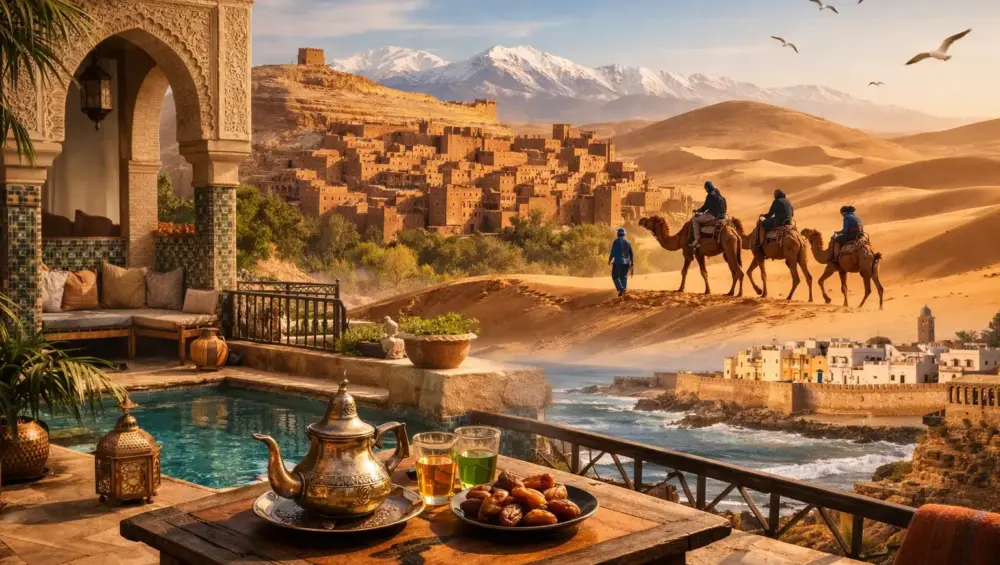
Ten days in Morocco sounds generous until you start pinning places on a map. Marrakech, Fes, the Sahara, Chefchaouen, Essaouira, the Atlas Mountains – suddenly your morocco itinerary 10 days turns into a race. I see this all the time. People arrive with a beautiful wish list and only later realise that Morocco is a country where the distances, road styles and pace of travel matter just as much as the sights themselves.
If you want those ten days to feel rich rather than rushed, the smartest approach is not to cram in everything. It is to build a route with rhythm. In Morocco, a good journey is not just about where you sleep each night. It is about how the places connect, how much road time you can genuinely enjoy, and where you allow space for Morocco to surprise you.
A Morocco itinerary 10 days travellers can enjoy
If you are visiting for the first time and want a balanced mix of cities, scenery and desert, my favourite shape for a 10-day route is Marrakech, the Atlas Mountains, Ait Ben Haddou, the Dades or Skoura area, Merzouga desert, Fes and then either a final night in Marrakech by flight or a different departure point depending on your international route.
Why this works so well is simple. It gives you contrast without constant backtracking. You get the sensory hit of Marrakech, mountain landscapes, cinematic kasbah country, the Sahara experience and the cultural depth of Fes. It also avoids one of the most common mistakes – trying to add both Chefchaouen and Essaouira into the same ten days as well. You can do it, technically, but the trip often ends up feeling like a transfer schedule with mint tea.
Days 1-2: Marrakech without rushing it
I usually suggest at least two nights in Marrakech at the start. After a flight, especially if you are arriving from long-haul routes, it helps to begin with somewhere lively but logistically easy. Marrakech is ideal for that. You can settle into a riad, get your bearings and enjoy the city properly instead of treating it as a box to tick.
On your first full day, focus on the Medina, a garden or two, and perhaps a guided visit if you enjoy context rather than wandering blind. Marrakech can be magical, but it can also be overwhelming when approached without a plan. This is one of those places where a few well-chosen hours are often better than a heroic all-day march through every souk.
Some travellers ask whether one night is enough. My honest answer is only if you are very short on time or not especially interested in cities. Most people appreciate Marrakech more when they are not trying to decode it while half-asleep.
Day 3: Atlas views and the road to kasbah country
On day three, head south across the High Atlas. This is not a throwaway transfer day. The route itself is part of the experience. The scenery changes dramatically, and if you stop well, the journey starts to feel like Morocco unfolding in layers.
I prefer including Ait Ben Haddou or a nearby kasbah area rather than pushing too far in one go. Some itineraries try to go from Marrakech straight to the desert in a single heroic drive. Yes, it can be done. No, I do not think it is a good idea for most travellers. You spend the day watching the clock, not enjoying the route.
Staying around Ait Ben Haddou, Ouarzazate, Skoura or the Dades region gives you a much better travel tempo. Which one suits you best depends on your style. Ait Ben Haddou is iconic and visually striking. Skoura feels greener and quieter. Dades gives you dramatic valley scenery. This is where private trip planning really helps because the right overnight stop depends on whether you care more about architecture, landscapes or simply minimising drive time the next day.
Days 4-5: Into the Sahara, but do it sensibly
From the south, continue towards Merzouga for your desert stay. This is usually one of the emotional high points of the trip, but expectations matter. The desert is not around the corner. It takes commitment to reach it, which is exactly why trying to squeeze it into too few days often backfires.
I recommend at least one night in the dunes area, and for many travellers, two nights is even better if the desert is a major priority. With one night, you can absolutely enjoy the camel ride or 4×4 transfer, sunset, dinner and the stillness of the dunes. With two nights, the experience becomes less performative and more personal. You actually get time to breathe.
There is also the camp question. Not everyone wants the same version of the Sahara. Some people want comfort, proper beds and a polished experience. Others care more about atmosphere and simplicity. It depends on your travel style. I always tell people the desert is memorable because of the setting, not because it is trying to be a city hotel in the sand.
Days 6-7: From Merzouga to Fes
The route from Merzouga to Fes is long, but it can be surprisingly varied if handled properly. You pass changing landscapes, palm groves, rocky plains, cedar forests and different Berber towns along the way. It is one of those days where a good driver and sensible pacing make all the difference.
Some travellers ask whether it is better to return to Marrakech instead of continuing to Fes. That depends on your flights and your interests. If you want two imperial cities and a route that feels like a true traverse of Morocco, continuing to Fes makes more sense. If your international flights work much better in and out of Marrakech and you are less interested in Fes, then a loop back south may be more practical.
Assuming you continue, give Fes at least two nights. Like Marrakech, it rewards proper time. Unlike Marrakech, it often feels denser, more layered and more cerebral. It is less about visual theatre and more about texture, craftsmanship and history.
Days 8-9: Fes with enough depth
Fes is not a city I recommend doing in a hurry. A good guide can transform it from confusing to fascinating, especially in the old Medina where navigation is not exactly self-explanatory. If Marrakech is immediate, Fes reveals itself more slowly.
Use one day for the Medina, artisan quarters and the city’s historic layers. On another day, you can either continue exploring or slow the pace down with a more relaxed morning and a few carefully chosen visits. Travellers often underestimate how tiring Morocco’s old cities can be. You do not need to prove anything by walking every lane.
This is also where I sometimes advise people to choose between depth and breadth. If your real dream is blue alleys in Chefchaouen, then you might reduce time elsewhere and head north. But adding Chefchaouen within ten days usually means a compromise somewhere else, and often that compromise is too much time in the car. Chefchaouen is lovely, but it is not always the right choice for a first trip with limited time.
Day 10: Departure day or smart extension logic
Your final day depends entirely on flight logistics. If you can fly home from Fes, excellent – that keeps the route efficient. If you need to return to Marrakech or Casablanca, then plan that movement carefully rather than pretending it is a minor detail. In Morocco, departure-day positioning is part of the itinerary, not an afterthought.
This is where many online route suggestions become unrealistic. They list beautiful places, but they do not account for how travellers actually move through the country while still enjoying themselves. Your wish is my command, habibi, but even magic works better with a map.
What to leave out of a 10-day Morocco route
The hardest part of planning a morocco itinerary 10 days is deciding what not to include. In most cases, I would not combine Marrakech, Fes, the Sahara, Chefchaouen and Essaouira all in one trip. Something has to give.
If you love coastal atmosphere and wind-down time, you might replace part of this route with Essaouira and skip Fes or the desert. If mountains and walking matter more than cities, I would shape the journey differently and give more time to the Atlas region. If this is a honeymoon or special anniversary trip, the pacing should usually be slower, with fewer hotel changes and stronger accommodation choices in key stops.
That is the truth people sometimes do not hear from generic itineraries. The best route is not the one with the longest checklist. It is the one that matches how you actually like to travel.
Why private planning changes the experience
Morocco is wonderfully rewarding, but it is not always simple to coordinate well. Driving times can be underestimated, accommodation quality varies, and the difference between a good guide, driver or desert setup and a mediocre one is enormous. A route that looks perfect on paper can feel disjointed in reality if the pacing and logistics are off.
That is why I always design around the traveller first. Some people want more markets and food. Some want scenic roads and boutique riads. Some are travelling with children and need a gentler rhythm. Others are happy with longer road days if the payoff is worth it. The route above is a strong starting point, not a rigid formula.
If you are planning ten days in Morocco, my best advice is simple: build a journey with breathing room. Morocco gives more when you stop trying to conquer it and start letting it unfold.