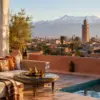
A great Moroccan stay should change the feel of the whole journey. The best boutique stays across Morocco are not necessarily the shiniest or most photographed places. They are the ones that put you in the right setting at the right moment: a calm riad after Marrakech’s intensity, a mountain kasbah with a real view, or a desert camp where the silence is the point.
When I plan a private journey, I never choose accommodation as an afterthought. In Morocco, where you sleep affects how you experience a medina, how far you need to walk with luggage, whether a long driving day feels worthwhile, and even how much you enjoy breakfast. Here are the stays and styles I return to when matching different travellers with the country.
What makes a boutique stay worth choosing in Morocco?
Boutique means something different here than it does in many destinations. A Moroccan riad may have only five rooms, a rooftop terrace and a courtyard planted with orange trees, yet offer more character and personal attention than a much larger hotel. Equally, a property can be beautifully designed but badly positioned for the way you want to travel.
I look for three things first: a genuine sense of place, thoughtful service and a location that makes practical sense. The final point matters more than people expect. A romantic riad deep in Fes el-Bali can be memorable, but it may involve a walk through narrow lanes from the nearest vehicle access. For some couples, that is precisely the magic. For a family with several cases or anyone who prefers easy access, I may suggest a different part of the medina or a property just outside it.
The right choice also depends on your rhythm. Morocco rewards variety. I would not usually recommend five similar riads in a row, however lovely they are. Mixing a city courtyard, an Atlas retreat, a palm-grove kasbah and a desert camp creates a journey with contrast rather than a procession of check-ins.
Boutique stays in Marrakech: choose calm over spectacle
Marrakech has no shortage of striking riads, but I am selective about where guests stay. The Medina is atmospheric, walkable and full of surprises, though it can be noisy and disorientating at first. A good riad acts as a quiet counterpoint: you step through an unremarkable door and suddenly find tiled floors, birdsong, shade and mint tea.
For design, atmosphere and a central base
El Fenn is a strong choice for travellers who want bold Moroccan design, generous shared spaces and the convenience of being within the Medina. It is more social and expressive than an intimate, hushed riad, so I tend to suggest it for couples or friends who enjoy a little buzz around the pool and rooftop.
For a smaller-scale stay, Riad BE Marrakech offers a brighter, more relaxed feel and works particularly well for travellers who want character without formality. The important question is not whether a riad has the most dramatic photographs. It is whether its room size, pool arrangement, access and atmosphere suit your actual holiday.
Those who want more space, easier driving access and a resort-style pause may prefer the Palmeraie or the area beyond the Medina walls. This can be sensible after a late arrival or before an early departure, but it does mean relying more on transfers for meals and exploring. My honest view: for a first visit of two or three nights, staying in or close to the Medina usually gives Marrakech more life.
Fes and Chefchaouen: character comes with practical compromises
Fes is where I encourage travellers to embrace a riad fully. The old city is a living maze of workshops, bakeries, family homes and historic doorways. Staying inside gives you the pleasure of hearing the morning city wake up from a roof terrace, rather than merely visiting it from outside.
Riad Fes and Palais Amani are two well-known examples of the more polished end of the boutique spectrum. Both offer the kind of setting that makes a rest afternoon appealing, which is useful after a guided walk through the medina. They are not interchangeable, though. Room layouts, ambience and access matter, especially for private groups.
Chefchaouen calls for a different expectation. Its blue lanes are very photogenic, but the town is built on a hillside and many attractive stays involve steps. Riad Cherifa is often a lovely fit for travellers who value intimate design and a restful courtyard, while Lina Ryad & Spa can appeal to those who appreciate a few extra facilities. If mobility is a concern, I always treat that as a planning detail, not an awkward afterthought. A beautiful room at the top of several steep lanes is not beautiful if reaching it becomes a daily ordeal.
The best boutique stays across Morocco are often beyond the cities
Some of Morocco’s most rewarding stays sit between the headline destinations. They turn a transfer day into part of the holiday and give you a better understanding of the country’s landscapes.
Atlas Mountains: stay for the view, but check the altitude
In the Atlas, Kasbah Bab Ourika offers wide views over valleys and terraced fields, with a sense of distance from Marrakech that is surprising given the journey time. It suits couples looking for a slow, scenic break and families who want room to breathe. Kasbah du Toubkal has a more village-based mountain character and can be an excellent choice for walkers or travellers who value local context over polished resort styling.
Mountain stays are not all the same. In winter, temperatures drop sharply after sunset. In summer, lower valleys can be warmer than expected. I also consider whether guests want guided walks, a pool, level paths or simply a good terrace with a book. “Atlas Mountains” is not one experience, habibi.
Skoura and the south: palms, kasbahs and proper downtime
Skoura is one of my favourite places to break the drive between the mountains and the desert. Its palm groves soften the landscape, and the slower pace is a relief after Marrakech or Fes. Dar Ahlam is exceptional for travellers who want highly considered service and privacy, while smaller kasbah-style properties can provide a more informal, rooted experience.
This is a part of the route where one night can feel rushed. If your itinerary allows two, the second evening often becomes a highlight: a walk among the palms, a quiet meal and no need to pack again at dawn. That is not about adding luxury for its own sake. It is about leaving enough room for Morocco to work on you.
Sahara camps: comfort matters, but setting matters more
Desert camps vary enormously, and the word “luxury” is used rather freely. I focus on the quality of the tents, private bathroom arrangements, bedding, food, staff and, above all, the camp’s position among the dunes. A camp too close to a busy access point can lose the feeling people have travelled so far to find.
Erg Chebbi near Merzouga is generally the better fit for travellers seeking high dunes and a more classic Sahara image. Erg Chigaga is wilder and more remote, usually requiring a longer journey and four-wheel-drive access. Neither is automatically better. Erg Chebbi is easier to weave into many first-time routes; Erg Chigaga suits travellers willing to trade convenience for greater isolation.
I also advise against expecting total silence at every camp. Desert evenings can include music, other guests and the practical sounds of hospitality. The magic is real, but it is not a film set. Choosing the right camp and travelling outside the busiest periods can make a substantial difference.
Essaouira: boutique comfort with Atlantic air
After inland heat and long drives, Essaouira feels like a reset. The sea breeze, ramparts and working harbour give it a different energy from Marrakech. Within the old town, Heure Bleue Palais has a grander, more classic character, while Les Jardins de Villa Maroc offers a more private feel outside the Medina for those happy to be away from the centre.
For a short stay, I usually lean towards the Medina, where you can walk to dinner, the beach and the harbour. For a longer pause, a property outside town can make sense if your priority is space, a garden and proper relaxation. Wind is part of Essaouira’s personality, particularly in the afternoon, so a sheltered courtyard or heated pool can be more valuable than it sounds.
How I build accommodation into a tailored route
The strongest Morocco itineraries use hotels and riads to regulate pace. I might place an easy-access Marrakech stay after an international flight, a characterful Fes riad alongside a private guide, then add a peaceful Skoura kasbah before the desert. Each choice has a job to do.
Availability changes quickly, room categories can differ dramatically within the same property, and the most suitable stay is not always the most famous one. This is where careful coordination saves a surprising amount of frustration. When I design a journey through Morocco Genie, I match accommodation to the route, group make-up and the details travellers often do not know to ask about until too late.
My closing thought is simple: choose the room that supports the day you want to have. A quiet courtyard, a mountain terrace or a tent beyond the last dune can become more than a place to sleep. It can be the moment you remember most clearly when you get home.