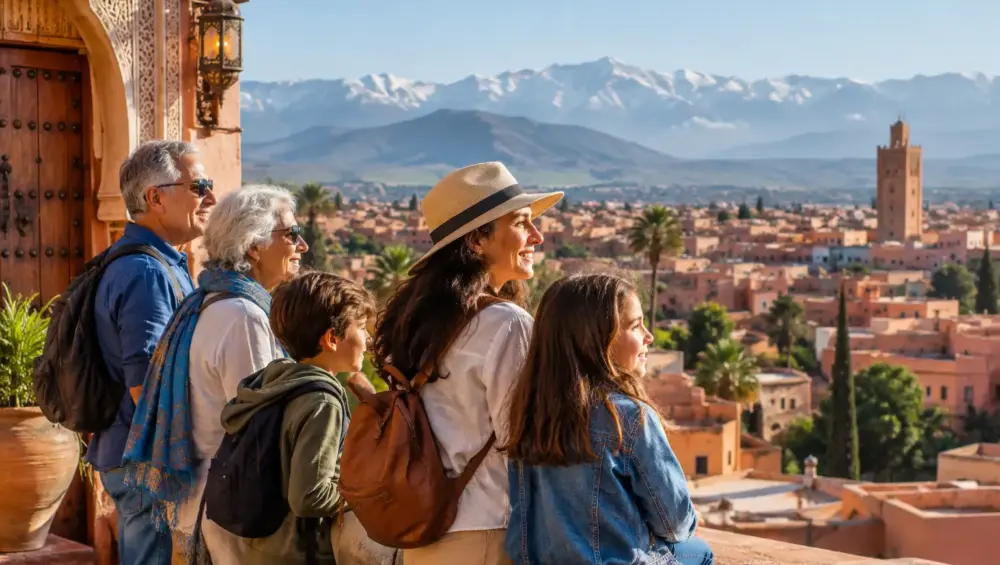
A family dinner in a riad courtyard can be one of the best moments of a Morocco holiday: grandparents swapping stories over mint tea, teenagers taking photographs of the tiles, young children watching a resident cat patrol the fountain. But Morocco multigenerational travel only feels easy when the journey is designed for the people actually taking it, not for an imaginary family with unlimited energy and identical interests.
I have learnt that the biggest planning mistake is trying to make every day equally exciting for every generation. Morocco is full of colour, noise, distances and wonderful distractions. The answer is not to cram in more. It is to create a rhythm where each person has enough comfort, choice and breathing room to enjoy the country in their own way.
Start with pace, not a list of sights
When several generations are travelling together, I begin by asking a very unglamorous question: how long can everyone comfortably be on the move? A family might dream of Marrakech, Fes, the Sahara, the Atlas Mountains and Essaouira in eight nights. It can be done on paper. In real life, it often means too many hotel changes and too little time to enjoy any of them.
For many families, two or three main bases work better than a nightly circuit. Marrakech offers gardens, food, markets and day trips. The Atlas Mountains provide cooler air, gentle walks and a welcome change of pace. A desert stay can be memorable for every age, but it needs enough time around it to justify the long drive.
There is no universal perfect route. A family with active older children may happily take on a longer southbound journey, while another group may be better served by Marrakech, the mountains and the Atlantic coast. I would rather leave one famous place for a future holiday than turn a family trip into a relay race.
Build in recovery time
Arrival day should be light, particularly for guests arriving from Britain, North America or Australia. A relaxed dinner close to the riad is usually more sensible than a guided tour immediately after check-in.
The same applies after a long transfer. If the route from Marrakech to the desert involves mountain roads, scenic stops and several hours in the vehicle, do not schedule a demanding activity the following morning. A late breakfast, time by the pool, or a short village walk may be exactly what the group needs.
Choose private transport for flexibility
For Morocco multigenerational travel, a private driver is not simply about comfort. It changes the entire shape of the journey. Families can stop when someone needs a toilet, linger at a viewpoint, buy fruit from a roadside stall, or skip a stop if the children are tired and the grandparents would rather reach the hotel.
This matters especially on longer travel days. Public transport has its place, but it gives a mixed-age group little control over timing, luggage and unexpected changes of plan. With a private vehicle, I can also design routes around sensible breaks rather than the fastest line on a map.
Vehicle choice deserves honest attention. A group of six with large suitcases may not fit comfortably into a vehicle advertised for six passengers. Prams, walking sticks and child seats all take space. It is far better to allow room from the start than begin a holiday with bags balanced on laps. Your wish is my command, habibi, but physics still gets a vote.
Make accommodation work for the whole family
A beautiful riad can be a highlight of Morocco, yet not every beautiful riad suits every family. Traditional properties may have narrow staircases, several levels, small plunge pools and no lift. That can be part of their charm, but it may be impractical for a grandparent with limited mobility or parents carrying a sleeping toddler.
I look beyond photographs and ask practical questions. Are bedrooms close together? Is there a ground-floor option? Does the property have a quiet courtyard where someone can read while others head out? Can the family have adjoining rooms or a private section? Is the walk from the vehicle drop-off short and manageable?
In Marrakech and Fes, staying inside the medina gives immediate atmosphere, but it also means navigating pedestrian lanes. Some families love this. Others prefer a property with easier vehicle access, particularly if they plan to return for afternoon rests. Neither choice is more authentic. The right choice is the one that lets everyone enjoy the setting rather than struggle with it.
In the mountains or desert, a pool, open space and calm evenings can be worth more than a long list of amenities. Children often remember feeding a donkey, looking for stars or playing cards on a terrace far more vividly than another polished museum visit.
Plan shared experiences, then leave room to split up
The best multigenerational days usually contain one meaningful experience everyone can share. A private food walk in Marrakech can work well when it includes frequent pauses and enough tasting to keep younger travellers interested. A gentle camel encounter near the dunes may delight children and grandparents alike, while teenagers may prefer sandboarding or a sunset walk.
Then give the group permission to divide occasionally. Parents and older children might take a cooking class while grandparents enjoy a hammam treatment or a quiet afternoon at the riad. One part of the family may want a longer hike in the Atlas foothills, while others visit a local village at a slower pace.
Splitting up is not a failure of family travel. It is often what preserves goodwill. The important part is choosing places where everyone can reunite easily for dinner and share what they did.
Use guides selectively
A knowledgeable local guide can turn the medina from confusing to fascinating, especially in Fes, where the history and lanes reward explanation. But a full-day guided walk is not automatically right for every group.
For families with small children, I often favour a shorter private tour with a clear focus: crafts, food, architecture, or stories of daily life. Older relatives may appreciate a guide who can set an unhurried pace and find quieter corners. Teenagers tend to engage more when the guide welcomes questions rather than delivering a long monologue.
Good guiding is not about covering every monument. It is about making the places you do visit feel alive.
Think carefully about the Sahara
The Sahara can be a powerful shared memory, but it is the part of a Morocco itinerary where I encourage families to be most realistic. Reaching the dunes takes time. Desert camps vary greatly in comfort, and temperatures can swing sharply between day and night depending on the season.
For a family that enjoys road travel, a two-night desert section gives the experience room to breathe. You can arrive without rushing, enjoy sunset in the dunes, sleep in the camp and leave the following day without making it feel like a box ticked between long drives.
For very young children, travellers who dislike bumpy terrain, or older relatives with mobility concerns, there are alternatives. The Agafay stone desert outside Marrakech offers a desert-style evening with dramatically less driving, although it is not the Sahara and should never be presented as such. Being clear about that difference prevents disappointment.
Agree the non-negotiables before planning
Every family has competing priorities. One person wants deep cultural experiences, another wants sunshine and a pool, and somebody else mainly wants exceptional food. This is normal. Before dates and destinations take over the conversation, ask each traveller to name two things they genuinely do not want to miss and one thing they would happily skip.
That small exercise reveals a lot. If the grandparents care most about comfortable hotels and the teenagers want adventure, the route can include both – perhaps a refined riad in Marrakech, followed by a mountain lodge with easy outdoor activities. If the group is divided between coast and desert, the number of nights available will decide whether both belong in the same journey.
It also helps to establish the holiday budget early, without turning every conversation into a spreadsheet. Private transport, room configurations and the level of accommodation affect the plan more than most people expect. Clear priorities make the trade-offs much easier to handle.
Let one person hold the logistical thread
A multigenerational trip has more moving pieces: airport arrivals, dietary preferences, room layouts, walking tolerance, celebration dinners and different ideas of what counts as an early start. It is why tailored coordination matters. I can shape the route around the family rather than asking the family to adapt to a fixed itinerary, with trusted drivers, guides and stays chosen for the practical details as much as the atmosphere.
The most successful Morocco family holidays are not those where everybody does everything together. They are the ones where grandparents feel included, parents are not quietly managing every problem, and children have enough wonder to stay curious. Give the journey a little space, and Morocco tends to do the rest.