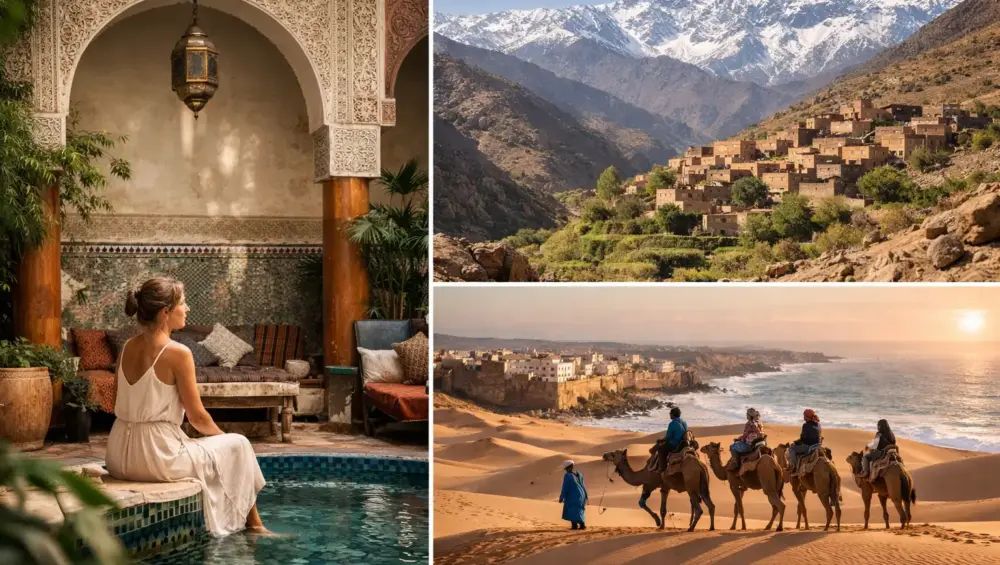
The most common Morocco itinerary mistake is not choosing the wrong places. It is giving every place one night, then spending the holiday checking out, sitting in the car and checking in again. Morocco looks compact on a map, but the best journeys are built around real driving times, arrival hours and the kind of pace you actually enjoy.
When travellers ask me how to split nights in Morocco, I do not begin by counting destinations. I begin with a more useful question: where do you want to wake up feeling settled, rather than merely pass through? A night in a riad after a late arrival is different from a full day in Marrakech. One night in the Sahara is memorable, but only if the journey there and back does not swallow the rest of the trip.
How to split nights in Morocco: count the travel days first
A Moroccan route needs breathing room. Private driving makes the journey more comfortable and allows for stops, but it does not make mountain roads shorter. The route from Marrakech to the desert, for example, is often best treated as a journey over two days rather than a race to reach camp before sunset.
I suggest treating every change of base as having a cost. Even a two-and-a-half-hour transfer usually affects the day: breakfast runs later, luggage needs moving, and there may be a guide, a lunch stop or a scenic detour worth taking. On a holiday of seven nights, three hotel changes can already feel busy. On ten to twelve nights, four or five bases may work beautifully if the route flows in one direction.
Arrival and departure nights matter too. If you land in Marrakech at 9pm, that first night is useful for rest, not sightseeing. Likewise, if your flight home leaves from Casablanca early in the morning, staying far away on the final evening is rarely worth the anxiety. I often protect the first and last nights because they make the middle of the journey feel far more relaxed.
Choose the shape of your route before choosing every hotel
Morocco rewards a route with a clear shape. Trying to see Marrakech, Fes, Chefchaouen, the Sahara, the Atlas Mountains and Essaouira in one short trip usually produces a very fine collection of car windows. It is better to choose a few priorities and let the route follow them.
For a first visit of around seven nights, I would normally choose either a southern loop or an imperial-cities route, not both. A southern loop might include Marrakech, the Atlas or Skoura area, and the Sahara, with enough time to enjoy each stop. A northern route can pair Marrakech or Casablanca with Fes and Chefchaouen, depending on flight logistics.
With ten nights, the classic Marrakech to Sahara to Fes journey becomes much more comfortable. You can include a proper Marrakech stay, break up the road south, spend a night in the desert, then continue north through the changing landscapes towards Fes. It is still a travelling route, but it has room for unplanned tea stops, a village walk or an afternoon by the pool.
With two weeks, you can add a contrasting final chapter. Essaouira works well after Marrakech if you want Atlantic air, seafood and slower days. The High Atlas suits travellers who would rather hike, visit local communities or simply sit with a mountain view than add another medina. There is no prize for covering more ground, habibi.
Give each destination the nights it deserves
Marrakech deserves more than an arrival night. For most first-time visitors, three nights is the sweet spot: one full day for the medina and major sights, one for a private guide or a deeper food-and-craft experience, and one with space for gardens, a hammam, the newer parts of the city or doing very little at all. Two nights can work for a short break, but it asks you to be selective.
Fes usually needs two or three nights. Its old city is more immersive than Marrakech and can feel less immediately navigable, which is precisely why a knowledgeable local guide is valuable. Two nights gives you one full day in the medina; three allows time for the surrounding area, a slower exploration and a more restful rhythm.
The Sahara is where I see the most optimistic planning. A desert camp stay is normally one night, but the desert section needs at least two nights in the wider region if you are travelling from Marrakech or onward to Fes. One night might be in a comfortable desert-edge hotel or kasbah, followed by the camp night. That structure turns a long transfer into part of the experience rather than an endurance test.
The Atlas Mountains deserve two nights if they are a real priority. With only one night, you may see the scenery but miss the pleasure of it: morning light on the peaks, a walk at your own pace and a long lunch with nowhere urgent to be. One night is fine as an extension from Marrakech if time is tight, but it is not the same thing.
Essaouira is often best with two or three nights. The journey from Marrakech is manageable, yet the town has a distinctly different energy and becomes more enjoyable when you stop treating it as a day trip. Families often appreciate the breathing space here, while couples may prefer it as a gentle ending after busier inland days.
Chefchaouen also benefits from two nights, especially when travelling from Fes. Its blue lanes are lovely in the early morning and late afternoon, after many daytime visitors have gone. A single night is possible on a compact northern route, but two nights give the town a chance to feel like a place rather than a photograph.
Build around your travel style, not somebody else’s checklist
The right split depends on what restores you. Some travellers genuinely enjoy changing scenery every day and are happy to make a road journey the centrepiece. Others want long breakfasts, beautiful accommodation and one proper base at a time. Neither approach is more authentic.
For food-focused travellers, I might allow extra nights in Marrakech and Fes, where guided market visits, cooking experiences and restaurant choices can fill days without any driving. For a family with younger children, fewer hotel changes and a pool or mountain stay can matter more than fitting in Chefchaouen. For friends who are keen photographers, the desert and Atlas region may deserve additional time for the best light rather than a rushed city schedule.
I also ask whether you want guided sightseeing every day. Usually, you do not need it. A private guide can make a significant difference in Marrakech or Fes, while an unstructured afternoon in Essaouira or a quiet morning at a desert lodge can be exactly what makes the trip feel personal.
Three sensible ways to divide a Morocco holiday
For seven nights centred on the south, a balanced rhythm could be three nights in Marrakech, one night on the road through the Atlas and southern valleys, one night in a desert camp, one night in the desert region or on the return route, and a final night in Marrakech or near your departure airport. This is active, but it avoids forcing the desert into a single exhausting out-and-back journey.
For ten nights from Marrakech to Fes, consider three nights in Marrakech, one night in the Atlas or Ouarzazate area, one night around Skoura or the Dades Valley, one night in the Sahara, one night near Midelt or another sensible northern break, and three nights in Fes. The exact stops should change with your interests and accommodation preferences, but the principle remains: use the middle of the country to connect the cities without turning it into a motorway dash.
For fourteen nights, I would keep the core route but add depth rather than simply add pins to the map. Two extra nights in the mountains and two or three in Essaouira can create a holiday with city energy, desert drama, rural quiet and coast. That variety is one of Morocco’s great strengths when the route is not overstuffed.
The booking decisions that can disrupt a good plan
A beautifully designed route can become awkward if accommodation is chosen in isolation. A riad deep in a medina may be atmospheric, but consider how luggage will be handled after a long drive. A remote mountain lodge may be perfect for two restorative nights, but less useful if you only arrive after dark and leave immediately after breakfast.
The other trap is booking every night before checking the whole journey. I prefer to map flight times, driving legs, priorities and realistic sightseeing first. Then the accommodation choices can support the route: a restful first night, the right location before a guided day, and enough time in each place to enjoy what you have selected.
If you are unsure where to add or remove a night, remove a destination before removing the pause. Morocco is generous with detail: the call of a street seller, mint tea offered without hurry, a roadside view that makes everyone ask the driver to stop. Leave room for those moments. Your wish is my command, but a little space in the itinerary is often the best wish of all.