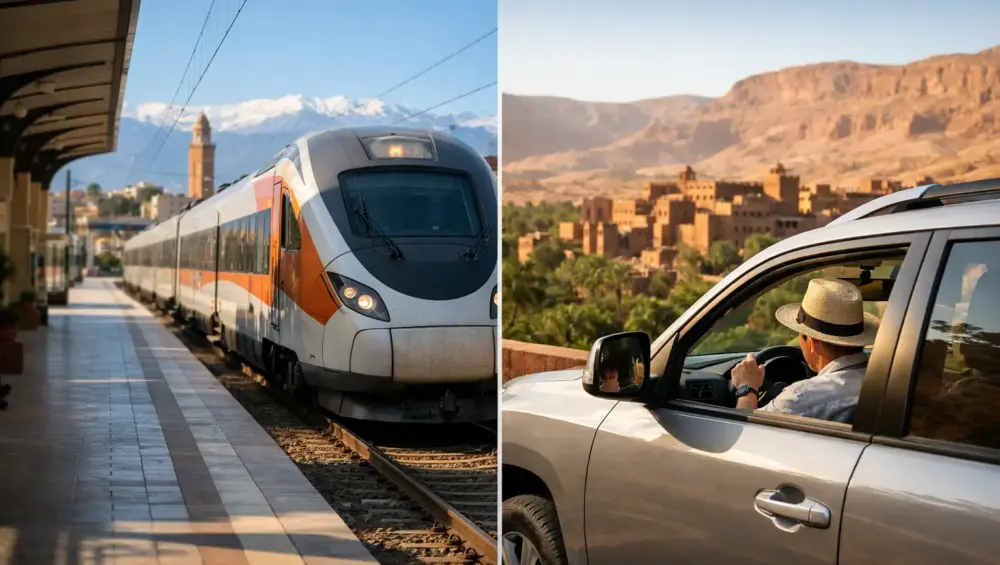
A train ticket may look like the obvious bargain on a Morocco itinerary. Then you notice your riad is down a pedestrian-only lane, your next stop is in the Atlas Mountains, and the desert is still many hours beyond the rails. That is where the Morocco train versus private driver question becomes less about transport and more about how you want your holiday to feel.
I plan routes around Morocco every week, and my honest answer is rarely that one option wins everywhere. The train is excellent on certain city-to-city journeys. A private driver becomes far more valuable when the road itself is part of the experience, or when your time, energy and luggage matter as much as the destination.
Morocco train versus private driver: the real difference
Morocco’s rail network is useful, comfortable on its main corridors and a sensible choice for travellers moving between the larger cities. It works particularly well for combinations such as Tangier, Rabat, Casablanca, Marrakech and Fes. You sit back, watch the landscape change, and avoid the concentration required for a long road journey.
But trains connect stations, not itineraries. They do not take you from your riad in the medina to a mountain kasbah, stop at a family-run pottery workshop, or wait while you photograph a quiet valley. A private driver does. That distinction sounds simple, yet it changes the rhythm of a trip completely.
The best choice depends on three things: where you are going, how quickly you want to move, and whether you see travel days as necessary gaps or worthwhile parts of the holiday.
When taking the train makes perfect sense
For a straightforward city break, I often like the train. If you are spending several nights in Marrakech and then heading to Fes or Tangier, you may prefer to let someone else handle the miles. First-class rail travel can be a pleasant, uncomplicated way to cross the country, especially for couples travelling light.
It also gives you a more independent feel. You choose a departure, arrive at a station, and make your own way to your accommodation. For confident travellers who enjoy that little bit of self-direction, this can be part of the fun.
There is another advantage: on busy approaches to major cities, rail can feel calmer than the road. You are not negotiating urban traffic after a long flight or trying to work out which taxi is legitimate outside the station. Arrange a transfer at either end if you wish, and the day remains very manageable.
Still, I would not choose a train merely because it appears faster on paper. The station transfer, arriving early, waiting for luggage and finding your riad at the other end all take time. In a large medina, the final stretch may involve walking with bags because cars cannot enter every alley. That is not a reason to avoid rail, just a reason to plan the door-to-door journey rather than only the train timetable.
The limits of the railway map
The places many people dream about before visiting Morocco are often beyond the tracks. Chefchaouen, the High Atlas, the Dades Valley, Skoura, Ait Ben Haddou, Essaouira and the Sahara all require road transport for at least part of the journey.
You can piece these places together with buses, taxis and separate excursions. Some travellers enjoy doing exactly that. But on a shorter holiday, each connection introduces another timetable, another luggage move and another decision to make. What seemed economical can begin to cost your most limited resource: unhurried time.
What a private driver actually adds
A good private driver is not simply a person behind the wheel. On the right route, they are the thread that holds different parts of the journey together. They collect you where you are staying, carry the practical burden of the road, and adjust the day around the reality on the ground.
That flexibility is especially useful between Marrakech and the desert, where the journey can include mountain passes, kasbahs, valleys and long open stretches of landscape. Rushing it in one punishing day is possible, but not always enjoyable. With a private vehicle, I can design the route with sensible overnight stops and places that suit your interests, whether that means architecture, gentle walks, food or simply a beautiful lunch with a view.
Families tend to feel the difference quickly. Children can stop when they need to, snacks and extra layers stay in the vehicle, and no one has to shepherd several suitcases through platforms and taxi queues. For a group of friends, the cost is also shared across the vehicle, which can make a private journey better value than it first appears.
Privacy matters too. You can chat, sleep, listen to your own music or sit quietly after a busy morning in the souks. Morocco is vivid and sociable, but you do not need to be switched on every minute of the day.
Driver, guide and fixer are not the same role
One misconception I like to clear up early: a private driver is not automatically a licensed local guide. Your driver knows the roads, routes and practical flow of the trip, but a specialist guide adds something different in Marrakech, Fes or a historic site. They can explain the stories, customs and details that turn a beautiful building into a meaningful place.
For this reason, I often recommend a combination rather than trying to make one person do every job. Use a driver for the travel days, add a licensed guide where interpretation genuinely enhances the experience, and leave space for wandering independently as well. Your wish is my command, habibi, but that does not mean filling every hour.
The trade-offs people should consider honestly
Private transport gives you comfort and control, but it does not make distances disappear. Morocco is larger than many visitors expect, and mountain roads require patience. If your itinerary has Marrakech, Fes, Chefchaouen and the Sahara squeezed into a few days, a driver can make the logistics easier, but cannot turn a rushed route into a relaxed one.
Trains, meanwhile, ask you to work within their geography and timings. If your priority is the imperial cities and you are happy to settle into each destination for several nights, that can be ideal. If you want to follow the quieter roads through the south, rail is simply not the main tool for the job.
There is also a question of travelling style. Some people love a rail journey precisely because it is public, ordinary and slightly unpredictable. Others come to Morocco wanting their first visit to feel supported without becoming regimented. Neither approach is more authentic. Authenticity is not measured by how awkward your luggage transfer was.
My favourite answer: use both when the route allows
For many tailor-made journeys, the strongest plan is a hybrid one. Take the train for one straightforward major-city transfer, then begin a private road journey when the itinerary moves into the mountains, coast, countryside or desert.
For example, you might arrive in Tangier, travel by rail towards the central cities, then use a private driver for Chefchaouen and a wider northern route. Or you might enjoy Marrakech independently, then set off by private vehicle through the High Atlas and southern valleys before returning to the city. The right sequence prevents backtracking and gives each form of transport a job it does well.
When I design a journey through Morocco Genie, I look beyond the map pins. I consider where you will be after breakfast, how you will feel by late afternoon, whether you enjoy scenic stops, and what you need from the day after a late-night flight or a long medina walk. Those small decisions are usually what make a route feel effortless rather than overplanned.
Before booking either option, sketch your holiday day by day and mark every door-to-door transfer, not just the major journeys. If a train carries you comfortably between two cities where you genuinely want to spend time, take it. If the best parts of your itinerary lie between the cities, let the road lead the way.