The question of private driver versus self drive Morocco usually appears once travellers begin joining the dots on a map. Marrakech to the desert looks manageable. Fes to Chefchaouen looks straightforward. Then come the mountain roads, unfamiliar parking rules, medina addresses that are not really addresses, and the rather optimistic arrival time suggested by a mapping app. Both choices can lead to a brilliant holiday, but they create very different days.
I have planned journeys for travellers who love the satisfaction of driving themselves, and for others who want to watch the High Atlas unfold through the window while somebody else handles the bends. The right decision is less about bravery and more about your route, your travel companions and how you want to spend your energy.
Private driver versus self drive Morocco: the real difference
A self-drive holiday gives you control of the wheel and the pleasure of an unplanned detour. A private driver gives you control of the experience while handing over the practical burden of getting from A to B. That sounds simple, but the distinction matters most on a Morocco itinerary where travel days can be part of the adventure rather than a gap between hotels.
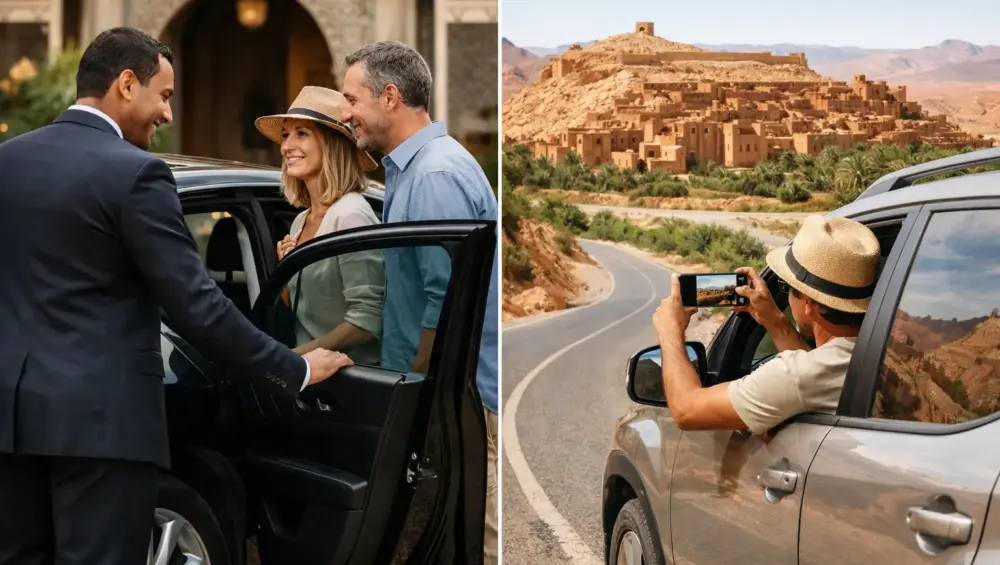
With a private driver, you can stop when a valley view catches your eye, linger over lunch in a small town, or pause for photographs on the road through the Dades Valley. The difference is that you are not watching for potholes, overtaking traffic or wondering whether that petrol station has card facilities. You arrive at your riad with some energy left for the city.
Self-driving is not inherently difficult, and many visitors manage it perfectly well. Main roads between major cities are generally practical, and it can be especially appealing for travellers who enjoy driving abroad. But Morocco is not a destination where I would choose a car simply because it appears to be the cheaper option on paper. Your time, comfort and confidence are part of the calculation too.
When self-drive is a very good choice
Self-drive works best when the route is deliberately simple and you genuinely enjoy being behind the wheel. A couple spending several nights around Essaouira, the Agafay area, or the quieter Atlantic coast may value the independence of a car. You can follow your own rhythm, visit a beach café on a whim and make minor changes without consulting anyone.
It also suits travellers returning to Morocco who already understand the general pace of the roads and want to explore a specific region in depth. If you are not trying to cover Marrakech, the Atlas Mountains, Ait Ben Haddou, the Sahara, Fes and Chefchaouen in one ambitious week, driving can feel relaxed rather than relentless.
The key is to allow generous time. Distances here can be deceptive. A route that looks short may pass through villages, mountain bends, roadworks or stretches where overtaking is slow. Daylight matters as well. I strongly prefer travellers to arrive before dark, particularly in rural areas and on a first visit. This is not a dramatic warning, just sensible holiday planning.
The parts of Morocco where driving tests patience
City driving is often the point at which self-drive loses its charm. Marrakech has busy roundabouts, scooters appearing from several directions and a traffic rhythm that takes a little getting used to. Casablanca is more intense again. Fes and Marrakech medinas are pedestrian territories, so your actual challenge becomes finding the correct parking area, meeting a host or porter, and navigating the final walk with luggage.
Then there is the desert route. Driving from Marrakech towards Ouarzazate, Skoura, the Dades or Merzouga can be spectacular, but it is a full travel day. If you are the driver, every viewpoint and roadside stop has to compete with concentration. If you have children in the back, or only a short time in Morocco, that trade-off becomes clearer.
Why a private driver changes the pace of a journey
A good private driver is not merely transport. He is the person making the route feel calm when a medina meeting point is confusing, when the weather changes in the Atlas, or when lunch needs to happen somewhere more worthwhile than the first place beside the road. He understands the practical realities that do not show up in an itinerary.
This does not mean you are locked into a rigid timetable. Quite the opposite. On a tailor-made journey, I build enough breathing room for the stops that make Morocco memorable: a saffron landscape near Taliouine, a women’s argan cooperative on the road towards Essaouira, a quiet palm grove near Skoura, or simply a tea break when everyone needs one.
For families, private transport is often a sanity-saving decision. Children can nap, snacks can appear when needed, and no parent has to navigate while attempting to answer questions about camels, couscous and whether the next hotel has a pool. Small groups benefit too, because the cost is shared while everyone gets to enjoy the scenery.
There is also a cultural benefit, though it depends on the person rather than the vehicle. A trusted local driver can explain the difference between a kasbah and a ksour, recommend what to order in a roadside restaurant, and help you understand where you are rather than simply passing through it. For deeper historical or architectural context in cities, I would still arrange a licenced local guide. A driver and a guide have different jobs, and pretending otherwise often leads to a thinner experience.
The cost question needs an honest answer
Self-drive can look less expensive because the headline costs are visible: car hire, fuel, parking and perhaps an additional driver. A private driver is a larger upfront commitment, but it covers more than the vehicle. The value comes from time saved, route knowledge, less stressful arrivals and the ability for everyone in your party to be on holiday during transfer days.
There is no universal winner. For two independent travellers taking short hops and staying mainly in one region, self-drive may be the sensible choice. For a family or a group travelling a longer circuit, the gap can narrow once you factor in the practicalities and the value of not losing half a day to a wrong turn or awkward parking.
I encourage travellers to ask a more useful question than, “Which is cheapest?” Ask, “Where do I want to spend my attention?” If the answer is on markets, food, landscapes and conversations, a driver usually earns his place. If the answer is on open roads, detours and complete autonomy, hire the car and keep the route light.
A mixed approach is often the cleverest one
You do not have to make one decision for the whole holiday. Morocco rewards a mixed plan. Spend a few nights in Marrakech without any vehicle at all. Use a private driver for the long journey through the Atlas and desert. Then collect a hire car for a slower coastal stay, where you want to explore at your own pace.
This approach also avoids paying for a car that sits unused while you explore a medina on foot. In Marrakech, Fes and Essaouira, walking and short local taxis are usually more practical than having a vehicle nearby. Cars are most valuable between destinations, not within the old city walls.
When I design a route, I start with the traveller rather than a default transport choice. Some couples are delighted by a quiet car journey and a long conversation with their driver. Others want the keys, a playlist and the freedom to take the wrong road occasionally. Habibi, both are valid ways to see Morocco.
Questions I would ask before choosing
Think honestly about whether you enjoy driving in unfamiliar conditions or merely tolerate it. Consider how many long travel days your itinerary contains, whether you will be travelling with children, and how important spontaneous rural stops are to you. Also consider your arrival and departure cities. A loop beginning and ending in Marrakech is simpler to self-drive than a one-way route that finishes in Fes or Tangier.
Your accommodation style matters too. If you are staying in remote lodges, mountain guesthouses or desert camps, local coordination can make arrivals far smoother. If you are based in a single coastal town with easy parking, a hire car can be wonderfully uncomplicated.
The best Morocco holidays tend to feel unhurried even when they cover a lot of ground. Choose the option that leaves room for the things you came for: the first sight of dunes at late afternoon, mint tea on a rooftop, a meal that runs longer than planned, and the small surprises no map can schedule. That is where the real magic usually begins.