The Sahara is often the moment travellers remember most clearly: the long approach through changing landscapes, the first glimpse of orange dunes, the quiet after sunset. But knowing how to organise Sahara logistics is what determines whether that moment feels wonderfully remote or unnecessarily exhausting. The desert is not a quick detour from Marrakech, and planning it well starts with respecting the distances.
Start by choosing the right Sahara gateway
Morocco has two main dune regions that suit most private journeys: Erg Chebbi, near Merzouga, and Erg Chigaga, reached from the M’Hamid area. Both are beautiful, but they create very different routes.
Erg Chebbi is the more accessible choice. Its towering dunes are reached by road, usually via the Dades Valley, Tinghir or the Ziz Valley, and it works particularly well for first-time visitors who want a classic Sahara experience without adding too much expedition-style travel. You can arrive at the desert edge, leave your main vehicle, and continue to camp by camel or 4×4.
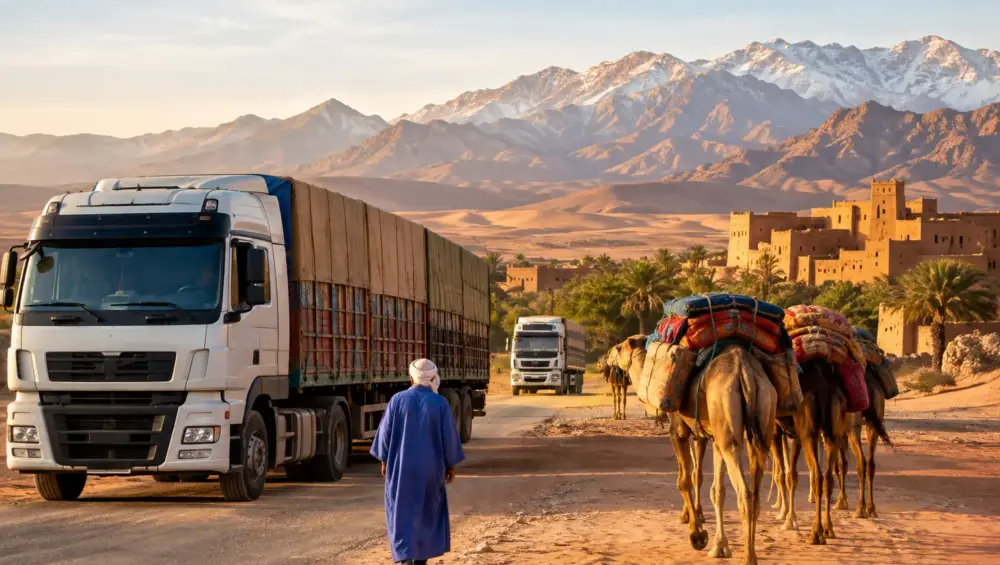
Erg Chigaga feels wilder and more isolated. The final stretch is off-road, so a capable 4×4 and a driver who knows the terrain are essential. I often suggest it to travellers who have more time, enjoy the feeling of being far from towns and prefer a quieter desert setting. The trade-off is simple: the journey takes longer, and comfort depends more heavily on good coordination.
Do not choose purely from photographs. Erg Chebbi makes sense for a route linking Fes, the Middle Atlas, the Todra Gorge and Marrakech. Erg Chigaga can fit beautifully after Ouarzazate, the Draa Valley and Ait Ben Haddou. The best dunes are the ones that belong naturally to your wider route, not the ones that force you into two punishing days in the car.
How to organise Sahara logistics around drive times
The most common planning mistake I see is treating a desert night as though it can be added casually between two major cities. From Marrakech to Merzouga, the road journey is long. Even with a private driver, scenic stops, lunch and the mountain roads mean this should be approached as a proper travel day, not a transfer to rush through.
For most travellers, I recommend allowing two nights around the Sahara. One night in a desert camp gives you the sunset, evening meal, stars and sunrise people hope for. A second night before or after the camp means you can travel at a human pace and enjoy the valleys, kasbahs and gorges along the way. Families with younger children, and anyone who dislikes long drives, may be happier with three nights across the south.
A sensible route from Marrakech often breaks in Skoura, the Dades Valley or near Tinghir before continuing towards Merzouga. From Fes, an overnight in the desert region can work well before heading south-west towards the Todra Gorge and Ouarzazate. There is no single correct sequence. It depends on where you start, where you finish, and whether your priority is landscapes, photography, culture or simply more time to relax.
I would be wary of plans that propose Marrakech to the dunes, a camp night, then straight back to Marrakech. It is possible, but it turns the Sahara into a great deal of windscreen time for a very short desert experience. For some travellers with limited days, that compromise is worthwhile. For many, it is not.
Build in daylight, not heroic timings
Moroccan roads reward daylight travel. You will want to stop when a valley opens up, when the light changes on the Anti-Atlas, or when a small roadside café is serving a particularly good lunch. Darkness also makes rural roads less enjoyable, particularly after a long day.
Aim to reach your desert meeting point well before sunset. This leaves space for a tea, a quick change of clothes, and a calm transfer onwards to camp. If the weather, roadworks or a leisurely lunch delay you, the experience should not unravel because every minute was planned too tightly.
Decide how you want to reach camp
The journey from the desert edge to camp is part of the experience, rather than merely transport. Camel trekking is iconic and, at the right length, genuinely memorable. I generally favour a shorter ride close to sunset or sunrise over a long trek in the heat. It is more comfortable for most people, especially if you are not used to riding.
A 4×4 transfer is usually the better option for travellers with mobility concerns, very young children, limited time or simply no desire to sit on a camel. Some journeys combine the two: arrive by 4×4, then take a brief camel ride when the temperature softens. There is no medal for choosing the least comfortable version of the Sahara, habibi.
Ask what happens to your luggage before you arrive. Normally, a large suitcase stays securely with the driver or at the desert lodge while you take only an overnight bag to camp. Confirm this in advance, particularly if you are moving on in a different direction the following morning.
Choose the camp for the experience you actually want
Desert camps vary considerably. Some have proper beds, private bathroom facilities and attentive service; others are deliberately simpler. Neither is automatically better. The question is whether the camp matches your expectations after a full day on the road.
For a couple celebrating something special, private tents and a little space from other guests can matter more than the largest tent. For families, practical details such as private facilities, warm bedding and straightforward access are usually more valuable than decorative extras. For friends, a sociable camp with a shared fire and music may be part of the appeal.
I also look closely at a camp’s position. Camps near the edge of the dunes are easier to access, which can be useful, but you may hear more activity from nearby properties. Camps set deeper into the sand can feel more secluded, yet require a longer transfer and are more exposed to weather. Again, it depends. A remote location is not automatically the right choice if a member of your group needs easy access or dislikes bumpy off-road travel.
Pack for temperature changes, sand and one night away
The Sahara can be hot during the day and surprisingly cold after dark, especially between late autumn and early spring. Pack light layers rather than relying on one heavy item: a breathable top, a warm fleece or jumper, long trousers and a light windproof layer cover most conditions. Closed shoes are sensible for walking on rocky ground around the camp, while sandals can be pleasant in the sand.
Bring sunglasses, sun cream, lip balm and a scarf or light shawl. The scarf is useful for sun, wind and the occasional burst of sand, not as a costume. Keep mobile phones, cameras and charging cables in a small pouch. Fine sand has a way of reaching places it was never invited.
Most camps provide bedding and towels, but I still advise checking the practical details. If you use medication, keep it in your overnight bag. If you rely on contact lenses, glasses may be more comfortable in wind. A small torch is useful even when camps provide lighting, particularly for moving around outside at night.
Treat weather as a real planning factor
The desert is not identical all year. Summer heat can be intense, which changes what is enjoyable and when you should travel. Spring and autumn are popular because days are generally more comfortable, though temperatures can still vary sharply. Winter often brings lovely clear light and cool days, but nights can be genuinely cold.
Rain is rare, but when it comes it can affect tracks and travel conditions. Sandstorms are also possible. Good local coordination means monitoring conditions, allowing sensible flexibility and having an alternative plan where necessary. It does not mean pretending that nature will follow an itinerary.
Connectivity is another small but useful expectation to set. You may have limited signal at camp, and Wi-Fi can be variable. For many people, that is part of the point. Tell family before you go off-grid, download anything you need, then let the silence do its work.
Leave room for the journey south
The desert becomes more meaningful when it is not treated as an isolated tick on a map. Pause at a palm oasis, visit a kasbah, walk briefly in the Todra Gorge, taste dates in the Ziz Valley, or stop for tea with a view that does not appear in every guidebook. These are the threads that make the long road feel like part of the holiday.
When I design a private Morocco journey, I plan the Sahara as a sequence of good decisions rather than a single camp booking: the right route, realistic travel days, trusted drivers, a camp suited to the group, and enough breathing room for Morocco to surprise you. Your wish is my command, of course, but the desert has its own rhythm. Give it the time it deserves and it will repay you generously.