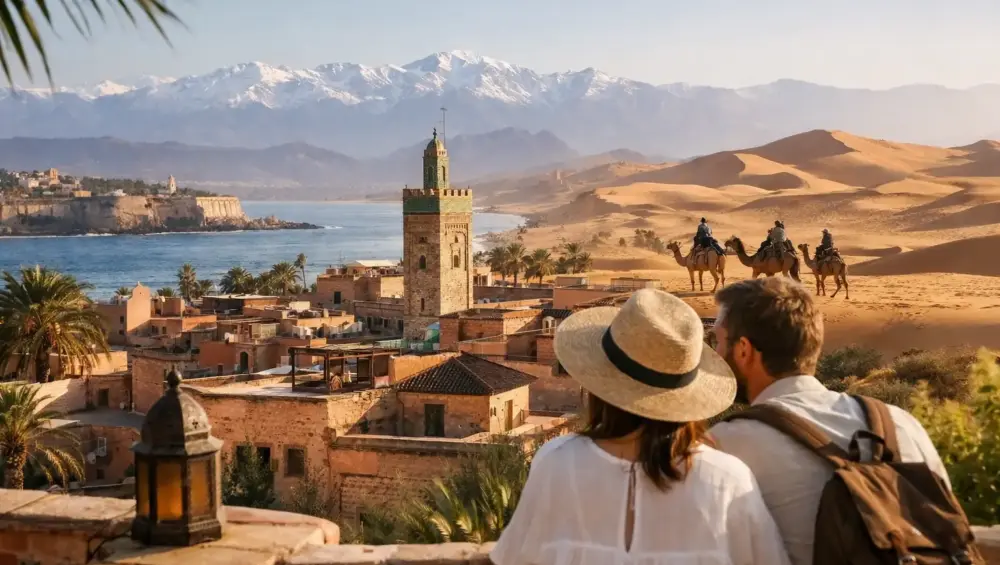
A question I hear before almost every first conversation is, “Is Morocco safe to travel?” Usually, it comes just after someone has fallen for photographs of blue Chefchaouen lanes, Sahara dunes or a Marrakech riad – and just before they start imagining everything that could possibly go wrong.
My honest answer is that Morocco is a very workable, rewarding destination for independent-minded travellers, couples and families. But it is not a place where you should switch off your usual travel awareness. The risks are generally practical rather than dramatic: busy traffic, persistent sellers in tourist areas, confusing medina lanes, uneven pavements and long driving days planned too optimistically.
When a journey is designed sensibly, with reliable people and enough breathing room, most visitors feel comfortable very quickly. Habibi, welcome to Morocco – it has energy, warmth and a little beautiful chaos. Knowing how to read it makes all the difference.
Is Morocco safe to travel for most visitors?
For most visitors, yes. Morocco is accustomed to tourism, and its major destinations have extensive visitor infrastructure. You will find riads, hotels, restaurants, guides and drivers used to welcoming travellers from around the world. In Marrakech, Fes, Essaouira, the Atlas Mountains and the desert regions, I see visitors travelling happily every day.
That does not mean every part of a trip feels identical. Marrakech can be intense, particularly around Jemaa el-Fna and the souks, where noise, mopeds and sales pitches arrive all at once. Essaouira tends to feel calmer and more straightforward. In Fes, the ancient medina is fascinating but genuinely labyrinthine. A rural road in the High Atlas requires a different kind of care from an evening stroll near the Atlantic coast.
The best approach is not to judge the whole country by one headline, one social-media video or one overly cheerful brochure. Think destination by destination, and build an itinerary that fits your confidence, interests and travel style.
The everyday issues travellers actually encounter
Petty theft and personal belongings
Like any popular destination, Morocco has opportunistic theft, especially in crowded places. Keep phones and wallets secure, avoid leaving bags dangling from a chair or on a car seat, and use the safe in your accommodation for passports and valuables you do not need that day.
In medinas, I prefer a zipped cross-body bag worn in front. It is simple, unobtrusive and means you can concentrate on what you came to see: tiled doorways, spice stalls, craftsmen at work and the occasional cat claiming a perfect patch of sun.
ATM use deserves ordinary caution too. Choose a bank machine in a well-used, visible location and put cash away before walking on. You do not need to be anxious; you just do not want to advertise that you have withdrawn a week’s spending money.
Street hassle, guides and pricing
The more common irritation is not crime but unsolicited help. Someone may offer to show you a shortcut, walk you to a tannery, point out a closed attraction or invite you into a relative’s shop. Sometimes the person is friendly. Sometimes there is an expectation of payment, a tip or a sales visit at the end.
A polite, firm “no thank you” and continuing to walk is usually enough. Do not feel obliged to explain yourself. In a medina, hesitation can look like an invitation to negotiate.
For taxis, agree the fare before getting in when a meter is not being used, or ask your riad or restaurant to arrange one. For local guiding, use a licensed guide arranged through a trusted source rather than accepting an offer on the street. This is less about fear and more about having a better day. A good guide gives context, navigates the medina and knows when to let you browse in peace.
Traffic and road travel
Road safety is where I encourage travellers to be most realistic. Moroccan roads can be excellent on major routes, but driving standards, pedestrians, mopeds, animals and changing light demand concentration. In cities, traffic can look improvisational to first-time visitors. In mountain areas, roads may be narrow, winding and slower than map estimates suggest.
I rarely recommend self-driving as the default for a first Morocco journey that includes Marrakech, Fes, the Atlas and the Sahara. It can work well for confident drivers on a simpler route, particularly around the coast. Yet the trade-off is that the driver spends their holiday watching the road rather than absorbing the landscape.
A private driver is not merely a comfort upgrade. For long desert transfers, mountain roads or arrivals after dark, it adds local road knowledge and removes a significant source of fatigue. Just as importantly, I build routes with realistic timings. A day that looks manageable on a map can become exhausting after photo stops, lunch, bends in the road and a late hotel check-in.
Safety in Morocco’s medinas and at night
Medinas are living historic neighbourhoods, not open-air museums. Their narrow alleys are part of the magic, but they can be disorientating. Save your accommodation pin offline, take a business card from the riad, and ask the reception team for clear directions to the nearest accessible drop-off point.
During daylight, explore with curiosity. At night, stay on active, lit routes and avoid wandering far into quiet lanes if you do not know the area. This is especially sensible in the larger medinas of Marrakech and Fes, where one turn can take you from lively shops to a very quiet residential passage in seconds.
If you are arriving in a new city after dark, arrange your transfer in advance. Many riads sit inside pedestrian-only medinas, so a driver may not be able to leave you at the door. A reliable host or porter meeting you at the nearest gate turns an awkward first arrival into a simple one.
Is Morocco safe for women travelling?
Morocco can be an excellent destination for women travelling alone, with friends or as a couple, but I would not pretend that unwanted attention never happens. Some women receive comments or invitations in busy tourist areas. Most are best handled with confidence, limited engagement and a clear sense of where you are going.
Dress does not determine whether someone deserves respect, full stop. Still, many travellers find that clothing which feels modest and practical helps them feel more comfortable and attracts less attention: loose trousers or longer skirts, covered shoulders, and layers for cooler evenings. It is also useful for entering religious or rural settings respectfully.
For solo travellers, choosing accommodation with attentive staff, pre-arranging airport and intercity transfers, and using a guide for a first walk through Fes or Marrakech can make a major difference. These are not rules imposed by Morocco. They are smart ways to arrive grounded instead of spending the first day navigating logistics alone.
Families, food and health considerations
Morocco is wonderfully family-friendly when the pace suits the children. Moroccans are often warmly welcoming towards families, and there is plenty to hold young travellers’ attention: bread baking, camel rides, pottery, cooking, dunes, markets and pools at the right accommodation.
The safety challenge for families is usually pace. I would not put a young family through back-to-back six-hour driving days just to tick off every headline. A shorter route with two or three nights in key places is safer, happier and far more memorable.
Food hygiene deserves sensible judgement. Eat where there is turnover, choose cooked food served hot, wash hands or use sanitiser before meals, and be cautious with anything that has been sitting in the sun. Drink sealed bottled water if you are unsure of local tap water, particularly while travelling between regions. Bring any personal medicines you rely on, plus basic supplies for an upset stomach, because the best view in the desert is less enjoyable when you are searching for a pharmacy.
A few choices that make a Morocco trip feel safer
Good planning should not make a journey rigid. It should remove the avoidable friction so you have room for spontaneous moments. In practice, that means confirmed transfers for key arrival days, accommodation in locations that suit your plans, realistic drive times and people on the ground you can contact if something changes.
It also means being honest about what you want. If you love cities but dislike crowds, I might suggest a quieter riad and structure Marrakech around early mornings and a guided first orientation. If you are nervous about long drives, we can build in a mountain stay rather than treating the route to the Sahara as one heroic push. If you are travelling with teenagers, a hands-on activity can be more valuable than another hour in a museum.
This is the practical side of the tailor-made journeys I design through Morocco Genie: not wrapping Morocco in cotton wool, but coordinating the moving parts so you can meet the country with confidence.
Morocco rewards travellers who stay alert, remain flexible and accept that not every moment will run on clockwork. Let the medina be busy, let the mint tea take its time, and give yourself a route that leaves space to enjoy both.