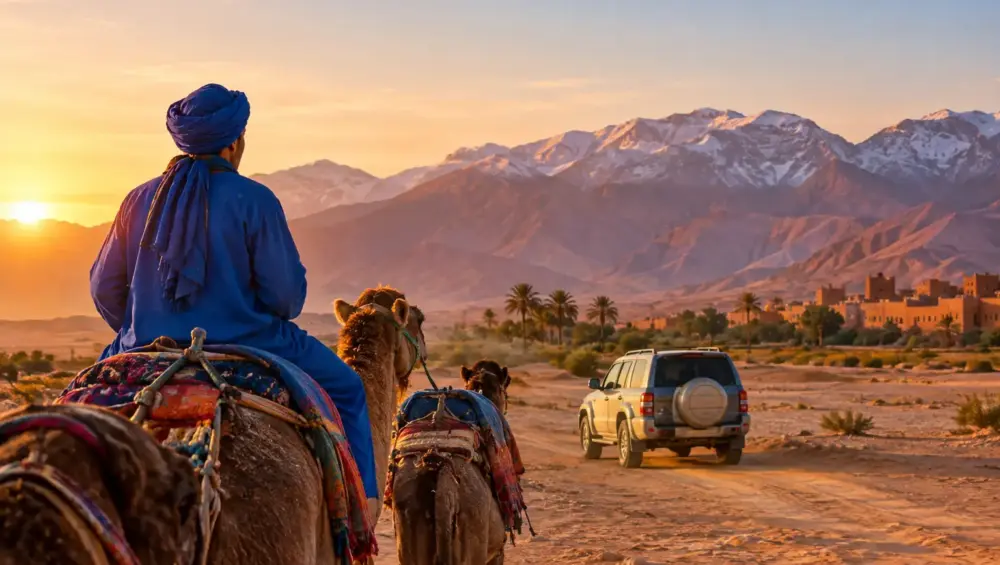
The desert transfer is where a Morocco itinerary either starts to feel wonderfully remote or unnecessarily exhausting. When travellers ask me how to choose desert transport, I do not begin with a vehicle. I begin with a much better question: what do you want the desert to feel like? A quiet night under stars, proper dunes, a camel ride at sunset, time for photographs, or simply a comfortable way to reach a beautiful camp?
Morocco’s desert is not one single destination, and transport is not a minor logistical detail. It shapes how much of your holiday is spent on the road, how much luggage you can bring, whether young children will enjoy the journey, and how rested you are when the sand finally appears.
Start with the desert you actually want to reach
For most private Morocco journeys, the main choice is between the dunes around Merzouga, on the edge of Erg Chebbi, and the more southerly Zagora and M’Hamid area. Merzouga is usually the right answer for first-time visitors who want the classic Sahara image: tall golden dunes, camel trekking and desert camps set beyond the last paved road. The journey is longer, but the payoff is unmistakable.
From Marrakech, reaching Merzouga takes a full day of driving, commonly with stops through the High Atlas, Ait Ben Haddou, Ouarzazate and the Dades or Todra region. I normally prefer breaking this into two days rather than treating the Sahara as a quick out-and-back mission. It gives the route room to breathe and means the desert does not become a prize earned through fatigue.
From Fes, Merzouga is more direct, though still a substantial drive. This can work well for travellers moving south through Morocco rather than returning to Marrakech. Zagora can be reached more quickly from Marrakech, but its landscape is different. There are desert experiences there, yet the towering dunes many people picture are farther south towards M’Hamid.
One useful clarification: Agafay, outside Marrakech, is a rocky desert rather than the Sahara. It can be a lovely overnight escape for a short itinerary, but it is not a substitute for the dune landscape of Erg Chebbi. Neither is better in every case. The right one depends on your available time and expectations.
How to choose desert transport for your route
A private, air-conditioned vehicle with an experienced driver is the most comfortable option for the long approach to the desert. It is especially sensible for couples, families and small groups who want the freedom to stop for lunch, viewpoints, kasbahs or a walk in a gorge without having to follow a coach timetable.
The vehicle size matters more than people expect. A compact vehicle may be perfectly comfortable for two travellers carrying soft luggage. Add a third adult, hard-shell cases or photography equipment, and that same journey can feel cramped by lunchtime. For four adults, I generally favour a larger vehicle so everyone has genuine space rather than spending two long travel days folded around bags.
A 4×4 is not always necessary for the road journey itself. Morocco’s main desert approach roads are paved, and a good private vehicle can handle them comfortably. The 4×4 becomes relevant for the final section into many camps, for travelling across sand, or for reaching more remote areas beyond the standard dune edge.
This is where vague wording can cause disappointment. Ask whether the booking includes transport all the way to camp, and how that final transfer happens. You may travel most of the route in one vehicle, then meet a separate 4×4 near Merzouga for the sand tracks. That is normal. What matters is that the handover is coordinated and suits your luggage, mobility and arrival time.
Public buses and shared transfers have their place for independent travellers with time and a tight budget. They are less suitable if you are hoping to make scenic stops, arrive at a particular camp in time for sunset, or avoid the uncertainty of piecing together the last stretch. The road to the Sahara is part of the experience, not merely a gap between Marrakech and sand.
The camel trek: choose it for the moment, not the mileage
A camel trek can be a memorable part of a desert stay, particularly at sunrise or sunset when the dunes are cool in colour and the pace naturally slows. But I advise choosing a shorter ride unless you already know you enjoy riding. Camels are not armchairs, habibi. The movement is distinctive, and even a beautiful hour can be enough for many people.
For travellers with back, hip or mobility concerns, a 4×4 transfer to camp is often the wiser choice. You still sleep among the dunes and experience the desert’s scale, without turning the ride into an endurance test. Families also need to judge honestly how their children respond to unfamiliar activities. A short camel outing can be exciting; a long one after a full day in the car can be a very different story.
There is no prize for arriving at camp by camel. I have planned desert stays where guests took a 4×4 in, then enjoyed a brief camel ride the following morning when they were fresh. That is often the most enjoyable balance.
Consider comfort after dark, not just transport by day
Desert transport and accommodation are closely connected. If you choose a camp deep among the dunes, the transfer is likely to be more adventurous and luggage arrangements more limited. A camp closer to the dune edge may be easier to reach and more practical for families, travellers with heavier bags or anyone who prefers fewer transitions.
Ask what you should take into camp and what can stay in the vehicle or at a nearby hotel. Usually, an overnight bag is enough: warm layers, toiletries, medication, a torch, charging cable and the clothes you need for the next morning. Desert evenings can be surprisingly cool, particularly outside the hottest months, so do not make the classic mistake of packing only for the afternoon sun.
If you are travelling with a large suitcase, that is not a problem in itself. It simply needs to be planned. Carrying every case over soft sand is not the romantic part of the Sahara anyone dreams about.
Match the journey to your pace
The biggest transport mistake I see is trying to visit Merzouga from Marrakech and return the next day. It is possible on paper, but paper has never driven through mountain bends, paused at a valley viewpoint, or sat down for a proper lunch. A rushed route can leave you seeing a great deal through a windscreen and experiencing very little of it.
For a private journey, I usually look at the desert in relation to the rest of the route. If you have limited time, Agafay or Zagora may be the more relaxed choice. If the Sahara dunes are a central wish, give Merzouga enough nights and connect it sensibly with the Dades Valley, Fes, or a longer southern route.
Season matters too. In summer, early departures and shade breaks make a difference, while winter calls for warmer clothing after sunset. During busy holiday periods, timing the arrival well can matter because the best part of the day in the dunes is often late afternoon, when the heat softens and the light becomes generous.
Questions worth asking before you confirm
Before choosing, get clear answers on a few practical points: how long you will actually spend driving each day; whether the final camp transfer is by 4×4 or camel; what happens to your main luggage; and whether your driver stays with you or meets you again the following day. If travelling with children, also ask about child seats early, not once the route is already set.
I also recommend being honest about your non-negotiables. If you want a private bathroom, easy camp access and minimal camel riding, say so. If you want remote dunes and do not mind a rougher final approach, that changes the recommendation. Tailor-made travel works best when the details are not treated as embarrassing preferences.
At Morocco Genie, I build these choices around the traveller rather than forcing every desert visit into the same formula. Your wish is my command, within reason – even a genie cannot shorten the distance from Marrakech to the Sahara.
The best desert transport is the option that lets you arrive curious rather than worn out. Leave enough time for the road, choose the final transfer you will genuinely enjoy, and let the first sight of the dunes feel like an arrival, not a recovery period.