A desert night can be the most memorable part of a Morocco journey – or the part that feels needlessly tiring if the setting does not suit you. The Sahara luxury camp versus bivouac question is not really about whether one is better. It is about deciding how much comfort, privacy and wildness you want when the road ends and the sand begins.
I have found that travellers often picture the Sahara as one fixed experience: camel ride, tent, dinner, stars. In reality, a night in a polished camp near Erg Chebbi can feel very different from a simpler, more remote bivouac in the dunes of Erg Chigaga. Both can be brilliant. They simply ask different things of you.
First, what does “bivouac” mean in Morocco?
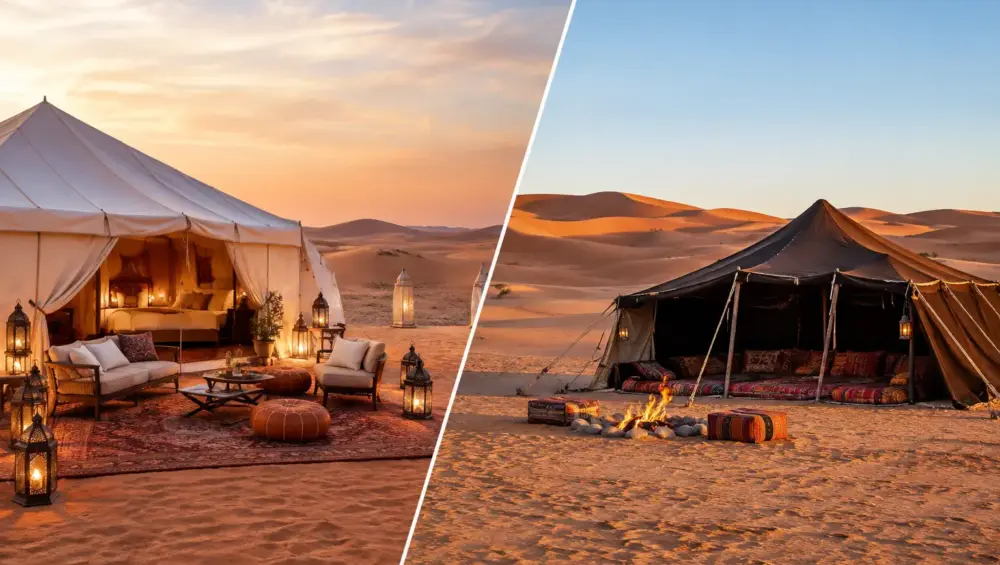
This word causes more confusion than almost any other desert term. In Morocco, a bivouac broadly means a temporary desert camp. It may be a modest arrangement of traditional-style tents with mattresses, shared facilities and a campfire dinner. It may also describe a beautifully designed camp with proper beds, private bathrooms and excellent food.
So do not assume that “bivouac” automatically means basic, or that “luxury camp” guarantees isolation. The label matters less than the practical details: where the camp sits, whether its bathroom is private, how many tents it has, how it is reached and whether it is permanent or assembled for your group.
When I design a desert stay, I look past the marketing language first. A traveller who says, “I want an authentic bivouac,” may actually mean they want silence and open dunes, not a cold night with a shared toilet. Another who asks for luxury may be happiest in a small, low-key camp rather than a large, highly styled one.
Sahara luxury camp versus bivouac: the real differences
Comfort after sunset
A luxury camp is usually the easier choice if you value a proper bed, quality linen, heating or extra blankets in colder months, an en-suite bathroom and reliable meals served at a table. The tents are often spacious, with thoughtful Moroccan touches rather than a bare sleeping setup. After a long drive from Fes, Marrakech or the Dades Valley, that comfort can make the desert feel restorative rather than demanding.
A simpler bivouac pares things back. You may sleep on a comfortable mattress, but the tent is likely to be more functional. Bathroom facilities can be shared and electricity may be limited. This is not a flaw. For some people, the small inconveniences are part of the point: fewer layers between you and the desert.
Families with young children, travellers celebrating a special occasion and anyone who sleeps lightly usually appreciate the predictability of a well-run luxury camp. More adventurous couples or friends may prefer the stripped-back character of a bivouac, especially if they have already spent several nights in comfortable riads.
Privacy and atmosphere
The word luxury can suggest solitude, but that is not always how it works. Some camps are close to the edge of the dunes and host multiple groups on the same evening. There may be music around the fire, several camel rides arriving at similar times and a lively social mood. That can be enjoyable, particularly for first-time visitors who want an easy introduction to the desert.
A private or semi-private bivouac often creates a quieter experience. It may be set farther into the dunes, with only your party and the camp team nearby. The evening becomes less about entertainment and more about the elements: wind moving over the sand, a long horizon after dinner, and stars that seem unusually close.
Neither atmosphere is inherently more authentic. A warm campfire with Gnawa rhythms and mint tea is authentically Moroccan too. But if your idea of a desert night is hearing almost nothing, say so clearly when planning. The right location is more valuable than an extra decorative lantern.
Access and the journey itself
Luxury camps are commonly reached by 4×4, sometimes after a short camel ride arranged for the experience rather than transport. This is practical for travellers with limited mobility, for families, or for anyone who does not fancy sitting on a camel for an hour at the end of a driving day.
A bivouac can require more commitment. In the Erg Chigaga region, for example, the final approach crosses tracks, dry plains and soft sand. The journey is part of the adventure, but it takes time and needs an experienced local driver. In some cases, walking or riding a camel into camp is a more central part of the stay.
That distinction affects your whole itinerary. Erg Chebbi, near Merzouga, is generally easier to include on a route from Fes towards the south-east. Erg Chigaga, reached from the M’Hamid area, works especially well on a longer Marrakech and southern Morocco circuit. Trying to force either one into too few days is a common mistake. The Sahara deserves time around it, not merely a quick overnight tick-box.
The desert you choose matters as much as the tent
Erg Chebbi is famous for its high, sculpted dunes and rich orange tones. It is visually dramatic and accessible, which explains its popularity. A good camp here can still deliver magical quiet, particularly at sunrise or after a short walk beyond the camp lights. Yet this area has more activity around it, so I would choose the specific camp carefully if privacy is a priority.
Erg Chigaga feels broader and wilder. The dunes can seem to go on forever, and the journey there creates a stronger sense of leaving ordinary life behind. It suits travellers with more time, a real appetite for remote landscapes and a willingness to accept a less polished journey. A luxury camp in Chigaga can offer impressive comfort, but the setting remains genuinely remote.
There are also smaller desert landscapes around Morocco that can be rewarding in the right route, though they do not carry the same vast-dune drama. The best choice depends on your wider journey, not on a single photograph.
Questions I would ask before choosing either
Rather than asking whether a camp is “luxury”, I would ask what is included in the experience. Is the bathroom inside the tent and for your use only? Is there hot water, and is it realistically available in the evening? How many tents are in the camp? Will other groups be present? How far into the dunes is it? Does the transfer involve a 4×4, camel, or both?
Ask, too, about the evening rhythm. Some travellers love a communal dinner and music around the fire. Others would rather eat quietly, take a guided walk at sunset and spend time away from the main gathering. These details are often easier to arrange when they are discussed in advance, rather than requested once everyone has arrived in the sand.
Season matters. Winter desert nights can be properly cold, even after a bright, warm afternoon. Summer heat can make a tent feel stifling before the temperature falls. A luxury camp may offer stronger bedding, ventilation and better facilities, but it cannot change the desert climate. Packing layers, closed shoes and a scarf is wise whichever style you choose.
My honest recommendation for different travellers
For a honeymoon, anniversary or first Morocco trip where the desert is a major highlight, I would usually lean towards a small luxury camp. You get the romance of the dunes without turning the night into an endurance test. Choose one with a calm setting rather than assuming the most elaborate décor equals the best experience.
For families, I would prioritise comfort, private facilities and an easy transfer. Children tend to remember sandboarding, camel encounters and the campfire – parents tend to remember whether everyone slept. There is no prize for making the logistics harder than they need to be.
For travellers who want true remoteness, a private bivouac or small camp deeper in the dunes is often the stronger choice. Keep expectations sensible: remote means fewer conveniences, variable conditions and more travel time. In return, you may have a desert evening that feels wonderfully unscripted.
For small groups of friends, the answer often lies in the balance. A private section of a quality camp, or an exclusive setup with a reliable local team, can give you atmosphere without sacrificing the ease of good beds and a well-organised dinner.
Make the desert night fit the journey
The best Sahara stay is not the one with the grandest description. It is the one that fits your pace, your tolerance for rough edges and the reason you came to Morocco in the first place. I would rather place you in a simple camp that feels perfectly you than in a glamorous tent that leaves you wishing for quiet, warmth or a proper night’s sleep.
When I plan a route through Morocco, I treat the desert as more than accommodation between two long drives. I consider the roads leading in, the kind of dunes you will see, the camp’s character and what you want to feel when the lights go out. Tell me whether you picture candlelight and a private shower, or sand beneath your shoes and nothing but silence. Habibi, that is where the real planning begins.