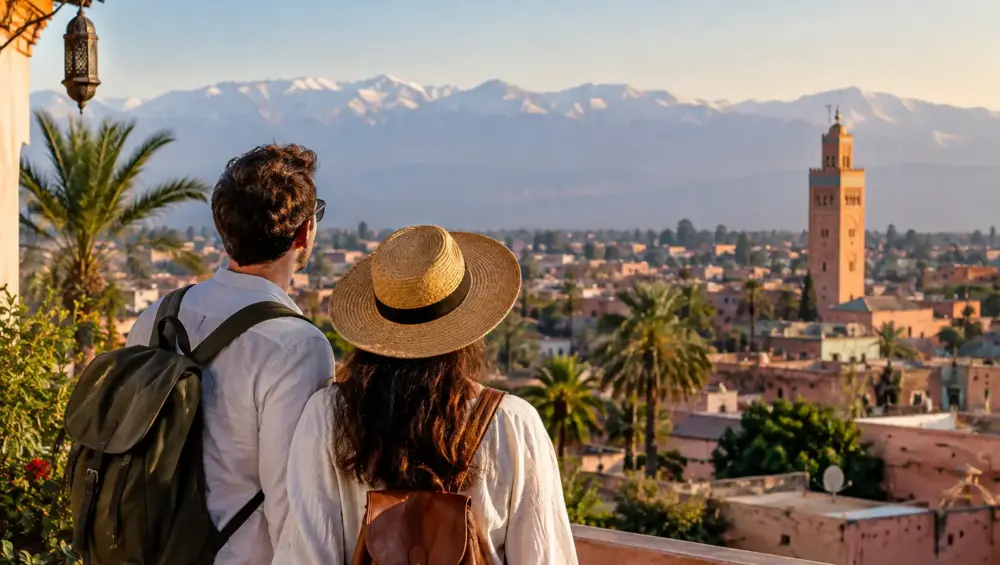
A couple once told me they wanted Morocco’s colour, food and desert skies, but worried that travelling without a group would feel awkward or difficult. Their question was simple: can couples visit Morocco alone? My answer is usually yes – and, for many people, travelling privately is the best way to experience the country.
Morocco works beautifully for couples because it offers very different moods in one journey: the energy of Marrakech, quiet mountain villages, a night under Sahara stars, Atlantic air in Essaouira and intimate riads where breakfast arrives in a sunny courtyard. The key is not treating Morocco exactly like a European city break. A little preparation, sensitivity and sensible route planning go a long way.
Can couples visit Morocco alone? Yes, with context
First, it helps to clarify what “alone” means. If you mean without a group tour, absolutely. Couples travel independently around Morocco every day, staying in riads and hotels, eating out, taking trains, booking drivers and arranging activities. If you mean being left entirely to chance in unfamiliar places, I would be more selective.
Morocco is easy to enjoy as a private couple’s holiday when the moving parts are well organised. Marrakech, Fes, Essaouira and Chefchaouen are walkable in parts, but medinas can be confusing at first. The distances between destinations are also larger than they look on a map. A journey from Fes to the desert, or from Marrakech across the Atlas Mountains, is not a casual afternoon drive.
This is why I often suggest combining independent time in the cities with a private driver for longer journeys. You keep the freedom to choose your pace, while avoiding the tiring parts: collecting a hire car after a long flight, navigating mountain roads, finding a desert camp after dark or working out where to stop for lunch. It is not about insulating yourself from Morocco. It is about saving your energy for the parts you came to enjoy.
The cultural side: relaxed, respectful and uncomplicated
Moroccans are widely warm and welcoming towards visitors, but public life is generally more conservative than in Britain. Couples do not need to feel self-conscious, yet a low-key approach to affection is the comfortable choice. Holding hands is usually unremarkable; prolonged kissing or overt displays of affection are best saved for private spaces.
Dress is similar: there is no single rule for visitors, and what feels normal in central Marrakech may feel too revealing in a small village. I advise packing for comfort and context rather than trying to follow a rigid formula. Loose clothing, layers, covered shoulders when visiting religious or rural settings, and something warmer for desert and mountain evenings will serve you far better than an entirely city-break wardrobe.
For unmarried couples, accommodation is usually straightforward at established riads and hotels accustomed to international travellers. Still, I recommend choosing places carefully and confirming practical details in advance, particularly if you prefer smaller, more local properties. Good planning is less glamorous than a rooftop sunset, habibi, but it prevents needless uncertainty.
Choose a route that gives you room to enjoy each other
The most common mistake I see is trying to fit every famous place into one week. Morocco rewards a slower rhythm. A couple who rushes from Marrakech to the desert, then Fes, Chefchaouen and Casablanca in six nights will mostly remember luggage, roads and check-in desks.
For a first trip, I would usually build around two or three contrasting areas. Marrakech and the Atlas Mountains work well for a shorter holiday. Marrakech, the desert and Fes make sense when you have more time and genuinely want the long scenic drive to be part of the experience. If sea air matters more than ticking off landmarks, Marrakech and Essaouira offer a gentler combination.
The best route depends on how you travel together. Some couples love long road days, impromptu photo stops and roadside cafés. Others would rather spend three unhurried nights in one excellent riad, with a guide for one morning and empty time for wandering. Neither approach is more authentic. Morocco is at its best when the itinerary reflects your actual holiday style, not somebody else’s highlight reel.
My rule for medinas
Stay somewhere central enough that you can walk to restaurants and sights, but do not expect every door in a historic medina to be obvious from the street. Many wonderful riads sit along lanes too narrow for vehicles. Arrange a meeting point or luggage assistance on arrival, keep your accommodation details saved offline, and accept that getting a little lost is part of the experience.
There is a difference, though, between pleasant wandering and frustration. In Fes especially, a licensed local guide can transform the first day. The medina is extraordinary, but it is dense, layered and easy to misread. A good guide gives you orientation, context and confidence, then you can return later to explore at your own pace.
Small practical habits make a big difference
Couples do not need to travel anxiously, but I would not arrive with no plan at all. Keep valuables discreet, agree on a meeting point if you separate in busy souks, and use official taxis or pre-arranged transport when arriving late. In crowded areas, polite but firm replies are more useful than getting drawn into long conversations with anyone selling an unwanted service.
Cash remains useful for small purchases, tips and places outside major cities, while cards are accepted at many hotels and restaurants. Carry small notes where possible. It makes everyday moments easier, whether you are buying orange juice in Jemaa el-Fna or stopping for coffee on the road to the mountains.
Food is one of the joys of travelling as a couple here. Share a tagine, try a long Friday lunch, or book a cooking experience if that is genuinely your thing. But do not schedule every meal as an event. Some of my favourite Morocco evenings are the unscripted ones: a simple table on a quiet terrace, grilled fish in Essaouira, or mint tea after a day with no agenda.
When private coordination is worth it
You can absolutely arrange Morocco independently. If you enjoy research, are comfortable adapting plans and are travelling between well-connected cities, that can be satisfying. The trade-off is that Morocco has many small logistical details that are hard to judge from abroad: which riad is peaceful rather than merely photogenic, how long a transfer really takes, whether a mountain stay suits your pace, and which activities are worthwhile for your interests.
Private coordination becomes especially valuable for multi-stop journeys, desert overnights, families, special occasions or anyone who wants the holiday to feel calm rather than pieced together. At Morocco Genie, I design journeys around the couple rather than a fixed route – perhaps a food-focused few days in Marrakech, a quiet kasbah in the Atlas foothills and a coastal finish, or a more adventurous road journey towards the Sahara.
The point is not to fill every hour. It is to make the transitions work so that you can be present when Morocco does its best work: the call to prayer drifting over a rooftop, the first view of red dunes, the smell of cedar in the Middle Atlas, or a stranger offering directions with genuine warmth.
A final thought before you book
Morocco is a wonderful place to travel as a couple, not because every moment will be perfectly polished, but because it gives you stories to share. Leave room for the unexpected, plan the complicated parts properly, and let the journey have a little breathing space. Your wish is my command – but my honest advice is to wish for less rushing and more Morocco.