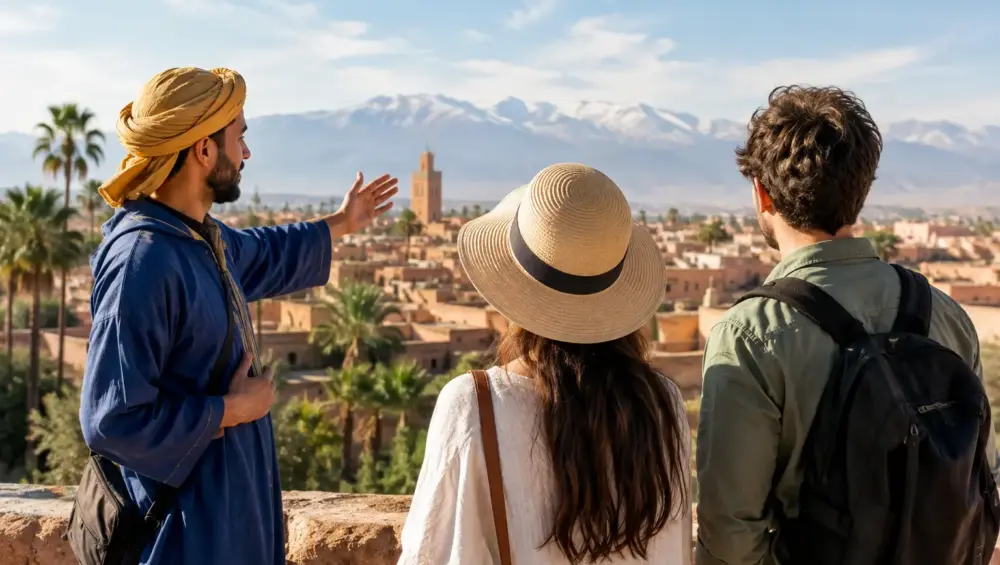
A guide can change the texture of a day in Morocco. In the Fes medina, the difference may be arriving at a tiny workshop through an unmarked doorway rather than spending an hour circling the same alley. In Marrakech, it may be understanding why a courtyard house is designed as it is, instead of merely photographing the tiles. But when travellers ask me how to find licensed guides Morocco has to offer, I tell them not to begin with the most persuasive online profile. Begin by deciding what you actually need a guide to do.
A licensed guide is not simply someone who speaks good English and knows where the best viewpoints are. The right person should add context, confidence and local judgement without turning your holiday into a lecture or a shopping exercise. That takes a little checking – and, just as importantly, a realistic idea of when a guide is worth having.
When a guide is genuinely worth booking
I do not believe every hour in Morocco needs guiding. Some of the best moments happen when you have time to wander, sit over mint tea or follow your nose towards the smell of fresh bread. Essaouira’s compact medina, for example, is wonderfully manageable for independent exploration once you know your bearings.
Fes is different. Its old medina is vast, intricate and easy to misread. A good local guide can make a first visit far more rewarding, especially if you want to understand traditional crafts, historic schools, food markets and the daily rhythm behind the busy lanes. The value is not that you would be helpless without one. It is that you spend your limited time seeing more clearly.
Marrakech also benefits from a guide, though the ideal format depends on you. Some travellers enjoy a focused half-day introduction early in their stay, then explore independently with confidence. Others want a slower, themed walk around architecture, gardens, food or artisan work. For families, a guide who can keep the pace flexible is often more valuable than someone attempting to recite every date in the history books.
In the Atlas Mountains, the Sahara and more rural areas, the question changes. You may need a local mountain guide for a walk, or a knowledgeable host for a village visit, but not necessarily a formal city-style tour. The best arrangement should fit the activity, terrain and your comfort level.
How to find licensed guides in Morocco without guesswork
The cleanest route is to book through a trusted Morocco-based travel specialist, hotel or riad that has a real working relationship with the guide. That does not mean accepting a name blindly. Ask who will guide you, what area they specialise in and whether they are officially licensed for guiding work. A professional coordinator should be comfortable answering plainly.
If you are arranging it directly, ask the guide about their official accreditation and experience in the exact destination you are visiting. Morocco has different guiding specialisms and local arrangements, so do not assume that a person who is excellent in Marrakech is the right fit for a day in Fes, a hike near Imlil or a desert route. Ask whether they can provide their guide credential details if you would like reassurance.
I would also pay attention to the quality of the conversation before you book. Are they asking what interests you? Do they respond clearly to practical questions? Can they explain the likely pace and meeting point? A guide who says only, “I show you everything,” may be perfectly pleasant, but it is not a plan.
Reviews can help, particularly when they describe specific details: a guide adapting for children, explaining a craft with sensitivity, or helping guests navigate a busy medina without rushing them. Be cautious with reviews that are all superlatives and no substance. Five stars are nice; useful evidence is better.
Ask these questions before confirming
You do not need an interrogation. A short exchange should cover the essentials: whether the guide is licensed, how long the visit will last, which language they guide in, what is included, and whether the route can be tailored to your interests.
I would also ask about shopping stops. This is a sensible question, not an awkward one. Morocco has beautiful craft traditions, and visiting a workshop can be a fascinating part of a tour. The issue is pressure. Tell the guide upfront if you are happy to visit artisans but do not want a sales-focused day, or if you would prefer no shopping stops at all. A good guide will respect that boundary.
If mobility is a consideration, say so early. Cobblestones, steps and the pace of a medina can be tiring even for fit travellers, particularly in warmer months. A knowledgeable guide can build in breaks, choose a more accessible route and avoid trying to cover too much ground.
Licensing matters, but fit matters too
It is tempting to treat a licence as the final answer. It matters because it is an important sign of professional standing and appropriate local authorisation. Yet paperwork alone cannot tell you whether someone listens well, speaks in a way you enjoy, or understands that your teenagers are fading after ninety minutes.
The best guides have judgement. They know when to explain and when to let a place speak for itself. They can answer a complicated question honestly rather than inventing a story. They understand that a couple interested in design, a family travelling with younger children and friends keen on street food do not need the same Fes.
Language is part of this too. A guide may be technically fluent in English but have a very different communication style from what you expect. If your holiday depends on a highly detailed, discussion-led visit, it is reasonable to ask about their style. If you prefer warmth, humour and a relaxed introduction rather than a deep historical tour, say that. Your wish is my command is a lovely sentiment, but the guide needs to know what the wish actually is.
Common mistakes I see travellers make
The first is booking a guide for every place because it feels safer. This can leave a carefully planned Morocco journey feeling over-scheduled. Build guided experiences around the places where insight or navigation will make the biggest difference, then leave room for a long lunch, a hammam, a rooftop sunset or an unplanned walk.
The second is choosing only on price. A very low quote can mean a shorter visit, unclear inclusions or a guide who is not the professional you thought you were booking. I am not suggesting that the most expensive option is automatically best. I am suggesting that a few clear questions are worth more than a bargain that becomes confusing on the day.
The third is requesting a generic “city tour”. That phrase gives little direction. Instead, explain your priorities: architecture and history, local food, photography, Jewish heritage, crafts, gardens, family-friendly storytelling, or simply an orientation walk with no pressure to shop. Specific requests produce better days.
Finally, do not confuse a driver with a guide. A good private driver is invaluable for moving comfortably between destinations, sharing practical local knowledge and keeping the journey running smoothly. But city guiding and specialist walking routes are different skills. In many itineraries, the strongest combination is a private driver for the wider route and licensed local guides where their expertise matters most.
Building guides into a private Morocco journey
When I design a tailor-made trip, I do not place guides into an itinerary like ticks on a checklist. I consider where a traveller may benefit from interpretation, where they need help navigating, and where freedom is more valuable. A first morning in Fes with a licensed guide can set up two confident afternoons on your own. A food-focused guide in Marrakech may be more memorable than another formal monument visit. A mountain walk may call for a local guide who knows the paths, weather and villages intimately.
Coordination matters as much as selection. A guide should know where you are staying, when you arrived, whether you have a driver waiting afterwards and what pace suits your group. Those apparently small details prevent the familiar holiday irritations: missed meeting points, too much walking before lunch, or being delivered to the wrong side of a maze-like medina.
The right guide should leave you feeling more connected to Morocco, not managed by it. Ask sensible questions, be clear about your interests, and leave enough empty space in the day for Morocco to surprise you. Habibi, that is usually where the best memories begin.