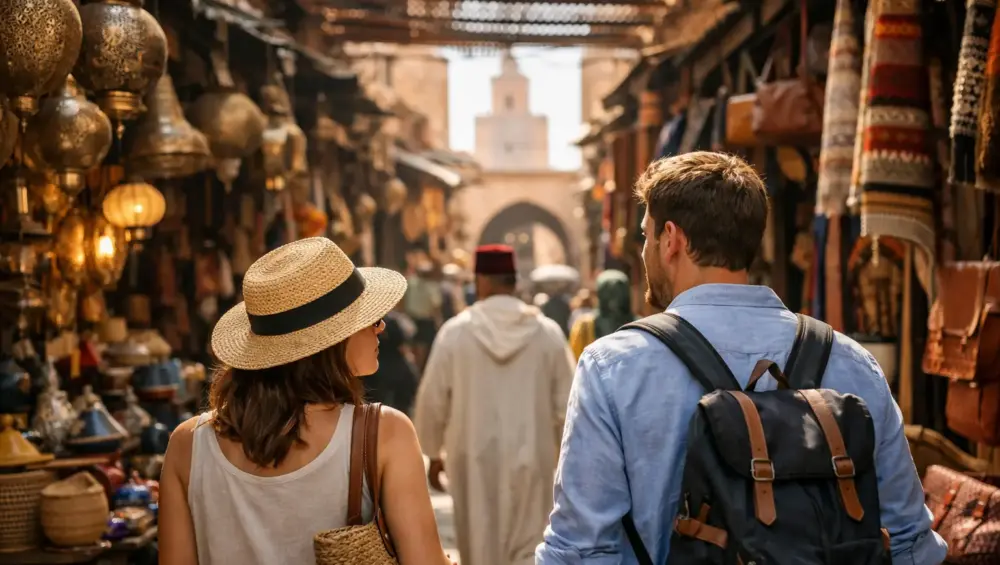
The first time you step from Jemaa el-Fna into the souks, the change is immediate. The open square gives way to a covered maze of narrow lanes, scooter horns, spice displays, copper lamps and shopkeepers calling out a friendly greeting. It is exciting precisely because it is not arranged for your convenience. Knowing how to navigate Marrakech souks is less about memorising streets and more about setting your own pace.
I regularly plan Marrakech stays for travellers who are keen to experience the medina properly but do not want an afternoon of getting lost, pressured or exhausted. My advice is not to treat the souks as one enormous shopping centre. Think of them as working neighbourhoods with pockets of craft, food and daily life. Give yourself permission to wander, but create a few anchors first.
Start with a simple route, not a perfect plan
Jemaa el-Fna is the most useful reference point for most visitors. If you are staying in a riad inside the medina, ask the staff to point out the clearest walking route between the riad and the square before you leave. Take a photograph of the entrance to your riad, save its location on an offline map, and note one or two landmarks on the way: a mosque, a fountain, a well-known café or a particular archway.
The medina lanes do not behave like a street grid. Some passages narrow, split or appear to lead nowhere, and a route that felt simple in daylight can look entirely different after dark. That is normal. Rather than repeatedly checking your phone in the middle of a busy lane, step to the side when you need to orientate yourself. You will enjoy far more when you are not trying to win a battle against the map.
For a first visit, I like a loose loop: enter the souks from the square, wander north towards the larger artisan areas, pause for mint tea or lunch, then return to Jemaa el-Fna by a different route. The point is not to cover every lane. You cannot, and you do not need to.
Choose the right time of day
Morning is best if you want room to look, ask questions and photograph details without the fullest crowds. Many stalls begin opening from mid-morning, so do not rush there at dawn expecting every shop to be ready. Late afternoon has a wonderful energy, particularly as the light softens and the square begins to change for the evening, but it is busier and can feel more intense.
If shopping is your priority, go earlier. If atmosphere is your priority, allow time before sunset and finish with dinner near the square. Families with younger children often enjoy a short morning visit far more than a long evening circuit. It depends on your appetite for bustle, heat and negotiation.
How to navigate Marrakech souks by neighbourhood
The souks are often described as a single place, but different areas have different characters. You may come across dyers’ wool hanging overhead, leather goods, slippers, baskets, wooden items, textiles, jewellery, spices and metalwork. Traditional craft groupings still exist, although modern souvenir shops are mixed throughout.
If you have something specific in mind, tell your guide or riad host what it is before setting off. For example, a traveller looking for a well-made leather weekend bag needs a different kind of browsing than someone seeking small gifts or a handwoven cushion cover. I encourage people to look in several places before buying larger items. It helps you understand materials, workmanship and the range of styles available.
For ceramics, textiles and rugs, do not judge only by the first impression. Ask where an item was made, whether the pattern is woven, embroidered or printed, and how it should be cared for. A handmade piece may have charming variations. That is not automatically a flaw, but it should be reflected in what you are comfortable paying.
Be especially conscious of size. A beautiful brass lantern or large rug can become a complicated holiday purchase if you have not considered packing, shipping arrangements or where it will live at home. Sometimes the most satisfying souvenir is the small one you will use often: a tea glass, a hand-carved spoon, a pair of babouches or a pouch of spices chosen because you genuinely cook with them.
Bargaining should be friendly, not theatrical
Bargaining is part of souk shopping, but it does not need to become a performance. Prices are usually not fixed in smaller shops, and the opening figure is often the beginning of a conversation rather than the expected final amount. I advise travellers to decide what the item is worth to them before they start negotiating. If you reach that number and the seller agrees, buy it with good grace.
A calm approach works better than trying to prove you are the toughest negotiator in Marrakech. Ask the price, make a lower counter-offer politely, and take your time. If the price does not feel right, smile, say thank you and leave. Walking away is useful only when you genuinely do not wish to buy.
Do not negotiate intensely over something you have no intention of purchasing. It wastes everyone’s time and can make a warm interaction needlessly awkward. Equally, do not feel guilty for declining. A friendly “la, shukran” – no, thank you – goes a long way.
There is no universal rule for what something “should” cost because quality, location, materials and craftsmanship vary sharply. A mass-produced slipper and a carefully made leather pair may look similar at a glance. The useful question is not whether you achieved a dramatic discount; it is whether you understand what you are buying and feel happy with the exchange.
Manage attention without closing yourself off
People will offer directions, invite you into a shop or suggest that a route is closed. Most interactions are simply part of the rhythm of a busy visitor area, but you are never obliged to follow a suggestion. If you need help, ask someone working at your riad, an official guide, or a shopkeeper you have chosen to speak with rather than accepting every offer made in passing.
A firm but pleasant response is enough. “No thank you, I’m fine” works better than a long explanation. Keep walking if you do not want to engage. You do not need to become suspicious of everyone to maintain your boundaries. Some of the loveliest souk moments come from a real conversation about a craft, a cup of tea offered during browsing, or a shop owner explaining how an object is made.
The distinction is simple: be open, but be intentional. Do not let someone else decide your route, your shopping list or how long you spend in a particular shop.
When a local guide changes the experience
A licensed local guide can be a very good choice for a first morning in the medina, especially if you are short on time, travelling with children, interested in particular crafts, or simply prefer context over guesswork. The best guides do not march you from one sales stop to another. They explain the medina’s layout, point out details you would miss and adapt the walk to your interests.
After a guided introduction, many travellers feel confident returning alone later for unhurried browsing. This is often the ideal balance: orientation first, freedom afterwards. When I design a private Morocco journey through Morocco Genie, I sometimes suggest this approach rather than filling every Marrakech hour with a guide. The souks reward both local insight and independent wandering.
Give yourself an exit plan
The most common souk mistake is staying too long because you think you ought to see more. Heat, noise and decision fatigue can make even experienced travellers irritable. Arrange a clear meeting point if your party separates, carry water, wear comfortable closed or supportive shoes, and leave some space in your day afterwards.
A rooftop lunch, a hammam, an hour by the riad pool or simply a quiet cup of tea can reset the day. Marrakech is not a destination to race through. The souks will still be there tomorrow, and you will notice more when you return with fresh energy.
My favourite souk purchases are rarely the most expensive ones. They are the objects tied to a small moment: the artisan who explained his work, the lane where I got pleasantly lost, the scent of cedar or cumin that brings Marrakech back months later. Let the maze be part of the story, habibi. You do not need to conquer it to enjoy it.