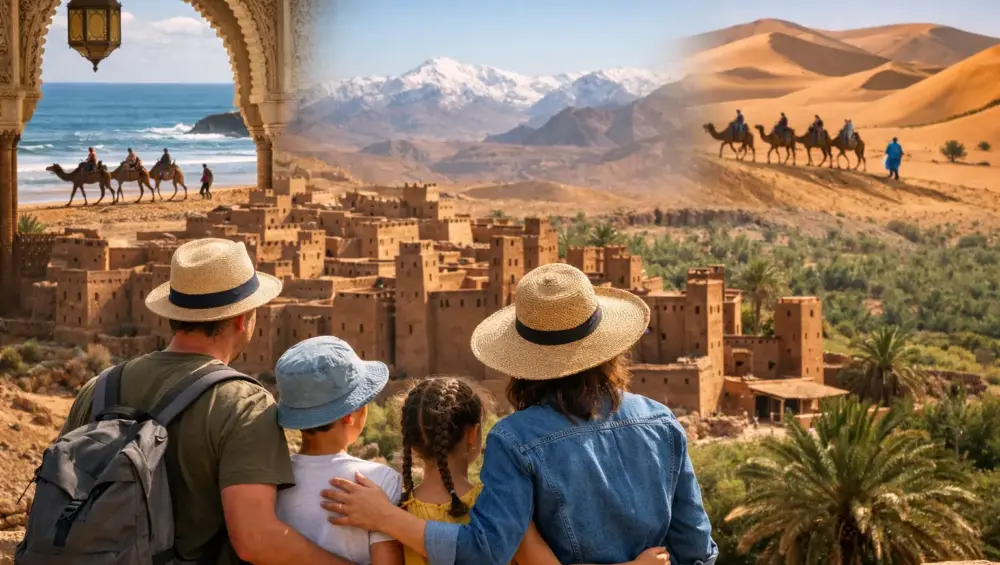
A child racing through a quiet riad courtyard to find the resident tortoise will often remember Morocco more vividly than any landmark. That is why the best Morocco experiences for families are not simply a checklist of famous sights. They are moments with room to touch, taste, ask questions and pause when someone needs an ice cream, a pool, or a break from the bustle.
I plan family journeys around a simple rule: Morocco should feel exciting, not like an endurance test. The country offers extraordinary variety – imperial cities, beaches, mountains and desert landscapes – but its distances are real. A well-paced private trip will usually deliver far more than trying to fit every major place into one holiday.
10 best Morocco experiences for families
1. Get happily lost in Marrakech, with a guide who knows when to stop
Marrakech can be a brilliant opening act for families. The souks are colourful, noisy and full of things children actually notice: pyramids of spices, brass lamps, leather slippers, orange juice stalls and tiny workshops where craftspeople are at work.
I strongly recommend a private family-friendly guide for a first walk through the medina. It removes the navigation pressure from parents and turns what could be sensory overload into a story-led morning. A good guide will adjust the pace, point out a traditional bakery or a hidden caravanserai, and avoid dragging children through shops they have no interest in visiting.
The trick is not to spend all day in the medina. Pair it with a garden, a relaxed lunch, or time by the riad pool. Marrakech rewards short, vivid outings rather than a marathon of monuments.
2. Learn to cook the food children have been smelling all week
A Moroccan cooking class works particularly well when it is genuinely hands-on. Shopping for ingredients, choosing herbs, mixing spices and shaping bread or pastries gives children a role beyond sitting at a restaurant table waiting for dinner.
For younger children, I would choose a shorter class focused on simple dishes, Moroccan bread or sweet treats. Teenagers often enjoy a fuller market-to-kitchen experience, especially if they are curious about food photography or want to bring a recipe home. Do mention dietary requirements well ahead of time. Moroccan hosts are usually wonderfully accommodating, but clarity helps.
3. Sleep in the Sahara, but choose the desert experience carefully
The first sight of the dunes near Merzouga has a way of quietening even the most screen-focused teenager. Families can ride camels at sunset, try sandboarding, watch the stars and wake to a desert sunrise that needs no filter.
However, this is the experience where route design matters most. From Marrakech, the journey to the Sahara is long and should not be treated as a quick overnight detour. I prefer building in a proper stop en route, often around the dramatic valleys and kasbah country, so the drive becomes part of the holiday rather than something to survive.
Camel rides also need an honest conversation. Some children adore them; others are nervous once the camel stands up and the movement begins. Shorter rides can be the sensible option, with a 4×4 transfer available where appropriate. For families, a comfortable private camp with proper beds and private facilities generally makes the night much more enjoyable than chasing the most remote-looking camp on a photograph.
4. Follow the old caravan routes through kasbah country
Between the High Atlas and the desert, southern Morocco is packed with landscapes that feel made for family imagination. Mud-brick kasbahs rise from palm groves, rivers cut through red rock valleys, and small villages appear around bends in the road.
A guided visit to Ait Ben Haddou is especially good for school-age children and teens. Rather than presenting it as a historic site to tick off, let the guide explain how families once lived inside fortified communities, how earth architecture works, and why the buildings are repaired rather than left to crumble.
This region is also one of the best places to slow down. A family-owned lodge, an easy walk through a palm oasis, or an unhurried afternoon by a pool can be every bit as valuable as another long drive.
5. Walk in the Atlas Mountains at a child-sized pace
The Atlas Mountains give families a completely different Morocco: walnut trees, terraced fields, rushing streams and village paths where people still greet passing walkers with a warm salaam. Even children who claim not to like walking often respond well when there is a destination – a waterfall, a village tea stop, or a riverside lunch.
The right walk depends on age, confidence and season. A gentle one-to-two-hour route is often ideal for younger families. Older children may enjoy a longer trail with a local mountain guide. I would not plan high-altitude trekking simply because it sounds adventurous. Wind, heat, cold and tired legs can change the mood quickly, particularly outside the mild spring and autumn months.
6. Spend a day with Moroccan crafts, not just souvenir shops
Morocco’s traditional crafts make much more sense when children see how they are made. In Fes, a guide can introduce the medina’s working trades: tile-cutters, metalworkers, weavers and woodcarvers. In Marrakech or the south, workshops can offer more practical encounters, such as pottery painting, weaving or simple craft activities.
There is a useful difference between watching a craftsperson and visiting a shop presented as a cultural stop. I favour experiences where the craft comes first and buying is entirely optional. Children are wonderfully direct judges of this distinction, habibi.
7. Let Fes become a treasure hunt, not a history lecture
Fes is often best for families with children old enough to enjoy its complexity. Its medina is a maze in the most literal sense, with narrow lanes, donkeys carrying goods, fountains, doorways and workshops around unexpected corners.
A private guide is particularly helpful here, but the visit needs a clear rhythm. Build in a scavenger-hunt feeling: find a carved cedar door, spot a donkey, count the colours in the tilework, try a freshly baked biscuit. Keep the formal historical explanations selective. The stories of scholars, merchants and craftspeople will land better when there is a real place or object in front of them.
For very young children, I would consider fewer nights in Fes and more time in a riad with a peaceful courtyard. Beautiful does not automatically mean entertaining for a four-year-old.
8. Ride horses or surf on the Atlantic coast
Essaouira is a welcome release after the intensity of the cities. The sea air is cooler, the medina is easier to navigate, and families can choose between active days and doing very little at all.
A gentle horse ride along the beach can be memorable, provided the operator matches the ride to each person’s experience. Older children and teenagers may prefer a surf lesson, while younger ones are often perfectly content building sandcastles and watching the kite-surfers. The Atlantic can be windy, especially in summer, so treat beach time as fresh-air fun rather than guaranteeing long, lazy swims.
The town is also excellent for a family lunch: grilled fish, simple salads, and plenty of space to linger without feeling rushed.
9. Share mint tea in a village home or rural cooperative
The experiences families speak about most warmly are often the quiet ones. Sitting down for mint tea, learning how bread is prepared, or hearing a host explain daily life in a mountain or desert community gives children a human connection to the places rolling past their car window.
These visits should be arranged thoughtfully and respectfully, never as if local people are an attraction. The best encounters are small-scale, mutually comfortable and connected to a real activity, such as farming, cooking, weaving or village life. I always build them around the family’s interest and the available time, rather than forcing one into every itinerary.
10. Give each child one choice that shapes the day
This is not a destination, but it is one of the most effective family travel tools I know. Let each child choose something small: the snack for the car, the colour of a handmade bowl, whether to try a camel ride or a sandboard, or which pastry to order at a café.
Morocco can feel wonderfully unfamiliar. A little agency makes that unfamiliarity feel adventurous rather than overwhelming. It also prevents the holiday becoming a series of adult decisions conducted around tired children.
How to make a Morocco family trip feel relaxed
Most family itineraries work best with two or three-night stays rather than changing accommodation every day. I also allow for private driving days that include real stops – toilets, snacks, viewpoints, a short wander, lunch – instead of calculating journeys only by map time.
Accommodation matters more than parents sometimes expect. Interconnecting rooms, family suites, heating in winter, a pool in warmer months, and easy vehicle access can transform the practical side of a stay. A gorgeous riad deep in a medina may be ideal for some families, while others will value easier arrival and more outdoor space.
There is no single perfect Morocco route. A family with toddlers may flourish with Marrakech, the Atlas and Essaouira. Families with older children might add Fes, kasbah country and the Sahara. When I design a journey through Morocco Genie, I start with those real-world differences – ages, energy, interests and how much driving everyone will genuinely enjoy.
Leave a little empty space in the plan. Morocco is at its best when a child can stop to watch a cat in a sunlit alley, when a tea invitation becomes an unplanned hour, or when the day ends early because the pool has won the argument. Your wish is my command, but sometimes the wisest wish is simply more time to enjoy where you are.