A riad can be one of the best parts of a Moroccan holiday. It can also be the wrong choice for the night before an early departure, after a long drive, or when travelling with children who need space to run around. That is why the question of riad versus hotel in Morocco is not really about which is better. It is about choosing the right place for the right moment in your journey.
I plan private Morocco trips around people rather than a checklist of accommodation types. Some travellers want to wake to birdsong around a tiled courtyard in the Fes medina. Others want easy parking, a large pool and a room where the family is not tripping over suitcases. Most want a little of both. Habibi, welcome to the useful dilemma.
Riad versus hotel in Morocco: the real difference
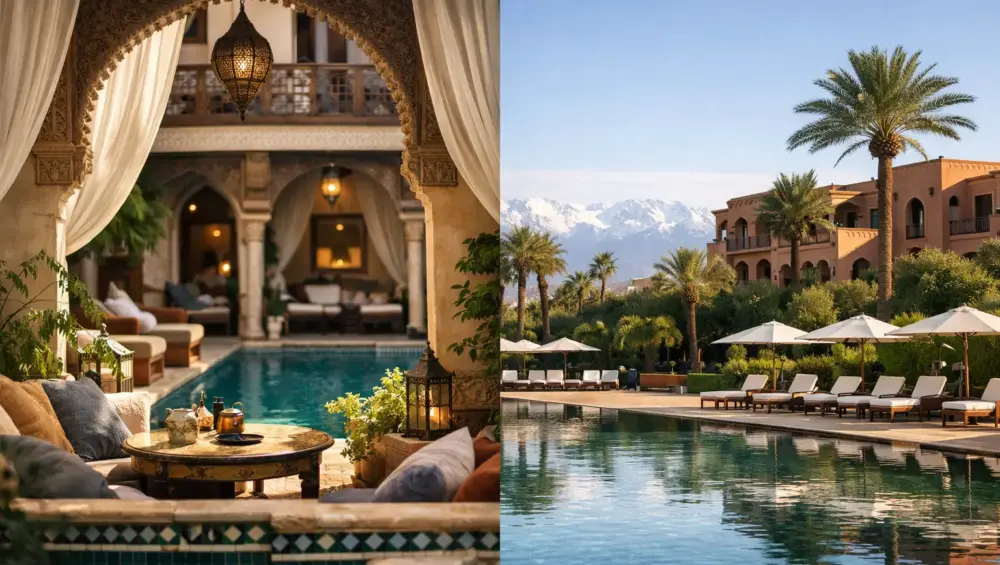
A traditional riad is a townhouse built around an interior courtyard, often with a fountain, citrus trees or a small plunge pool at its centre. The architecture turns inward: from the street, the building may look plain; beyond the door, there is usually colour, craft and calm. Many riads are in the old medinas of Marrakech, Fes, Essaouira and other historic towns.
In practice, the word riad is used quite loosely. A small, characterful guesthouse may be called a riad even if it does not have the classic courtyard layout. What matters more than the label is its size, location, access and level of service.
Hotels range widely too. They might be intimate heritage properties, modern city hotels, resort-style stays outside the medina, mountain lodges or desert camps. A hotel generally gives you more standardised facilities: reception cover, lifts in some cases, broader dining options, larger rooms, parking and often a pool or spa. That consistency can be extremely valuable, particularly in the middle of a busy route.
Neither choice is automatically more authentic. A beautifully run hotel can feel deeply Moroccan through its design, food and staff, while a poorly chosen riad can feel more like a photogenic room with logistical complications. I look at how a place fits the day, not just how it looks in photographs.
Choose a riad when the medina is the experience
For a first stay in Marrakech or Fes, I often recommend a riad because it changes how the city feels. You step from a lively alley into a cool courtyard, hear the call of swifts overhead, and have a quieter base after the intensity outside. It is a very Moroccan rhythm: movement and noise beyond the door, then tea and stillness within.
Riads tend to suit couples, friends and independent-minded travellers who enjoy being close to the action. In Marrakech, staying inside or near the medina means you can walk to many sights, cafés and souks without dealing with city traffic each time. In Fes, a riad can place you inside the maze-like old city, where a local guide is especially helpful on your first proper exploration.
The personal touch is another strength. Smaller riads often remember how you take your breakfast tea, help with a restaurant reservation, and offer useful local perspective. That is not guaranteed, of course, but it is more common when there are only a handful of rooms.
There are trade-offs. Medina lanes are not built for vehicles. Your driver may stop at a nearby gate and a staff member may meet you with luggage, but the final walk can be five minutes or fifteen, depending on the property. In Marrakech this is usually manageable; in Fes, uneven lanes and steps can make it more significant. Anyone with reduced mobility, very heavy luggage or a strong preference for instant car access should consider this carefully.
Riads can also have compact rooms. Historic buildings were not designed around king-size beds, multiple suitcases or interconnecting family suites. Some are wonderfully spacious, but I never assume. For a family of four, the right arrangement may be two adjoining rooms, a suite, or a hotel with clearer family-friendly layouts.
A note on rooftops, pools and winter evenings
A riad rooftop is often a joy, especially for breakfast in Marrakech or sunset over the Fes rooftops. Yet the rooftop pool in a photograph may be a decorative plunge pool rather than somewhere you will spend an afternoon swimming. It is worth setting expectations correctly.
Likewise, riads can feel cool indoors in winter and very peaceful at night, sometimes with fewer communal facilities. That is perfect for travellers seeking atmosphere. It may be less ideal for a group that wants a proper bar, late dinner choices and space to socialise without worrying about other guests.
Choose a hotel when convenience shapes the day
Hotels are often the more sensible choice at transition points in a route. If you arrive late in Casablanca, leave early from Marrakech airport, or have only one night between driving days, easy access can matter more than sleeping behind an ancient medina door.
They are also useful where the destination itself calls for a different setting. In the Atlas Mountains, I may favour a lodge with valley views and walking access over a city-style riad. Near the coast, a hotel outside the old town can offer beach access, larger terraces and a proper swimming pool. In the desert, the question becomes less about riad or hotel and more about whether a camp provides the level of comfort, privacy and atmosphere you actually want.
Families frequently appreciate hotels for practical reasons. Larger pools, more flexible room configurations, outdoor areas and straightforward vehicle access remove small stresses that can become tiring after several days. Travellers celebrating a special occasion may also prefer a hotel with a spa, a wider restaurant offering or a private terrace that is genuinely private.
A hotel can be a better fit for travellers who like certainty. If having a lift, a 24-hour reception, a gym or a full menu is part of your comfort, say so at the planning stage. There is no prize for choosing the most traditional accommodation if it leaves you feeling inconvenienced.
The downside is that some hotels can feel detached from the city. A resort beyond Marrakech may offer gardens and calm, but you will rely more on transfers for evening meals and medina wandering. This is not necessarily a problem. It simply changes the experience from living within the city to visiting it from a comfortable retreat.
The best Morocco routes usually mix both
My honest answer is that a well-designed Morocco holiday often includes riads and hotels. I might pair three nights in a medina riad in Marrakech with a mountain lodge in the High Atlas, a thoughtfully chosen desert camp near Merzouga, and a hotel or coastal guesthouse in Essaouira. Each stop has a different job to do.
For a classic loop through Marrakech, the Atlas Mountains, Ait Ben Haddou, the Dades Valley, the Sahara and Fes, the accommodation should help you recover from the road as well as experience each place. A riad in the centre of Fes makes cultural exploration easier. A valley hotel with parking and views makes more sense after crossing mountain roads. The desert is about the setting, but the details matter: bedding, bathroom arrangements, heating in colder months and how far the camp is from the dunes all affect the night.
This is where copying a route from a travel blog can lead to frustration. An accommodation that suits a couple travelling light in spring may not suit a family in August, or friends arriving with several large cases after a late flight. Morocco rewards a little thoughtfulness.
Questions I ask before recommending either
I start with pace and priorities. Do you want to walk out of your door into the souks, or return to a pool after sightseeing? Are you travelling with small children? Is anyone sensitive to stairs, noise or firm mattresses? Will you have a private driver throughout, or need regular taxis? Do you value a memorable room, excellent food, a spa, or simply a quiet night and an easy start?
I also consider the order of the trip. A riad can be a brilliant opening to Morocco when you are ready for sensory immersion. For others, it works better later, once they have settled into the country. On a private journey, there is room to make that choice around you rather than forcing every night into one style.
Do not choose by photographs alone
Beautiful images are useful, but they rarely show the approach lane, the number of stairs, whether the pool is heated, the size of a family room, or how long it takes to reach the main sights. They cannot tell you whether a rooftop faces a busy street, whether the property is right beside a mosque, or whether dinner is available on the night you arrive.
Those details do not make a place good or bad. They make it suitable or unsuitable for a particular traveller. I would rather recommend a less dramatic-looking hotel that gives a family an easy, restful night than place them in a fashionable riad that complicates the whole day.
When I design a journey through Morocco Genie, accommodation is not a decorative extra added after the route is finished. It is part of the route itself: how you arrive, how you rest, what you can do on foot, and how each place makes you feel.
The best choice is the one that lets you enjoy Morocco on your own terms. Take the riad when you want to be held by the medina’s atmosphere. Take the hotel when comfort and convenience will give you more energy for the adventure ahead. A thoughtful mix usually gives you both.