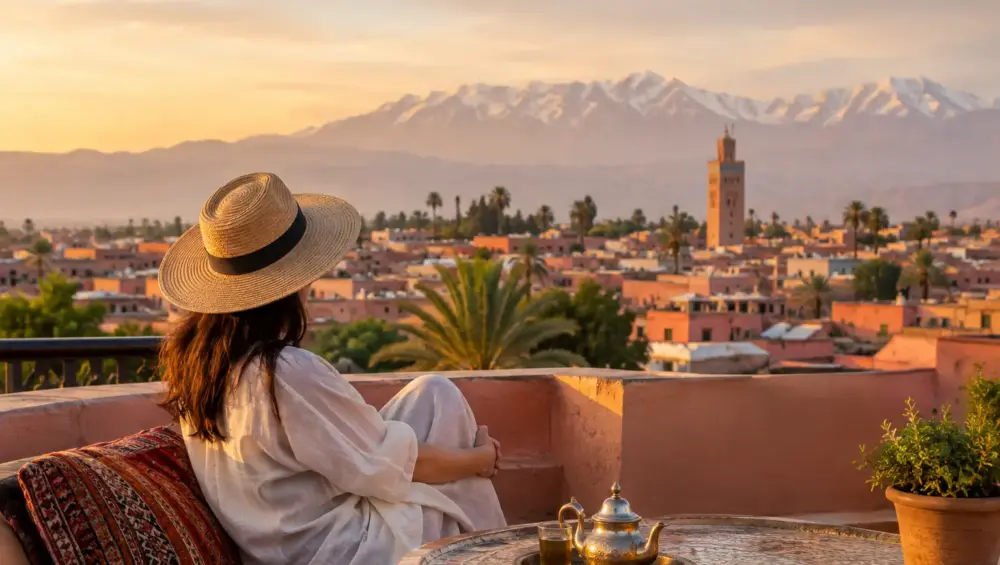
The Morocco I remember most clearly is rarely the Morocco ticked off before lunch. It is the second cup of mint tea on a riad roof in Fes, when the call to prayer has faded into birdsong. It is a roadside stop in the Atlas where an unexpected view earns twenty quiet minutes. It is the moment after sunset in the desert, when nobody feels the need to check the time.
That is the appeal of slow travel Morocco. It is not about seeing nothing or spending every day beside a pool. It is about giving the country enough room to reveal itself, rather than treating it as a sequence of pins on a map. Morocco rewards curiosity, but it also asks for patience: its medinas are layered, its distances can be deceptive, and its best moments are often unplanned.
When I design a private journey, I encourage travellers to decide what they want to feel at the end of the holiday. If the answer is rested, connected and full of vivid memories rather than mildly proud of a long checklist, a slower rhythm is usually the right place to begin.
What slow travel Morocco actually means
Slow travel is often mistaken for staying in one place for two weeks. That can be wonderful, particularly for people who want a deep relationship with Marrakech, Essaouira or the High Atlas. But it can also mean choosing four meaningful bases instead of seven, taking two nights where one would have been technically possible, and not driving five hours simply to photograph a famous gateway.
Morocco has an unusually varied landscape for its size. A journey can move from the Atlantic coast to imperial cities, mountain valleys and Saharan dunes. The temptation is understandable: people want to see it all. Yet each transition has a cost. Changing accommodation means packing, checking out, meeting a driver, travelling, arriving, checking in and finding your bearings. Do that every day and even beautiful places begin to blur.
A slow itinerary protects time for the details. In Marrakech, this could mean a guided walk through the medina one morning, then an unstructured afternoon to return to the craft shops, galleries or cafés that caught your eye. In Fes, it might mean separating the old city from a visit to the pottery workshops and the surrounding viewpoints, rather than forcing both into a single breathless day.
Choose fewer bases, not fewer experiences
The most effective change I make to an over-ambitious Morocco route is nearly always the same: I remove a hotel change. That one decision can improve the whole journey.
For a first visit of around ten days, Marrakech, the Atlas Mountains, the desert region and Fes may sound achievable. They are, but only if travellers accept several long travel days. For some people, especially energetic friends on a once-in-a-lifetime trip, that trade-off is perfectly reasonable. For couples wanting a relaxed holiday, families with younger children, or anyone who enjoys lingering over breakfast, it may not be.
A better slow-paced route might pair Marrakech with the High Atlas and Essaouira. It offers city life, mountain air and the coast without making the windscreen the main attraction. Another option is to focus on Fes, Chefchaouen and a quieter stretch of northern Morocco. The desert is extraordinary, but it is not a compulsory box to tick if reaching it means sacrificing the kind of pace you actually enjoy.
This is one of the most useful questions I ask when planning: what are you happy to miss? A good itinerary is not one that includes everything. It is one where the chosen places have time to matter.
Give Morocco’s distances the respect they deserve
On a map, Morocco can look manageable. In reality, a three-hour drive often becomes four or five once you include comfort stops, lunch, photos and the natural pauses that make a private journey worthwhile. Mountain roads are scenic but slower. Medina accommodation may involve a short walk from the vehicle. And after a long flight, a packed first day is rarely anybody’s favourite memory.
I recommend treating transfer days as part of the experience, not empty space between experiences. The route from Marrakech towards the kasbahs and desert can include mountain passes, fortified villages, date palms and changing colours in the rock. With a private driver, you can stop when the light is right or when a small local lunch spot looks inviting. Still, scenic does not mean effortless. Build in a lighter evening after a substantial drive.
The same applies to the desert. I would rarely suggest travelling a long distance to the dunes, sleeping one night, and leaving immediately the next morning. Two nights in the desert area give you a far better chance to arrive calmly, enjoy the changing light, spend time in the dunes and leave without feeling as though the camel ride was merely a transfer between cars.
Let each place set the pace
Different Moroccan destinations ask for different rhythms. Marrakech is stimulating, colourful and occasionally intense. A slow approach there is not necessarily about doing less; it is about alternating activity with breathing space. Plan a food-focused evening, a private guide for the medina, perhaps a hammam or a garden visit, then leave a morning deliberately open. You may use it for shopping, or you may decide your riad courtyard is exactly where you want to be.
The High Atlas encourages another kind of slowing down. A village walk with a local guide becomes much richer when there is no need to race back to the city by mid-afternoon. Stay long enough to notice the shift in temperature after sunset, hear the stream below the terrace, and eat a meal that is not squeezed between departure times.
Essaouira suits travellers who need a soft landing after busier days. Its compact medina, sea air and working harbour make it easy to wander without an agenda. It is also a sensible place to add an extra night if the rest of the journey has involved long distances. Not every day needs a headline experience, habibi.
Fes is different again. It rewards guidance at first, because its old city can be wonderfully disorientating. But it also deserves independent time afterwards. Once you understand the neighbourhoods, you can return to a bakery, a textile shop or a quiet corner that would be impossible to find in a rushed half-day visit.
Make room for the unbookable moments
A carefully planned trip should not feel over-programmed. This is particularly true in Morocco, where a spontaneous conversation, a market detour or a recommendation from your host can become the story you tell first when you get home.
I generally prefer one anchor activity per day, not three. That might be a licensed guide in the morning, a cooking experience in the afternoon, or a mountain walk before lunch. The remaining hours are not wasted. They allow for a proper meal, an unhurried browse through the souk, a rest during the warmer part of the day, or simply enough time to get pleasantly lost and then found again.
There is a practical benefit too. Morocco is not a place where every day runs to military precision. Weather, traffic, a festival atmosphere, a late lunch or a road pause can alter timings. A little slack in the plan makes these normal travel realities feel like part of the adventure rather than a problem.
Stay where the atmosphere supports the journey
Accommodation is not just where you sleep on a slow journey. It shapes the pace. A characterful riad with a peaceful courtyard can make a city stay feel restorative. A mountain lodge with views may be worth an extra night precisely because there is little pressure to go anywhere. In the desert, the difference between a rushed overnight camp and a well-timed stay can be the difference between a novelty and a genuine sense of stillness.
That does not mean every stay must be remote or extravagant. Sometimes the right choice is a well-located riad so you can walk back for a break between exploring. Sometimes it is a comfortable property outside a busy centre, where parking and access make arrival easier. The best choice depends on your priorities: atmosphere, convenience, privacy, accessibility or a little of each.
This is why I plan accommodation and route together rather than treating hotels as separate bookings. A beautiful place in the wrong location can quietly steal hours from the holiday.
Slow travel needs a little structure
There is a romantic idea that slow travel means avoiding plans altogether. I do not agree, especially in Morocco. A good private driver, well-timed transfers, selected accommodation and the right local guides create the freedom to slow down. They remove the logistical noise so you can be present.
The goal is not to fill every minute. It is to know that the important pieces work, while leaving room for Morocco to surprise you. At Morocco Genie, that is often where the real tailoring happens: not by adding more experiences, but by protecting the time to enjoy the ones that suit you.
If you are tempted to add one more city, one more night in the dunes or one more mountain pass, pause before you do. Your wish may be to see Morocco. But the better wish is to remember how it felt to be there.