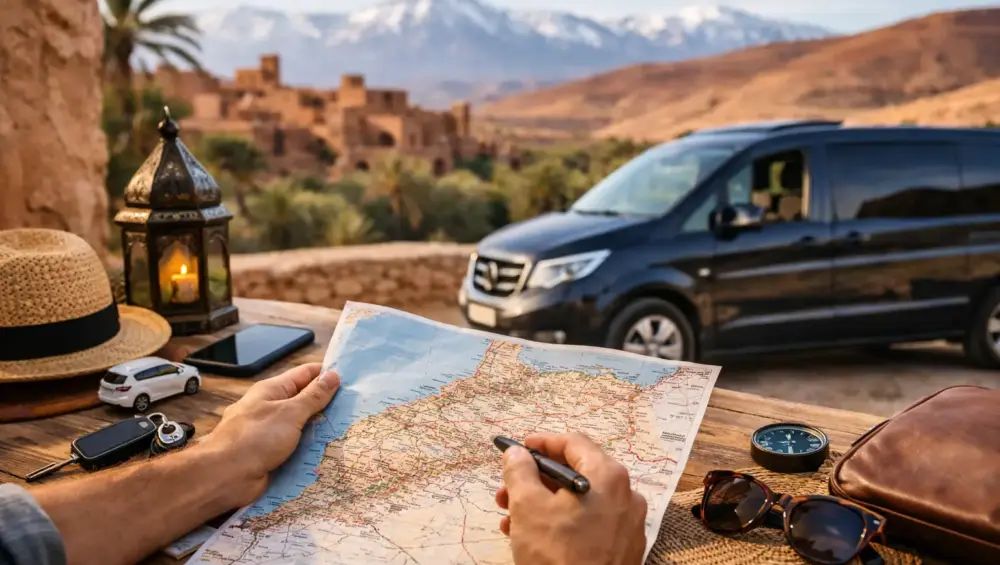
You can have the loveliest riad in Marrakech and a beautiful desert camp booked, then still begin the holiday standing outside the airport wondering which driver is yours. Knowing how to arrange Morocco transfers is less about finding the cheapest car and more about joining the right places together at a sensible pace.
I plan private Morocco journeys every week, and transfers are where an itinerary either feels relaxed or becomes a series of avoidable little frictions. The good news is that Morocco is wonderfully suited to road travel. The better news is that a few decisions made before you arrive can make a very big difference.
Start with the route, not the airport pickup
Most travellers first think about the airport transfer. It matters, particularly after a late arrival in Marrakech or Casablanca, but it is only one piece of the picture. I prefer to map every movement first: where you land, where you sleep each night, how long you genuinely want to spend in the car, and where you will finish.
For example, Marrakech to the High Atlas can be a short and scenic drive. Marrakech to the Sahara is not a quick excursion, whatever an enthusiastic itinerary might suggest. Reaching Merzouga usually involves a long day on the road, often broken with a night around Skoura, the Dades Valley or Ouarzazate. This is where a private transfer becomes more than transport. It shapes the rhythm of the holiday.
A route also reveals when a transfer is unnecessary. If you are spending three full days in Marrakech, you do not need a driver waiting outside the riad each morning. The medina is best explored on foot, and a licensed guide is often more useful there. Save the private vehicle for journeys between cities, the mountains, the coast and the desert.
Build in Morocco time, not map-app time
Driving times shown online can be optimistic. Roads are generally good on the main routes, but villages, mountain bends, roadworks, photo stops and a long lunch can all change the day. I usually advise treating transfer times as a framework rather than a promise.
A four-hour drive may become five or six hours once you include a proper stop. That is not poor planning. It is Morocco being worth looking at through the window. The question is whether you want that day to feel like a scenic part of the journey or simply a necessary connection.
Choose the transfer style that suits your holiday
There is no single right answer. A couple travelling from Marrakech to Essaouira may be perfectly happy with a direct private car. A family with children, several cases and a wish to stop at an argan co-operative or coastal viewpoint will need more space and a more flexible plan.
For most tailor-made holidays, I recommend a private driver for the intercity sections. You have room for luggage, the freedom to stop, and someone who understands where vehicles can and cannot reach. This is especially valuable at riads inside historic medinas. Your driver may need to drop you at the nearest accessible gate, where a member of the riad team meets you and helps with bags. That detail sounds small until you are wheeling a suitcase along cobbled lanes in the evening.
Trains are a worthwhile option on certain routes, particularly Casablanca, Rabat, Tangier and Fes. They can be comfortable and avoid a long road day. But they do not remove the need for planning. You still need a transfer to and from each station, and train times may not suit every arrival or departure. I see rail as a useful tool, not a rule.
Domestic flights can also make sense when time is tight, but only if the airport schedules align with the rest of the route. A flight that looks efficient on paper can consume much of a day once check-in, transfers and waiting are included. For a first Morocco holiday, a well-paced road journey often gives you more of the country, not less.
How to arrange Morocco transfers with the right vehicle
When arranging a private vehicle, do not only say how many people are travelling. Mention the number and size of bags, whether anyone has mobility needs, whether you are travelling with young children, and whether you prefer extra room on long journeys.
A standard saloon may work well for two people with light luggage on a short route. For four adults with large suitcases, it may be a cramped start to an otherwise special holiday. A spacious van is often the more comfortable choice for families and groups, even if everyone could technically fit in a smaller car.
The desert adds another consideration. You do not necessarily need a four-wheel-drive vehicle for every route towards Merzouga or Zagora. Main roads reach the usual desert meeting points. However, the final approach to a camp, luggage handling and the camp’s own arrangements need to be clear in advance. Ask who meets you, where you leave the vehicle, and how you reach the camp. A camel ride, a short drive or a walk over sand can each be part of the experience, depending on the location and your preferences.
Agree what the driver’s day includes
A private driver is not automatically a tour guide. Many drivers have excellent local knowledge and are brilliant at suggesting a lunch stop or viewpoint, but guided visits in Fes, Marrakech or Volubilis are best handled by an appropriate licensed local guide. Keeping those roles clear leads to a better experience for everyone.
Before confirming transfers, I would make sure you know the collection time, expected journey length, planned stops, luggage capacity, hotel or riad drop-off point, and how to contact the driver or coordinator. For airport arrivals, share the flight number, not just the landing time. Flights can be early or delayed, while immigration and baggage collection can take longer than expected.
Book the important journeys before you travel
I would not leave airport pickups, desert routes or one-way journeys between major destinations until the last minute. These are the parts of a Morocco holiday where availability, vehicle size and timing matter most. This is particularly true during busy travel periods and when your journey involves an early departure, a remote mountain property or a desert camp.
That said, you do not need to over-engineer every short movement. Taxis are useful for straightforward city journeys outside the medina, and your riad can often help arrange local transport. The difference is between a simple ten-minute ride and a transfer that determines whether you catch a flight, meet a guide or arrive at a remote lodge before dark.
For airport departures, allow more time than you think you need, especially from Marrakech when traffic around the city can be busy. I also suggest confirming your collection time with your accommodation or coordinator the day before. It is a small habit that prevents unnecessary holiday-morning stress.
Plan for the moments cars cannot solve
Morocco is not a destination to experience entirely from a vehicle. In the medinas of Marrakech and Fes, cars stop at the edges. In the Atlas, a short walk may be the best way to reach a village. In the desert, the final part of the journey may be by camel or camp vehicle. These are not logistical failures. They are often the moments people remember most.
The key is to know about them before arrival. If you have reduced mobility, are travelling with very young children, or simply do not fancy carrying luggage through narrow lanes, say so early. There are usually practical ways to adapt the plan, but they work far better when considered alongside your accommodation and route.
When I coordinate a journey through Morocco Genie, I look at transfers as part of the whole design: the flight arrival, the riad location, the mountain roads, the energy level after a desert day and the departure that follows. Your wish is my command, of course, but I will also tell you when a requested route is too rushed to enjoy.
The best transfer plan is rarely the one with the fewest kilometres. It is the one that lets you arrive curious rather than exhausted, with enough time to notice the changing landscape between one Moroccan memory and the next.