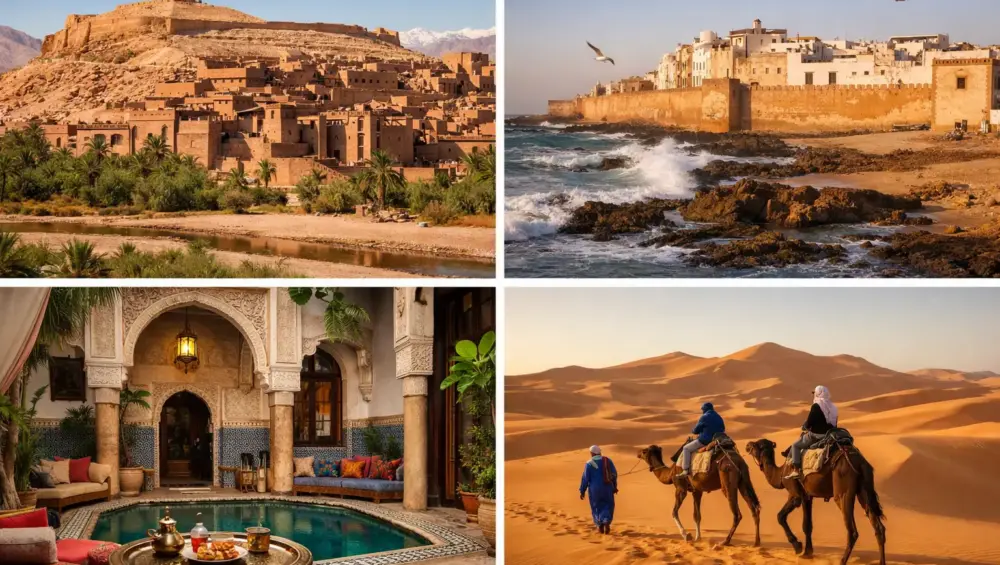
The best places in Morocco are not simply a checklist of famous names. They are places with very different rhythms: a Marrakech rooftop at sunset, the quiet geometry of a Fes alleyway, wind rolling across the dunes near Merzouga, or a long lunch above a mountain valley. The trick is not trying to see everything. Morocco rewards a well-paced route far more than a heroic one.
When I design a private journey, I look first at what a traveller wants to feel. Some people want colour, food and energy. Others need space, scenery and quiet. Most want a sensible mix. Here are the places I return to again and again, plus the honest part: who each one suits and how to fit it into a journey that does not feel like a relay race.
Marrakech: for energy, design and first impressions
Marrakech is usually the right starting point because it makes Morocco immediately tangible. The medina is busy, imperfect, fragrant and occasionally overwhelming. That is precisely why it works. Behind an unassuming doorway, you may find a calm riad courtyard, a beautifully restored palace or a roof terrace where the calls of the city soften into the evening.
I recommend at least three nights for first-time visitors. One day can cover the major sights with a good local guide, but Marrakech is better when you leave room for aimless wandering, a hammam, a slow lunch and a little recovery time by the pool. It is not the place for travellers seeking silence, although the surrounding countryside offers an easy reset.
The Atlas Mountains: for a change of pace
Just beyond Marrakech, the High Atlas changes the mood completely. Villages cling to hillsides, walnut trees shade the valleys, and tea feels less like a drink and more like a proper pause. The Imlil area works well for those who would like gentle walks, mountain views and a glimpse of rural life without committing to a serious trek.
For a more scenic and less hurried stay, I often favour the Ourika Valley or the quieter valleys around Asni, depending on the season and the style of accommodation wanted. The mountains are ideal after Marrakech, especially for couples or families who do not want every day to be a city day. A single night is pleasant; two nights lets the place do its job.
Ait Ben Haddou and Ouarzazate: for the classic southern route
Crossing the Tizi n’Tichka pass from Marrakech towards Ait Ben Haddou is one of those drives that makes people put their phones down. The road climbs through the Atlas, with changing rock colours and wide views, before descending towards the kasbah country of the south.
Ait Ben Haddou is famous, and it can be busy at the most obvious times. Yet an early walk through the earthen lanes or a view from across the river still feels special. Nearby Ouarzazate is practical rather than romantic, but it can be useful as a stop on a longer journey east. This section of Morocco is best treated as part of a route, not a destination to rush through between breakfast and dusk.
The Dades Valley and Todra Gorge: for dramatic landscapes
The road through the Dades Valley is where many travellers realise that Morocco is far more geographically varied than expected. Red cliffs, old kasbahs, palm groves and small settlements appear in quick succession. Further east, the Todra Gorge narrows dramatically between high rock walls.
These are not places to tick off from a car window. An overnight stay in the valley creates time for a relaxed drive, a village walk or simply a terrace dinner with the landscape in front of you. The trade-off is that accommodation here is generally simpler and more characterful than the polished riads of Marrakech. For many people, that is exactly the appeal.
Merzouga and the Sahara: for the desert night that earns its place
A Sahara desert experience near Merzouga remains one of Morocco’s great highlights, provided it is planned with realistic expectations. This is a long way from Marrakech or Fes, so it needs enough time around it. Trying to drive from Marrakech to the dunes in one day, sleep one night, then leave again is a recipe for seeing more tarmac than desert.
Give the journey at least three nights from Marrakech to Fes, or build in extra stops if travelling at a gentler pace. The reward is substantial: camel rides or 4×4 transfers over dunes, a sunset that changes colour by the minute, stars away from city light and the strange calm of an early desert morning.
Not everyone needs to sleep in a tent. Some travellers prefer a lodge at the edge of the dunes and a private sunset excursion, particularly families with young children or anyone wanting more comfort. Your wish is my command, but I will always ask whether the romantic idea of a desert camp suits the reality of your travel style.
Fes: for depth, craftsmanship and a living medina
Fes has a different character from Marrakech. It is less polished, more layered and, in my view, more rewarding with a knowledgeable guide. Its old medina is a working world of workshops, bakeries, schools, tiny neighbourhood mosques and merchants carrying goods through lanes too narrow for cars.
This is a city for travellers interested in craft, history and everyday life. A good guide helps turn apparent confusion into a story: why particular streets developed, how traditional crafts continue and where to pause for an excellent local meal. Two nights is the minimum. Three gives you time to see the medina without trying to absorb it all at once.
Meknes, Volubilis and Moulay Idriss: for a quieter historical detour
These three places combine naturally, usually between Fes and Chefchaouen. Meknes has grand gates, broad avenues and a more relaxed feel than Fes. The nearby Roman ruins at Volubilis are among the most striking historical sites in the country, especially when visited in the softer morning or late-afternoon light.
Moulay Idriss, set across two hills, is small but visually memorable. It is not somewhere I would send everyone for a long stay, but it adds texture to a northern route. If history matters to you, this detour is worthwhile. If your priority is coast, desert and cities, it may be one place too many.
Chefchaouen: for slow mornings and mountain air
Chefchaouen’s blue-painted streets photograph beautifully, but the better reason to visit is its atmosphere. The town sits beneath the Rif Mountains and invites a slower pace: a morning coffee, a stroll up quiet stairways, perhaps a short walk into the surrounding hills.
It is a lovely two-night stop after Fes, though I would not place it at the centre of a short Morocco trip. It takes time to reach, and the journey onward can be lengthy. For travellers with eight or nine nights, it is often a good fit. With five or six nights, I would usually choose between Chefchaouen and the Sahara rather than squeezing in both.
Tangier, Asilah and the northern coast: for a different Morocco
Tangier has a coastal, international energy shaped by its position at the meeting point of the Atlantic and Mediterranean. Its old town is compact, its cafés are excellent for watching the world go by, and it works particularly well as an arrival or departure point for a northern itinerary.
Nearby Asilah is smaller, whitewashed and more restful, with painted walls and an Atlantic breeze. It is appealing for travellers who enjoy art, seafood and unstructured time. Neither place delivers the intensity of Marrakech, but that is not a weakness. They show another side of the country.
Essaouira: for sea air, seafood and breathing room
If Marrakech is a drumbeat, Essaouira is the exhale afterwards. Its medina is manageable, its ramparts face the Atlantic and its food scene is refreshingly straightforward: grilled fish, fresh bread, olives and long lunches. The wind can be strong, particularly outside the warmer months, so it is not always a classic beach holiday destination.
Still, Essaouira is one of the best places in Morocco for a final two or three nights. It suits surfers, food lovers, couples and families who need a softer landing after the cities. I particularly like it for travellers who say they want Morocco’s character but do not want to spend every day negotiating busy medina streets.
Agafay: for a short desert-style escape near Marrakech
Agafay is not the Sahara, and I never pretend otherwise. It is a rocky, open landscape outside Marrakech, not a sea of golden dunes. But for travellers with limited time, it offers striking sunsets, open skies and desert-style accommodation without the long drive east.
Choose Agafay for convenience, a celebratory night or an easy pairing with Marrakech. Choose Merzouga when the desert itself is a central reason for visiting Morocco. Knowing that distinction before booking avoids one of the most common disappointments I see.
How I would choose between them
For a first trip of around seven nights, Marrakech, the Atlas, Ait Ben Haddou and Essaouira make a balanced route with manageable driving. With ten to twelve nights, adding the Dades Valley, Merzouga and Fes becomes realistic. For a northern-focused journey, combine Fes, Volubilis, Chefchaouen, Tangier and perhaps Asilah, then leave the desert for another visit.
The best route is rarely the longest one. Leave a little room for a mint tea that runs long, a market you did not expect to enjoy, or a viewpoint that makes everyone ask the driver for five more minutes. Habibi, that is often where Morocco becomes your Morocco.