A Sahara night can be the moment your Morocco journey becomes something you talk about for years. It can also become a very long day in a car, followed by a camp that feels less peaceful than the photographs suggested. Good Sahara overnight planning is not about adding a desert camp to an itinerary because it seems obligatory. It is about deciding whether the desert fits your pace, then giving it enough time to work its quiet magic.
I have found that travellers enjoy the Sahara most when they stop treating it as a quick tick-box between Marrakech and Fes. The dunes reward a little patience. Arrive with time to settle in, watch the light change, eat slowly, and wake before the sun has properly decided what it is doing. That is where the real desert experience begins.
Start Sahara overnight planning with the route
The first question I ask is not, “Which camp do you want?” It is, “Where will you be the day before, and where do you need to be afterwards?” Morocco is a larger country than it can appear on a map, and reaching the dunes involves proper driving distances.
For many first-time visitors, Erg Chebbi near Merzouga is the most practical choice. The dunes are dramatic, accessible by road, and easy to combine with the Todra Gorge, Skoura, Ouarzazate and either Marrakech or Fes. They are also the classic tall, golden dunes many people picture when they imagine the Sahara.
Erg Chigaga, reached from the M’Hamid area, feels wilder and more remote. It suits travellers who have more days available and genuinely want distance from towns and busier desert entry points. The final approach is usually by four-wheel drive across rougher terrain, which is part of its appeal. It is not the right choice for every family, every back, or every itinerary.
There is no universal winner. Erg Chebbi generally makes more sense if you have limited time or want a smoother route. Erg Chigaga can be extraordinary when the desert itself is a central priority rather than one stop among many.
The mistake: trying to do it in one huge day
A common route on paper is Marrakech to Merzouga in a single day. It is possible, but possible and enjoyable are not the same thing. Even with a private driver, it means many hours on the road, mountain bends, comfort stops, lunch, viewpoints and changing landscapes. Add a sunset camel ride or transfer to camp, and the day can feel hurried before you have even reached the sand.
I normally prefer breaking the journey with an overnight around Skoura, the Dades Valley or Tinghir, depending on the wider route. This lets you see the High Atlas and southern valleys without turning the journey into an endurance test. Travellers then reach the desert with some energy left for it.
The same principle applies when leaving. If your next stop is Fes, the drive is substantial but can be rewarding, passing the Ziz Valley, Midelt and cedar forest country. If you are returning towards Marrakech, consider another night in the south rather than retracing everything at speed. Your wish is my command, habibi, but I will always tell you when the wish needs one more night.
Choose the camp experience, not just the tent
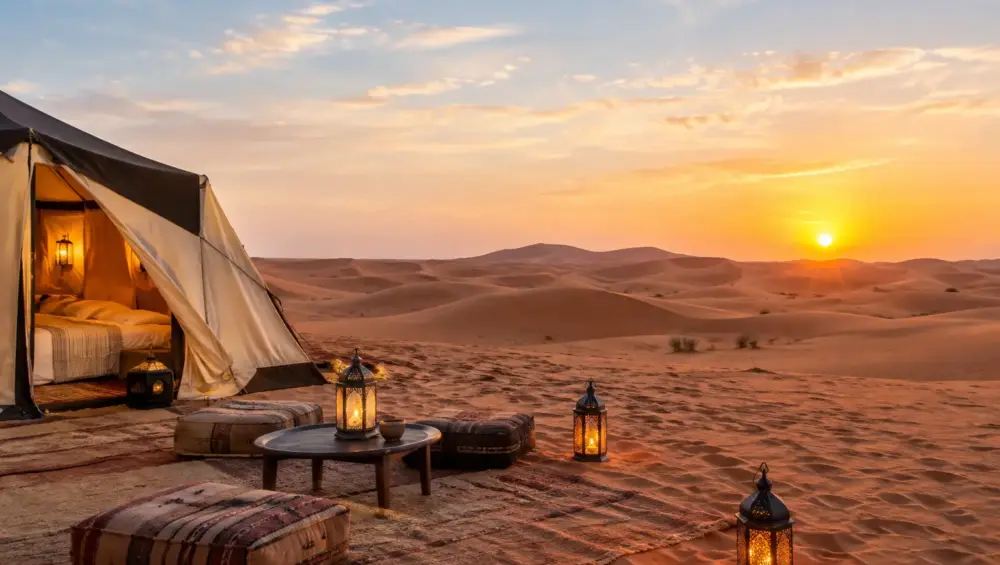
“Luxury camp” covers a surprisingly broad range in Morocco. One camp may offer spacious private tents, proper beds, en-suite bathrooms and thoughtful food. Another may use the same label while providing a far simpler set-up. Neither is automatically wrong, but expectations need to match reality.
For a one-night stay, I look at the whole experience: how far the camp is from the dune edge, whether the tents are private, how bathrooms are arranged, what heating is available in winter, how dinner is handled, and whether the camp’s atmosphere suits the traveller. A honeymoon couple might value privacy and a quiet dinner. A family may prefer easy access, generous tent space and a camp that can accommodate children comfortably.
Ask about electricity too, but do not make it the centre of the decision. Some camps run generators or solar power for limited periods. Mobile signal can be patchy. Frankly, that is often a benefit. One night without constant notifications is not a hardship when the sky is doing its best work overhead.
Camel ride, four-wheel drive, or both?
A camel ride is iconic, and at sunrise or late afternoon it can be beautiful. It is not compulsory. Some travellers love the slow rhythm and the feeling of approaching camp through the dunes. Others find it uncomfortable, especially after a long driving day, or simply prefer the ease of a four-wheel-drive transfer.
There is no prize for choosing the more traditional option. A short camel experience combined with a vehicle transfer is often a sensible middle ground. For young children, older travellers or anyone with mobility concerns, I would discuss the practicalities honestly before committing. The Sahara should feel memorable, not like an aching negotiation with a saddle.
Give the desert the right amount of time
One night is enough to experience the essentials: arrival in the afternoon, time in the dunes, dinner, stars, sleep and sunrise. For travellers on a 7 to 10-night Morocco journey, that can be an excellent balance.
Two nights changes the pace completely. You can have a slower morning, explore nearby villages or desert landscapes, try sandboarding if conditions suit, take a longer walk, or simply sit with a book while the heat settles. This option is particularly good for couples who dislike constant packing and for anyone travelling a long way to reach the Sahara.
It depends on your wider holiday. If Fes, Marrakech, the Atlas Mountains and the coast all matter deeply to you, a single well-planned desert night may be perfect. If the Sahara is your main reason for coming to Morocco, two nights prevents it becoming a beautiful but fleeting interruption.
Plan around weather, not assumptions
The desert is not permanently hot. Summer days can be intensely hot, making midday activity unpleasant, while winter nights can be genuinely cold. From roughly June through August, I would plan conservatively: early starts, shaded stops, air-conditioned transport and a camp with credible cooling arrangements where possible. The heat does not cancel the experience, but it changes how you should approach it.
Spring and autumn often offer the most comfortable overall conditions, though popular dates can require earlier planning. Winter brings lovely clear light and crisp days, but warm layers are essential after sunset. Pack a jumper or fleece, a light jacket, closed shoes for cool evenings, sunglasses, lip balm and a scarf or buff for windblown sand. Sandals are fine around camp, but they are not always ideal for walking over dunes.
Weather can shift quickly. Wind may reduce visibility and make a sunset walk less appealing. A little flexibility helps. The desert does not perform on a timetable, and that is part of why it feels real.
Leave room for the moments nobody can schedule
The best Sahara stays are usually not built around a packed activity list. They leave space after arrival. Walk until the camp lights look small behind you. Sit on a dune rather than chasing the highest one. Wake up for sunrise even if you are not naturally a morning person. The early silence is worth it.
I also encourage travellers to keep dinner expectations grounded. A camp meal is usually a warm, generous Moroccan dinner in a remote setting, not an urban fine-dining event. What makes it special is the setting: lamps, sand underfoot, perhaps music by the fire, and a sky full of stars when the conditions are clear.
When I design a private Morocco journey through Morocco Genie, the desert planning is never separated from the route around it. The camp, driver timings, accommodation before and after, and the kind of transfer all need to make sense together. A beautiful camp cannot rescue an exhausted itinerary.
Plan the Sahara as a pause rather than a race. If you can arrive before the best light fades and leave after sunrise has had its moment, you will understand why so many travellers consider one quiet night among the dunes the heart of their Morocco holiday.