A riad can be the place you remember most vividly from Morocco: the quiet courtyard after the medina, the scent of orange blossom at breakfast, the rooftop call to prayer drifting across the old city. But knowing how to choose a Morocco riad is more than picking the prettiest tiled bathroom online. The wrong one can mean a long walk with luggage, a room facing a noisy courtyard, or a location that quietly makes every day harder.
I plan private journeys across Morocco, and I have learned that a riad works best when it fits the rhythm of the trip. A beautiful stay matters, of course, but so do sleep, access, service and what you want to do once you step outside the door.
First, understand what a riad really is
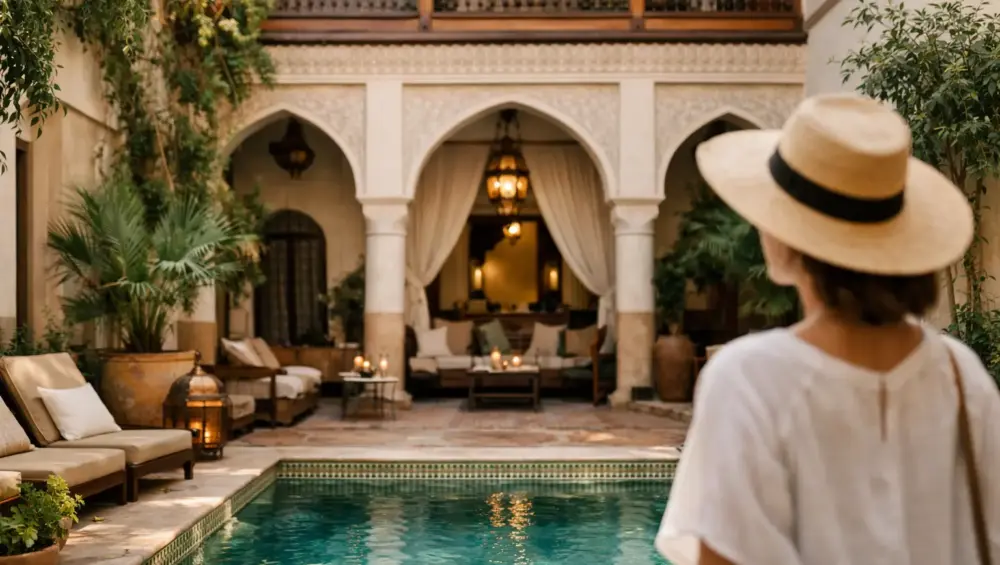
Traditionally, a riad is a house built around an interior courtyard, often with a fountain, garden or small plunge pool at its centre. The design turns inward: from the busy medina lane outside, you may enter through an unremarkable door and find a calm, intricately detailed space within.
Today, the word is used quite broadly. Some are carefully restored historic homes with only a handful of rooms. Others are polished boutique properties that borrow the riad style. Both can be lovely, but do not assume every riad has the same character, facilities or level of service.
A small, owner-run riad may feel intimate and personal, with staff who know exactly how you take your mint tea by day two. It may also have limited reception hours, steep stairs and no bar or restaurant beyond breakfast. A larger riad can offer more facilities and easier logistics, but may feel less like staying in a private Moroccan home. Neither is automatically better. It depends on whether you value atmosphere, practical convenience or a bit of both.
Choose the location before you fall for the photographs
The biggest decision is usually not the room. It is the neighbourhood.
In Marrakech, staying inside the medina puts you close to the souks, historic sights and evening energy. It is ideal if you want to walk out into the old city and feel part of it. Yet the medina is not one single experience. A riad near Jemaa el-Fna can be wonderfully central but noisier and busier. One deeper in the northern medina may feel calmer and more residential, though you will walk further to certain restaurants and landmarks.
In Fes, location matters even more because the medina is larger, hillier and easier to lose yourself in. A riad near a practical drop-off point can make a real difference, especially for families, guests with limited mobility, or anyone arriving after a long journey. The romantic idea of navigating labyrinthine lanes with suitcases loses its charm very quickly, habibi.
For a short city stay, I generally favour a riad within the medina that is still accessible from a nearby gate or taxi point. You get the character without turning each arrival and departure into an expedition. If you prefer more space, reliable vehicle access, a larger pool or a quieter evening, a boutique hotel outside the old city may suit you better than a riad. This is not a failure to “do Morocco properly”. It is simply good trip design.
Ask how far the walk really is
Descriptions such as “a short walk from the taxi” are subjective. Ask whether luggage is carried from the vehicle, whether the route includes uneven lanes or steps, and how long it takes on foot. In the medinas, 300 metres can feel very different from 300 metres on a level pavement in London.
This also matters when arranging a private driver. A good plan includes a clear meeting point, someone expecting you, and the confidence that you will not be left searching for an anonymous door in a maze of alleyways.
Let your sleep needs guide the room choice
Riads are historic buildings, and their charm comes with compromises. Rooms can vary dramatically in size, light and noise, even within the same property. The most photographed room may be the darkest, while the least dramatic-looking room may have the best layout and most peaceful night’s sleep.
If you are light sleepers, ask for a room away from the courtyard, kitchen and rooftop stairwell where possible. Courtyards carry sound. Early breakfast preparations, guests returning late and conversations near the fountain can travel upwards. Street-facing rooms can bring a different soundtrack: scooters, deliveries, neighbourhood life and, depending on the location, a little late-night bustle.
Ground-floor rooms may be convenient but can feel less private. Upper rooms often have more daylight and better views, but come with stairs. In older riads, lifts are unusual. For couples on a romantic break, a terrace or a room with a sitting area may be worth prioritising over the largest bathroom. For families, the more useful question is often whether rooms connect, sit close together, or can accommodate proper beds rather than a makeshift sofa bed.
Air conditioning and heating deserve a direct question too. Marrakech and Fes can have hot days but surprisingly cool evenings, particularly outside summer. The Atlas Mountains and desert areas are another matter entirely. Decorative blankets are not the same as dependable heating.
Read for clues, not just star ratings
Reviews are useful when you read them like a detective rather than a judge. One negative comment about a small shower may not matter to you. Several comments about unreliable hot water, difficult access, poor cleanliness or persistent noise deserve attention.
I pay particular attention to recent reviews that mention:
- how staff handle problems rather than whether everything was perfect
- breakfast quality and timing for early departures
- room temperature, water pressure and Wi-Fi in the actual bedrooms
- whether the property feels cared for or merely looks good in photographs
- the ease of finding it and transferring luggage from the nearest vehicle point
A riad with a handful of honest limitations and consistently warm, practical feedback is often a better choice than one with glossy images and vague praise. Morocco is wonderfully human, and small independent properties can have occasional hiccups. What matters is whether someone takes ownership and sorts things out.
Match the riad to the purpose of each stop
One mistake I see is trying to use the same accommodation criteria everywhere. A riad in Marrakech may be a stylish base for three busy days of exploring. In Fes, you may want a more spacious property with a view over the medina, because the city can be intense and a restful retreat becomes valuable. In Essaouira, you might prefer a relaxed coastal house near the ramparts or beach, with salty air rather than a grand interior courtyard.
If your itinerary includes the Sahara, the riad before or after the desert deserves extra thought. After a long drive or a desert camp night, a comfortable shower, easy access and a quiet room can be more satisfying than maximal decoration. There is a time for hand-painted ceilings and a time for a properly functioning shower. A well-designed Morocco journey makes room for both.
For longer stays, consider where you will spend the middle of the day. Some riads have inviting lounges, rooftops and pools that make a break from the heat enjoyable. Others are perfect for sleeping and breakfast, but not somewhere you will linger. If you plan to be out from morning until dinner, that may be absolutely fine.
Service is often the difference between good and exceptional
The best riads do not need to be formal to be attentive. They make arrivals easy, offer useful local advice, prepare breakfast around an early guide departure, and understand the small details that make you feel looked after rather than processed.
That said, be clear about what you expect. Not every riad has a full restaurant, a 24-hour desk, a heated pool, room service or an in-house spa. If these matter to you, check rather than assume. Likewise, a rooftop in a historic medina may be beautiful but not suitable for children without close supervision.
I also look at whether the team understands the wider journey. Can they coordinate with your driver? Do they know when you are arriving? Can breakfast be arranged before a sunrise balloon flight or an early road departure? Accommodation should support the itinerary, not create another thing for you to manage.
A beautiful riad should make Morocco easier to enjoy
When I help travellers choose riads, I do not begin with a list of fashionable names. I begin with questions: Are you celebrating something? Do you need quiet? Are you travelling with children? Do you want to disappear into the medina or retreat from it at the end of the day? These answers shape the right choice far better than a filter for five stars.
A great riad feels personal without becoming impractical. It gives you a sense of Morocco’s craft, hospitality and history, then quietly lets the rest of the journey flow. Choose the one that suits the way you actually travel, not the one you think you ought to choose. Your wish is my command, but a good night’s sleep is a very sensible wish.