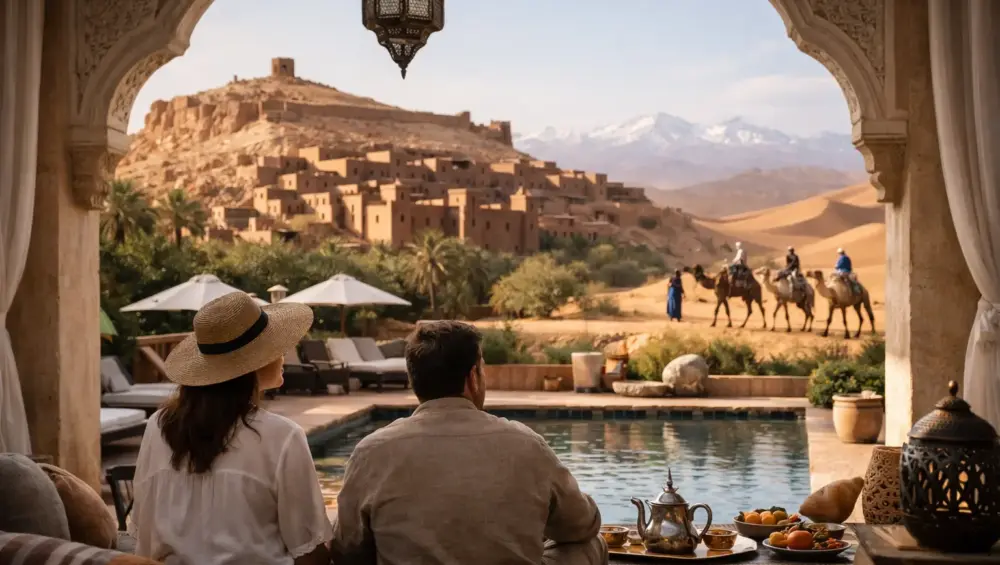
At 5.30 in the morning, the dunes outside Merzouga are quiet enough to hear the sand move. This is the moment many people imagine when they search for luxury travel Morocco. Yet the real luxury is not the camp tent alone, nor the champagne some travellers expect to find in the desert. It is arriving there without having spent the previous day rushing through three towns, wondering where your luggage is, or negotiating every next step.
I have found that Morocco rewards travellers who define luxury less as display and more as freedom: freedom to linger over a long lunch, take the scenic road when the light is right, choose a riad with character rather than a generic five-star address, and have someone reliable handling the moving parts behind the scenes.
Luxury travel in Morocco is about control of time
Morocco is not a destination where the most expensive itinerary automatically becomes the best one. It is a country of striking contrasts, but distances are real, medinas are intricate, and a beautiful plan can become exhausting if every day is built around ticking off highlights.
A private driver changes the rhythm considerably. You can leave Marrakech after breakfast rather than at dawn, stop in the High Atlas when a view catches your eye, and arrive at your kasbah-style hotel near Skoura with enough afternoon left to enjoy it. That is far more valuable than cramming Marrakech, Ait Ben Haddou and the Sahara into an unrealistic two-day sprint.
The same principle applies in the cities. Fes is fascinating, but its old medina is not best experienced by wandering with a map and a deadline. A good licensed local guide can make the difference between simply passing workshops and understanding why a particular neighbourhood became known for metalwork, leather or weaving. You still need time to get lost a little – that is part of Fes – but you should be able to do so confidently.
For me, a well-designed private journey has breathing space built in. Three nights in Marrakech can be more luxurious than two, particularly if you want a cooking experience, a hammam, a garden lunch and an unhurried morning in the souks. One night in the desert can be memorable, but two nights may be the better choice for travellers who genuinely want to settle into the landscape rather than treat it as a photograph between long drives.
What to spend on, and what not to
There is no single version of a luxury Moroccan holiday. A couple seeking privacy may prioritise an intimate riad, a beautiful desert camp and excellent restaurants. A family may care more about connecting rooms, a patient driver, a pool, and sensible driving days. Friends travelling together may prefer a privately staffed villa for part of the trip.
I encourage travellers to spend where it changes the experience. Accommodation is one obvious area, but not always in the way people assume. In Morocco, a small riad with ten rooms, thoughtful service and a roof terrace overlooking the medina can feel more special than an international hotel. In the Atlas Mountains, the location and view may matter more than elaborate décor.
Private transport is another worthwhile investment, especially on multi-stop routes. It is not merely a car from A to B. The right driver understands the road conditions, knows when a stop is worthwhile, and appreciates that a traveller may want quiet after a busy day in Marrakech. For longer routes, comfort, vehicle size and luggage space deserve proper attention. A glamorous-looking itinerary quickly loses its shine if four adults are folded into a vehicle with bags at their feet.
What I would not prioritise blindly is upgrading every night to the most extravagant room category. Sometimes it is worth it: perhaps for a special anniversary night in Marrakech or a peaceful stay overlooking the Atlantic near Essaouira. But Morocco’s magic often happens outside the room – over mint tea in a family-run garden, in a tiny chef-led restaurant, or on a walk through palms and mud-brick villages in the Skoura oasis.
The desert deserves particular care
The Sahara is where vague ideas of luxury can disappoint. Not every desert camp offers the same level of privacy, comfort or atmosphere, and the best option depends on the season, the size of your party and what you actually want from the experience.
Some travellers want a proper dune setting, a camel ride at sunset and a night of music around the fire. Others would rather arrive by four-wheel drive, skip the camel, and sleep in a quieter camp with fewer tents. Neither is more authentic. The question is whether the arrangement suits you.
Winter nights can be cold, even after a warm afternoon. Summer heat is serious. A responsible plan considers timing, tent comfort, meals, transfers and how much desert driving feels enjoyable rather than performative. Luxury here is good planning with no unpleasant surprises.
The most memorable details are often local
Morocco has iconic sights for a reason: Marrakech’s energy, the blue lanes of Chefchaouen, the tanneries of Fes, and the first sight of Erg Chebbi’s dunes all stay with people. But a private trip becomes personal through the details between those headlines.
That might mean a market visit with a food-focused guide before a private cooking session, rather than a standard demonstration. It could be meeting an artisan in a less-visited town when there is genuine interest in pottery or textiles. For walkers, it may be a gentle route in the foothills of the Atlas rather than an ambitious trek chosen simply because it sounds impressive.
These experiences need to fit naturally into the route. Sending someone on a three-hour detour for a fleeting activity is not thoughtful design. Nor is filling every spare hour because an itinerary looks more luxurious when it is full. Morocco is one of those places where an empty hour on a riad terrace, watching swallows circle above the rooftops, can be exactly the right use of time.
Food is another area where personal planning pays off. Some travellers want refined contemporary Moroccan cooking; others want the best grilled fish by the sea in Essaouira, or a simple tagine in a mountain village. I ask about dietary needs early, but also about preferences. There is little value in reserving a celebrated tasting menu for someone who would be happier with sardines, salad and a cold drink after a day by the coast.
A polished journey should still feel like Morocco
There is a fine line between comfort and insulation. If every interaction is filtered, every meal is familiar and every stop looks the same, you may have travelled far without really meeting Morocco.
The best private journeys give you a soft landing, not a bubble. You have a trusted driver when roads and distances demand it, expert guidance when context matters, and carefully chosen accommodation where you can rest properly. At the same time, you can bargain for a basket in the souk, try unfamiliar pastries from a neighbourhood bakery, hear the call of a street seller below your riad, and follow your curiosity.
This is why I prefer to discuss travel style before discussing hotels. Do you enjoy being in the centre of things, even if that means a little street noise? Would you rather stay outside the medina with easier vehicle access? Are you celebrating something, travelling with teenagers, or hoping for slow mornings and long dinners? Honest answers produce a far better route than a list of supposedly essential places.
At Morocco Genie, that conversation is where I begin. Your wish is my command, Habibi – but I will also tell you when a wish needs an extra night, a different route or a gentler pace to work properly.
Start with the feeling you want to take home
Before choosing properties or pinning destinations on a map, think about the moments you want from Morocco. Perhaps it is breakfast on a roof terrace in Marrakech, cool mountain air after city heat, a quiet evening under desert stars, or fresh seafood beside the Atlantic. Those answers reveal more than a hotel star rating ever will.
Give Morocco enough time, leave room for surprise, and let comfort support the experience rather than replace it. The country has plenty of splendour. The real art is arranging it so that it feels, unmistakably, like your own journey.