A beach stay in Morocco can mean very different things. One traveller imagines windsurfing and grilled fish in a whitewashed medina; another wants a calm bay where children can paddle; a third wants empty Atlantic sands after days in Marrakech and the desert. When travellers ask me about the best coastal towns Morocco has to offer, I first ask what they want the coast to do for their trip.
Morocco has two very different shorelines. The Atlantic is broad, wild and often breezy, with excellent surf and a wonderfully untamed feel. The Mediterranean is generally calmer, greener and better suited to a classic swim-and-relax finish. Neither is automatically better. The trick is choosing a town that suits your route, season and travelling style rather than adding a beach stop simply because it looks appealing on a map.
How I choose the best coastal towns in Morocco
Distance matters more than many first-time visitors expect. Morocco is not a country where it makes sense to zigzag from Fes to Essaouira, then up to Tangier, unless you have plenty of time. I usually build a coastal stay into a logical route: the north coast after Chefchaouen or Fes, the Atlantic after Marrakech, or the far south for travellers happy to make Dakhla the focus of their journey.
I also look beyond the beach itself. Some towns are places to explore, eat and wander for several days. Others are peaceful bases with little to do beyond slowing down. That can be precisely the point, but it is worth knowing before you arrive.
1. Essaouira for character, food and easy Atlantic time
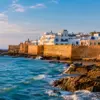
Essaouira is the coastal town I recommend most often, particularly for couples, friends and first-time visitors who want the sea without sacrificing atmosphere. Its compact medina, old ramparts, working fishing harbour and broad beach make it feel alive year-round. You can spend the morning with a local guide in the lanes, have seafood for lunch, then watch kitesurfers from the sand in the afternoon.
The honest caveat is the wind. It is part of Essaouira’s personality and a gift for watersports, but it can make sunbathing less appealing than travellers expect, especially outside the height of summer. For a two- or three-night stop after Marrakech, though, it is one of Morocco’s most satisfying combinations of culture and coast.
2. Asilah for a gentle northern escape
Asilah is small, artistic and easy to love. Its white-and-blue medina sits beside the Atlantic, its walls are painted with changing murals, and the pace is noticeably softer than Tangier. I particularly like it for travellers who enjoy lingering over a coffee, walking at sunset and staying somewhere with a sense of local life.
The town works beautifully as part of a northern route with Tangier and Chefchaouen. It is less suitable if your priority is a resort-style beach holiday, as its charm lies in its streets and atmosphere rather than a long list of activities. In summer, nearby beaches become the main draw; in cooler months, come for the town itself.
3. Tangier for history with a sea view
Tangier is not Morocco’s quietest beach destination, and that is exactly why some travellers enjoy it. It is a port city of steep streets, grand old buildings, lively cafés and a fascinating position where the Mediterranean meets the Atlantic. The views alone can make a stay worthwhile, especially from the kasbah and the headland near Cap Spartel.
I see Tangier as an urban coastal stop rather than a place to spend every day on the sand. It is an excellent beginning or end to a private northern journey, and it pairs naturally with Asilah and Chefchaouen. Give it time to reveal itself. One night often feels rushed; two allows for the medina, the caves, the coastline and unhurried meals.
4. Al Hoceima for clear Mediterranean water
For genuinely beautiful swimming water, Al Hoceima deserves much more attention than it gets. Set among dramatic Rif Mountains, it has small coves and striking shades of blue that surprise travellers who picture Morocco only as desert, medinas and Atlantic surf. The setting is the attraction here.
It is best for those who value scenery and quieter beach time over polished nightlife or a packed sightseeing schedule. Reaching it takes commitment, so I would not force it into a first Morocco itinerary of just a week. But for travellers with a longer northern route, or a particular wish for the Mediterranean, it can be exceptional.
5. M’diq for a relaxed Mediterranean base
Near Tetouan and not far from Tangier, M’diq is a practical choice for families and travellers who want a straightforward beach stay in the north. Its wide bay, promenade and proximity to other northern destinations make it easier to weave into an itinerary than Al Hoceima.
This is not the place I would choose for a deeply historic medina experience. Instead, think of it as a pause between cultural stops, where the days can be structured around swimming, simple seafood lunches and a slower rhythm. In the busier summer period, advance planning matters, as the coast is popular with Moroccan holidaymakers too.
6. Taghazout for surf and a laid-back rhythm
Taghazout, north of Agadir, has long been associated with surfing. You do not need to surf to enjoy it, but it helps if you appreciate a casual, outdoorsy atmosphere and do not need every detail to feel formal. The coastline is rugged, the light is beautiful and the pace encourages you to leave space in the day.
For beginners, conditions and instruction should be matched carefully to the season and your confidence. For non-surfers, I often suggest balancing time here with an excursion inland or a few nights in nearby Agadir if you prefer more choice in restaurants and facilities. Taghazout has a strong personality. It will either be exactly your scene or not quite it.
7. Mirleft for the quieter Atlantic
Mirleft is for people who read the word beach and picture space. South of Agadir, it has cliff-backed coves, long stretches of sand and a distinctly slower pace than the better-known Atlantic towns. It is an appealing option after the bustle of Marrakech, particularly for travellers who are happy with modest local charm rather than lots of polished entertainment.
The Atlantic demands respect here. Conditions can be changeable, and not every beach is ideal for swimming at every moment. I recommend Mirleft more for coastal walks, views, surf and quiet restoration than for guaranteed calm-water bathing. That distinction avoids disappointment.
8. Sidi Ifni for a different kind of Morocco
Sidi Ifni has a faded, slightly eccentric character shaped by its Spanish-era architecture and its position on the southern Atlantic coast. It is not manicured, and that is the appeal. The town feels like an interesting pause on a route towards the Anti-Atlas or the far south, with a market-town energy and dramatic nearby coastline.
Choose Sidi Ifni if you enjoy places with texture and do not need a conventional seaside resort. Legzira’s sandstone arches and cliffs are within reach, though the coastline is best appreciated with flexible expectations because the ocean and tides shape the experience. A private driver is particularly useful in this part of Morocco, where the rewarding viewpoints are spread out.
9. Larache for travellers who prefer the overlooked
Larache rarely appears at the top of glossy lists, but I think that makes it more interesting. On Morocco’s north-west coast, it has a handsome waterfront, an unhurried centre and access to the atmospheric ruins of Lixus. It suits curious travellers who would rather encounter an ordinary Moroccan coastal town than tick off another obvious highlight.
There are fewer boutique options and fewer ready-made activities than in Essaouira or Tangier, so it takes a little more thoughtful planning. Still, as a one- or two-night stop between Rabat, Asilah and Tangier, it adds variety and a quieter perspective on the country.
10. Dakhla for a destination in its own right
Dakhla is not a convenient add-on. It is far south, set on a long peninsula between lagoon and Atlantic, and deserves to be treated as its own journey rather than squeezed into a classic imperial cities route. For kitesurfing, birdlife, wide-open landscapes and a real sense of getting away from it all, it is remarkable.
The trade-off is travel time and a more specialised atmosphere. If your dream holiday includes desert, Fes, Marrakech and Dakhla in one short trip, something will feel hurried. I would rather design Dakhla around its own pace, with enough time to enjoy the lagoon rather than merely say you have been.
The coastal route that usually works best
For most first visits, I favour Marrakech, the Atlas or desert, then Essaouira as a restorative finale. If Morocco’s north is the priority, Tangier, Chefchaouen, Tetouan and either Asilah or M’diq create a much more coherent rhythm. Families seeking gentle swimming may lean towards the Mediterranean; active travellers and those who love a wild horizon often prefer the Atlantic.
The best choice is not necessarily the prettiest photograph. It is the town where you will have enough time to settle in, where the weather suits what you hope to do, and where the journey there does not steal the pleasure from the rest of your holiday. Tell me how you like to travel, habibi, and I can help turn that answer into a coast-to-country Morocco route that feels like yours.