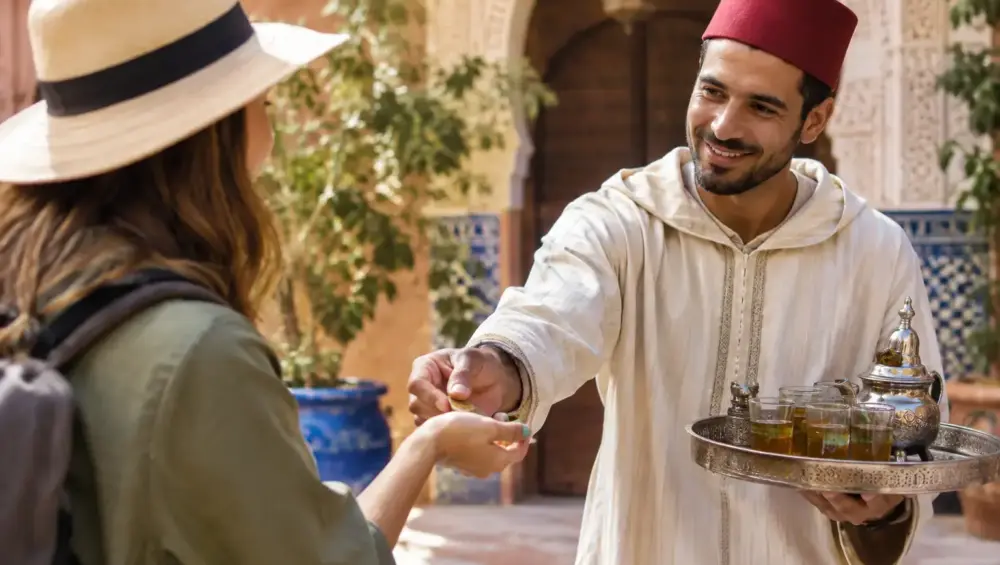
The first time many travellers reach the end of a lovely meal in Marrakech, they have the same quiet question: should I leave something extra, and if so, how much? Morocco tipping etiquette is not a rigid rulebook, but it is part of the everyday rhythm of travel here. A small, thoughtful tip can show genuine appreciation for good service. Equally, nobody should feel pressured into handing out cash at every turn.
I always advise travellers to treat tipping as a thank-you, not a fee. Morocco is a country of warm hospitality and personal service, particularly when you are travelling with a private driver, local guide or staying in a smaller riad. The right approach is simple: carry small notes, tip when service has made a difference, and do not overthink the occasional awkward moment.
Morocco tipping etiquette starts with small cash
The Moroccan dirham is what you will use for nearly all tips. Cards are increasingly accepted in hotels, smart restaurants and shops, but tips are best given in cash. I recommend arriving with, or withdrawing, a useful mix of smaller notes: 20, 50 and 100 dirhams are the most practical. Coins are helpful for small gestures, although they soon become heavy in your pocket.
Do not save all your cash for the final day. In a well-planned journey, there are plenty of people whose helpfulness becomes clear as you go: the porter who carries luggage through a medina alley, the café waiter who finds a table in the shade, or the attendant who keeps a public loo clean. Having small money means you can respond naturally rather than apologetically.
A word on context: service charges sometimes appear on a restaurant or hotel bill, especially in more polished establishments. This does not necessarily mean the individual who looked after you receives it. If the service was particularly attentive, a modest cash tip is still welcome. If it was indifferent, you are not obliged to add more.
Restaurants, cafés and everyday service
For a casual café, rounding up the bill or leaving 5 to 10 dirhams is perfectly reasonable. At a sit-down restaurant, 10 per cent is a useful guide for good service. In a more informal local place, people often leave less, while in a high-end restaurant you may choose to leave a little more if the experience has been excellent.
There is no need to perform complicated maths over a modest lunch. If a waiter has been friendly and attentive, leave what feels proportionate to the bill and setting. A 20-dirham note can be a kind gesture at a simple lunch; it may barely register at an elegant dinner for six. Read the room.
For baggage help at a hotel or riad, around 10 to 20 dirhams per bag is sensible, particularly where somebody has navigated steps, narrow lanes or a maze-like medina entrance. Housekeeping is easy to forget, but a small amount left at the end of your stay is appreciated. I usually suggest 20 to 50 dirhams per night in a riad or hotel, adjusted for the level of service and length of stay.
Public toilets are another small but common moment. Where there is an attendant, 2 to 5 dirhams is usual. Keep a few coins handy and it will never become a drama.
Tipping private drivers and local guides in Morocco
Drivers and guides are where travellers most want clarity, and understandably so. They often spend the most time with you, and the quality of their work shapes the whole journey. A good private driver does far more than steer between cities. They manage timing, recommend sensible stops, help with luggage, make lunch arrangements, and quietly solve problems before they become your problem.
For a private driver accompanying you across Morocco, I generally suggest allowing around 100 to 200 dirhams per day from a couple or small private party for good service. Larger groups can tip more collectively. Consider the actual experience: Was the driving calm and safe? Did the driver adapt to your pace? Did they make a long transfer feel easy rather than exhausting? Those are the details worth rewarding.
For a licensed local guide on a private half-day or full-day visit, 100 to 200 dirhams per group is a fair starting point, with more for an exceptional full-day experience or a larger party. In Fes, Marrakech and Chefchaouen, a good guide can turn a confusing old town into a story you understand. In the Atlas Mountains, they may also pace a walk well and help you engage respectfully with local communities.
I prefer that travellers tip drivers and guides directly at the end, with a warm thank-you. It is clearer and more personal. If you feel someone has gone well beyond what was expected, say so. A few sincere words often matter alongside the cash.
Desert camps, mountain stays and riads
In the Sahara, service is often shared by a small team: camp hosts, cooks, camel handlers, servers and musicians. Rather than trying to tip everyone individually, I usually recommend giving one collective tip to the camp manager and asking for it to be shared amongst the team. For a couple, 100 to 200 dirhams for a one-night stay is a reasonable gesture when the experience has been well looked after.
Camel handlers deserve separate consideration if they have guided your ride, helped you feel comfortable and handled photos or luggage with care. Around 50 to 100 dirhams per couple is generally appropriate. Remember that a sunset camel ride is not compulsory for every traveller, and neither is a large tip. Comfort, kindness and good horsemanship are what should guide your decision.
At a mountain guesthouse, small family-run lodge or riad, the staff may work across several roles. A pooled tip at checkout is often the easiest option. If one person has been especially helpful, such as arranging an early breakfast before a mountain walk, giving them something directly is also thoughtful.
When not to tip
Tipping should never feel like buying goodwill. If somebody approaches you insistently after offering unsolicited directions, a photograph, or a quick bit of help you did not ask for, you can politely decline to tip. A calm “la, shukran” means “no, thank you”. You do not need to argue or explain.
The same applies when service has clearly not met a reasonable standard. Morocco is generous and sociable, but it is not a place where travellers must pay extra simply because they are visitors. Be kind, be firm, and keep your own boundaries.
I would also avoid flashing a thick bundle of notes. Count discreetly, give tips with your right hand where practical, and keep the interaction relaxed. There is no need for ceremony.
A simple way to budget for tips
Rather than trying to predict every individual tip, set aside a separate envelope or wallet section for gratuities. For a private trip, the biggest share will usually go to your driver and guides, followed by accommodation staff and dining. Small daily spending covers cafés, porters and attendants.
Your group size, itinerary and travel style all change the final figure. A couple staying in boutique riads, taking several guided city tours and spending two nights in the desert will tip differently from a family making a slower self-led journey. That is why I prefer sensible ranges over one supposedly perfect number.
If I am helping design a journey through Morocco Genie, I can also explain where tips are most likely to arise on that particular route. It is one less uncertainty to carry alongside your suitcase.
The best Morocco tipping etiquette is ultimately straightforward: notice the people who have made your day easier, more comfortable or more memorable, and thank them in a way that feels fair. Habibi, a little consideration travels a long way here.