A beautiful room can be the least important thing about choosing Marrakech hotels. I have seen travellers book a gorgeous riad, then realise it is a 20-minute walk through the medina from where their driver can stop. I have also seen people choose a polished resort outside the city, only to find that they wanted to wander to dinner every evening. Neither choice is wrong. The right one depends on how you want Marrakech to feel when you wake up, return for a rest, and head out again after sunset.
Marrakech is compact on a map but intensely varied in real life. The call to prayer, scooters, rooftop dinners, narrow lanes, palms, pool time and long drives into the Atlas Mountains all ask different things of your accommodation. My job when planning a journey is not to point at the most photogenic property. It is to understand the rhythm of the trip and choose a place that supports it.
Marrakech hotels begin with the neighbourhood
The first decision is rarely five-star versus boutique. It is whether you should stay inside the medina, just beyond it, in Hivernage, or farther out among the palms. Each creates a distinctly different holiday.
The medina: atmosphere at your doorstep
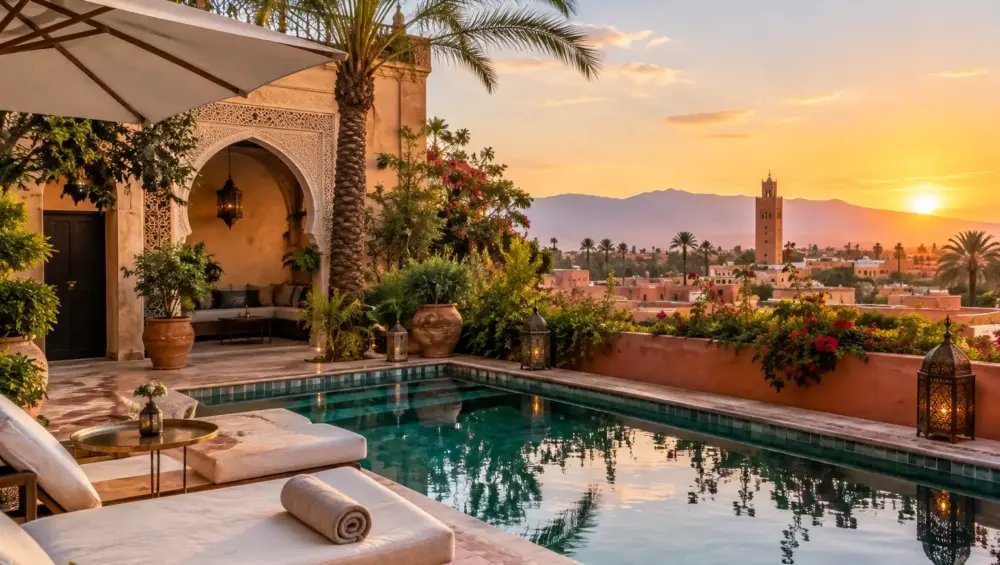
For first-time visitors, the medina is often the emotional heart of Marrakech. Staying here means stepping from a quiet courtyard into lanes lined with artisans, little food stalls, historic monuments and the energy of Jemaa el-Fnaa. A well-chosen riad can feel wonderfully private: birdsong around the courtyard, mint tea on the roof terrace, and staff who quickly learn whether you prefer breakfast early or slowly.
But I am honest about the trade-off. Cars cannot access many medina doors. Depending on the riad, you may be met at a nearby drop-off point and walk the final stretch with luggage. This is usually manageable, and often part of the charm, but it is not ideal for everyone. Families with pushchairs, travellers with limited mobility, or anyone arriving late after a long flight may value easier access more than romance.
The medina also varies lane by lane. Some addresses are calm and close to major sights; others are more residential, more atmospheric, and farther from the action. A riad near the edge of the medina can offer a useful middle ground, particularly if your itinerary includes several early starts with a private driver.
Hivernage and the new city: space and convenience
Hivernage and the newer districts offer wider roads, larger hotels, gardens, proper swimming pools and easier vehicle access. This can be an excellent choice for travellers who want a resort-style reset within reach of Marrakech’s main attractions. It also suits a short stay where smooth arrivals, easy dinners and a reliable pool matter more than sleeping behind ancient medina walls.
The compromise is that you do not simply stroll out into the old city’s texture. You will normally take a short drive or taxi to reach the souks and main historic sites. For some couples, that separation is a relief after a busy day. For others, it makes Marrakech feel more like any international city. I usually ask one direct question: do you imagine your evenings ending on a quiet hotel terrace, or with the medina still humming outside the door?
The Palmeraie: retreat, not base camp
The Palmeraie has space, greenery and larger resort properties, often with an appealing sense of escape. It can work beautifully for a traveller who wants several unhurried pool days, a family needing room to breathe, or a special occasion built around staying put.
For a first visit of only two or three nights, however, it can be too removed. Every meal, guide visit and evening in the old city requires transport and a little more planning. I tend to see it as a deliberate retreat choice rather than the default answer to Marrakech.
Riad or hotel? Choose for the way you travel
The riad-versus-hotel question is not really about category. It is about scale and energy.
A riad is often intimate, characterful and rooted in place. Rooms may differ dramatically in size and layout, which is part of the appeal but worth considering when travelling as a family or group of friends. Pools, where present, are commonly plunge pools rather than places for a serious afternoon swim. Service can feel very personal, while facilities may be more limited than at a large hotel.
A larger hotel generally offers more predictable room standards, lifts, larger pools, spa facilities and the ease of on-site dining. This is especially helpful after a desert journey, an early Atlas Mountains excursion, or several nights spent moving between destinations. Yet a large hotel can occasionally insulate you from the character that brought you to Morocco in the first place.
There is no prize for choosing the more traditional option. If you love design, local details and the idea of breakfast in a tiled courtyard, a riad may be exactly right. If you want a generous pool, plenty of shade and minimal logistical friction, choose the hotel without apology. Your wish is my command, but first I need to know what that wish actually looks like.
Details that change the stay more than photographs do
When I assess Marrakech hotels for an itinerary, I pay attention to the small practical points that booking pages often hide behind beautiful images. Air conditioning matters in warmer months, but so does whether the room has good natural light and a quiet orientation. A rooftop is lovely, though it may bring stairs and city noise. A courtyard room can be atmospheric, though the sound of breakfast or late arrivals sometimes carries.
For travellers arriving by private transfer, vehicle access is a major consideration. The same applies when a guide is collecting you for a morning tour or a driver is taking you to the airport before dawn. A medina porter and a short walk may be entirely straightforward, but I prefer that nobody discovers this detail with four suitcases at midnight.
Families should look beyond the phrase “family-friendly”. Ask whether rooms genuinely interconnect, whether the pool is suitable for the children’s ages, and whether a late dinner is realistic after a full day. Couples may prioritise privacy, a good rooftop, a hammam or simply the sort of room in which they are happy to linger during the hottest part of the afternoon.
Food deserves a thought too. Marrakech has excellent restaurants, so I would not choose a property purely for dinner. Still, a reliable breakfast and the option of an easy first-night meal can make arrival day much gentler. In the medina especially, a good roof terrace becomes more valuable than many people expect.
Match the hotel to the rest of your Morocco route
Accommodation works best when it is planned as part of the whole journey, not as a separate trophy booking. If Marrakech comes after the Sahara, a pool and uncomplicated access may suddenly matter a great deal. If it is your first stop before travelling through the High Atlas, staying within the medina can give the journey a strong opening sense of place.
I also think about pace. Two nights in Marrakech is enough for some travellers to enjoy the essential sights, but it does not leave much time to recover from travel or get lost in the souks. With three or four nights, the case for a riad with a restful courtyard grows stronger because you can enjoy the property as well as the city. If you are splitting your stay, perhaps before and after the desert, using two contrasting styles of accommodation can be more rewarding than trying to find one property that does everything.
Season matters too. In cooler months, a sunny terrace and heated pool can transform a stay. In summer, shade, excellent air conditioning and a sensible afternoon plan are less glamorous but far more useful. Marrakech is generous to travellers who work with its climate rather than against it.
My honest approach to choosing where you sleep
I do not believe the best Marrakech hotel is a universal answer. A couple celebrating an anniversary, parents travelling with teenagers, friends who want late dinners, and travellers seeking quiet after a demanding itinerary should not be given the same recommendation simply because it is popular.
That is why I begin with questions: How much walking feels enjoyable? Is a pool essential or merely nice to have? Do you want to be able to pop back to your room during the day? Are you happy with a short luggage walk? Does the room need to work as a shared space for a family? The answers narrow the choices quickly and intelligently.
A carefully chosen place to stay gives Marrakech the right tempo. Pick somewhere that supports the holiday you actually want, leave room for a little spontaneity, and let the city do the rest. Habibi, welcome to Morocco.