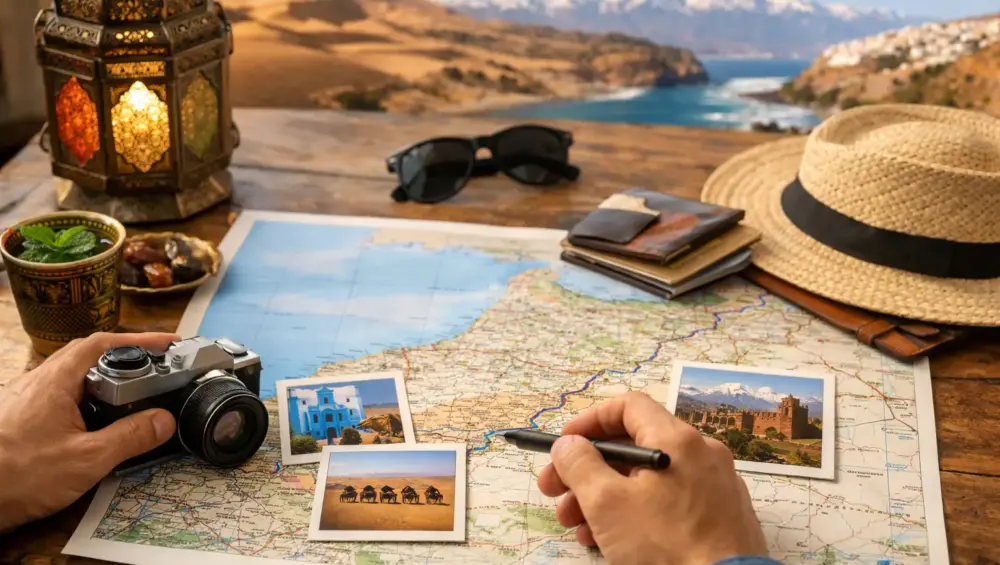
The mistake I see most often is trying to fit Morocco’s entire map into one holiday. Marrakech, Fes, Chefchaouen, the Sahara, the coast and the High Atlas can all look temptingly close on a screen. On the road, they are not. This Morocco route planning example shows how I would shape a 10-day private journey that feels rich without turning every second day into a long transfer.
The key is not ticking off the maximum number of places. It is choosing a route with a rhythm: busy medinas balanced by quiet landscapes, memorable driving days followed by proper time to enjoy where you have arrived. Your wish is my command, Habibi, but sometimes the best planning advice I can give is to leave one destination for another visit.
Why this Morocco route planning example works
This route begins in Marrakech and ends in Fes. That matters because it avoids retracing several hours of road and gives each section of the journey a clear purpose. You start with Morocco at full volume, cross the mountains and desert, then finish among the intricate lanes and craft traditions of Fes.
It is especially well suited to couples, friends and families who want a private driver, thoughtful accommodation and a mix of landmark experiences with time to absorb them. It does involve a few substantial road days. The desert is worth the effort for many travellers, but I would not pretend it is around the corner.
Days 1 and 2: Marrakech, with time to settle in
Arrive in Marrakech and keep the first day deliberately light. A riad transfer, a mint tea on a roof terrace, perhaps a gentle walk near your accommodation – that is enough after a flight. I do not recommend planning a packed guided tour on arrival day unless timings are unusually favourable.
Use the next full day for Marrakech properly. A private local guide can help turn a confusing medina into a place with context: the old trading streets, artisans at work, architectural details that are easy to miss, and the practical art of crossing Jemaa el-Fna without getting swept along by the crowd. Leave part of the afternoon unplanned. Marrakech rewards wandering, but it also rewards a pause beside a pool or on a shady terrace.
Two nights is the minimum I like here. Three makes sense if you are keen on food, gardens, contemporary design or a day trip, but on a 10-day route I would usually keep the focus moving east.
Day 3: Marrakech to the High Atlas or Ait Ben Haddou
This is where route choices begin to matter. Rather than driving all the way to the desert in one punishing day, I prefer a stop on the southern side of the High Atlas. The road over Tizi n’Tichka Pass is scenic, winding and dependent on conditions, so it deserves daylight and a relaxed schedule.
One option is to stay around Ait Ben Haddou, where the earthen ksar rises above the riverbed. Another is a quieter kasbah-style property in the Ouarzazate or Skoura area, particularly appealing for travellers who prefer palm groves and garden lunches to another busy town.
This is not merely a break in the drive. It is a change of Morocco. Red earth replaces the city’s terracotta walls, villages appear on hillsides, and the architecture begins to feel shaped by the desert ahead.
Day 4: The Valley of a Thousand Kasbahs to the Dades
From the Ouarzazate region, travel through the Skoura oasis and along the Route of a Thousand Kasbahs towards the Dades Valley. It is a day for small stops rather than rushing between headline sights: a local kasbah, rose-growing country near Kelaat M’Gouna in season, or a short walk beside cultivated fields.
I usually recommend sleeping in or near the Dades Valley rather than pushing onwards to Merzouga. This gives the landscape some breathing room and means the next day does not start with a desperate race for sunset. There are simple, characterful places here where dinner is often quieter and more personal than in the major cities.
Morocco route planning example: making the desert day realistic
Day 5: Dades to Merzouga and the Erg Chebbi dunes
The drive from Dades towards Merzouga is long enough to require honest expectations. Depending on stops and the precise overnight location, plan on much of the day being spent on the road. The changing scenery is the point: dramatic gorges, stony plains, date palms and, finally, the first proper view of Erg Chebbi’s golden dunes.
Arrive in time to switch to the desert experience arranged for you, whether that means a camel ride, a 4×4 transfer, or simply heading to a camp before dusk. Camel riding is atmospheric, but it is not compulsory. For some travellers, especially young children or anyone with mobility concerns, a vehicle transfer is the more comfortable choice.
A good desert night is not about pretending you are alone in the Sahara. It is about being in a carefully chosen location, eating well, looking up at a sky with very little artificial light, and waking early enough to see the dunes before the heat builds.
Day 6: Merzouga to the Ziz Valley or Midelt
I almost never advise driving directly from Merzouga to Fes after a desert night. It can be done, but it creates a very long day and turns the journey into endurance rather than enjoyment. Instead, break the route around the Ziz Valley or Midelt.
This section is less famous than the dunes, yet it often surprises travellers. The Ziz Valley is a vast ribbon of palms cutting through dry terrain, while the Middle Atlas brings cooler air and a distinctly different landscape. A night here also makes the following arrival in Fes more civilised.
Day 7: Midelt to Fes via the Middle Atlas
Continue north through the Middle Atlas towards Fes. The route may pass cedar forests and mountain towns, though I treat any wildlife encounter as a bonus rather than a promise. This is a good day to arrive at your Fes riad in the late afternoon, settle in, and enjoy dinner without trying to decode the medina immediately.
Fes can feel more intense and less visually polished than Marrakech. That is precisely why a gentle first evening helps. It is a living city, not a museum set.
Days 8 and 9: Fes beyond the obvious
Give Fes a full guided day, ideally with a licensed local guide who knows how to adapt the walk to your interests. The old medina is dense, layered and easy to get lost in. You may want to focus on craftsmanship, food, history, architecture or everyday market life. A good guide makes those choices meaningful rather than offering a hurried procession of photo stops.
Keep day nine flexible. Some travellers want a cooking experience or a slow morning with a hammam. Others prefer a visit beyond the main medina, perhaps to see the broader city and its viewpoints. If you are travelling as a family, this extra day is particularly valuable. Children rarely enjoy being marched through historic sites from breakfast until sunset, however beautiful the tiles may be.
Day 10: Departure from Fes
Depart from Fes, or add nights if your flight schedule requires it. If your international flight leaves from Marrakech or Casablanca, the route needs adjusting. I would not add a final cross-country dash simply because a flight was booked before the itinerary was considered. Open-jaw flights, arriving in one city and leaving from another, often make a Morocco journey far calmer.
When I would plan this route differently
A route is only good if it suits the people travelling it. For a first-time visitor with 12 to 14 days, I might add Essaouira after Marrakech for Atlantic air, fresh seafood and a slower few days. For someone who dislikes long drives, I would skip the Sahara and spend more time between Marrakech, the High Atlas and the coast. That is not a lesser Morocco holiday. It is a better-designed one.
Chefchaouen belongs on a northern route, usually paired with Tangier, Fes and perhaps Rabat, rather than squeezed between Marrakech and Merzouga. The blue lanes are beautiful, but they do not magically sit on the way to the desert.
The season also changes the calculation. Summer heat makes the desert more demanding, while winter can bring cold nights and weather-related uncertainty in mountain areas. Spring and autumn are popular for good reason, but even then, pacing matters more than a perfect-looking itinerary.
When I design a journey through Morocco Genie, I start with the moments you care about most – a desert sunrise, a mountain walk, a riad with character, a family-friendly pace, proper food – then build the roads around them. Morocco is generous, but it is not a country to rush. Give it room, and it has a way of giving far more back.