
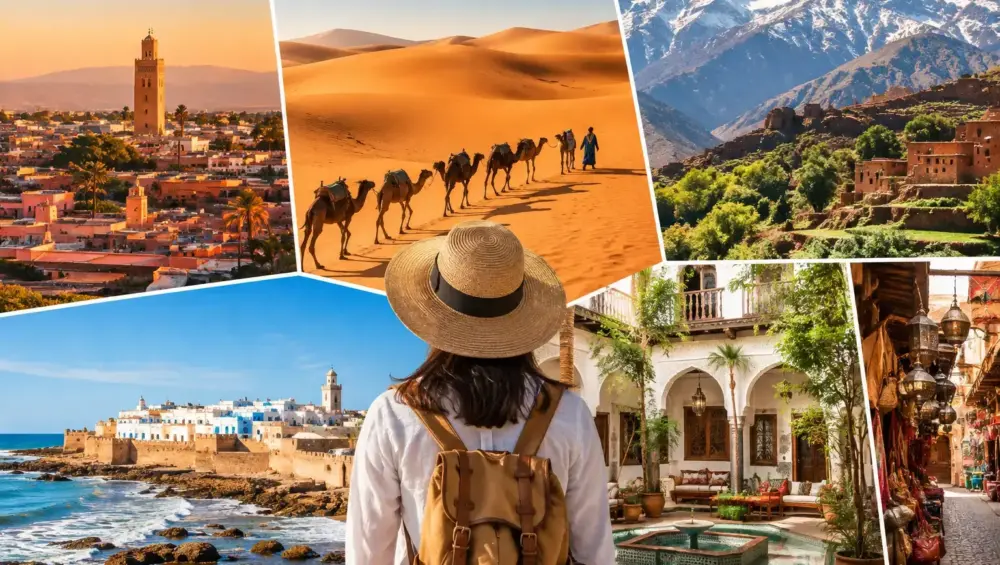
A Morocco itinerary can look wonderfully simple on a map. Marrakech, the Atlas Mountains, the Sahara, Fes and Chefchaouen appear almost to line up for you. Then you notice that a desert sunrise may require a full day on the road beforehand, and that getting from the blue streets of Chefchaouen back to an airport can reshape the final days of your holiday.
When I help travellers organise a Morocco multi city trip, I begin with one slightly unromantic question: how many hours do you genuinely want to spend in a vehicle? Your answer matters more than how many pins you can fit on a map. Morocco rewards movement, but it also rewards slowing down long enough to hear the medina wake up, eat a proper lunch and let a place surprise you.
Start with the shape of your holiday, not a list of cities
Most people arrive with a wish list. Marrakech, Fes, the desert, perhaps Essaouira or Chefchaouen. These are all excellent choices, but they do not belong in every itinerary together. The right route depends on your arrival airport, number of nights, appetite for driving and what you most want to feel when you are here.
For a first visit of around seven nights, I would usually choose three strong chapters rather than attempt the whole country. Marrakech and the High Atlas, a route through the south to the Sahara, then Fes can make a very satisfying journey. It includes the contrast people come for: a buzzing city, mountain scenery, kasbah country, wide open desert and an ancient imperial medina.
With ten to twelve nights, there is more freedom. You might add Chefchaouen in the north, allow an extra night in the desert region, or finish with Essaouira for Atlantic air and a gentler pace. But these choices involve trade-offs. Chefchaouen is photogenic and genuinely lovely, yet it is not a quick detour from Marrakech. Essaouira is easy to pair with Marrakech, but less natural after Fes unless you are happy with a longer transfer or a domestic flight option.
My advice is to select two priorities and one bonus. If the desert and food are your priorities, build around them. If you care most about architecture, artisan workshops and medina life, give Marrakech and Fes proper time. The bonus is the place you add only if the route still feels comfortable.
Organise a Morocco multi city trip around road reality
Distances in Morocco can be deceptive. Motorways connect some major cities efficiently, while mountain roads and desert routes take longer than their kilometre count suggests. That is not a problem when the drive is part of the experience. It becomes a problem when every day is treated as a transfer day with a photo stop attached.
The journey from Marrakech towards the Sahara is a good example. Crossing the High Atlas via the Tizi n’Tichka pass brings changing landscapes, villages clinging to hillsides and views that deserve pauses. Continuing through Ait Ben Haddou, Ouarzazate and the Dades or Skoura area can create an exceptional road-trip day, but it is still a long day. I prefer splitting this route where possible, especially for families, couples who value relaxed mornings, or anyone who wants to enjoy a kasbah rather than merely tick it off.
Likewise, travelling from the desert to Fes is possible in one day. The scenery changes dramatically, from dunes and rocky plains to cedar forests and the Middle Atlas. Yet it can take much of the day. If you have limited time, it is a worthwhile link between two very different parts of Morocco. If you have more nights, a slower onward route may leave you fresher for Fes.
A good private journey has a rhythm: travel, explore, rest, travel, explore. It should not feel like a relay race with mint tea.
Open-jaw flights can make a major difference
Whenever possible, consider arriving in one city and departing from another. Flying into Marrakech and home from Fes, or the reverse, can remove a needless return journey. It often gives you an extra night for a city, mountain lodge or coastal stay instead of using it to retrace your route.
This does not always suit flight availability or your preferred airline, so it is not a rule. But it is one of the first practical decisions I would examine before finalising accommodation. A beautifully planned route can become awkward if the flights are treated as an afterthought.
Give each stop a job
Every overnight stop should earn its place. Marrakech is for energy, design, food and sensory overload. Fes is for craft, history and the more intricate experience of a living medieval medina. The Sahara is for scale, silence and a night sky that makes even committed city people go quiet.
The High Atlas offers a different Morocco again: valleys, walking opportunities, Berber villages and cooler air. Essaouira gives the itinerary breathing space, particularly after Marrakech, with sea views, seafood and a manageable medina. Chefchaouen is best for travellers who enjoy atmosphere, photography and slower wandering, rather than those chasing a long list of monuments.
When a stop has a clear purpose, it is easier to decide how long it needs. Marrakech deserves at least two nights for most first-time visitors. One night in Fes can feel rushed, because the medina is more rewarding with a knowledgeable local guide and time afterwards to return to corners you noticed. Desert camps are memorable, but the experience differs greatly depending on whether you arrive exhausted after a marathon drive or with enough daylight to settle in and watch the dunes change colour.
Choose accommodation for location and flow
A riad in the heart of a medina can be magical, but it comes with practical considerations. Cars cannot always reach the door, so you may walk along narrow lanes with luggage. For many travellers, that is part of the pleasure. For others, especially after several travel days or with very young children, easier access matters more.
I look at accommodation as part of the route, not a collection of pretty rooms. In Marrakech, a central riad may make sense if you want to explore on foot. In the Atlas, a property with a terrace and valley views can justify an earlier arrival. On a desert route, a comfortable kasbah-style stay breaks up the drive far better than pushing on simply to gain another hour of road.
It also helps to vary the atmosphere. A few nights in intimate riads, followed by a mountain lodge or a well-run desert camp, gives the journey texture. Not everyone wants to unpack every night, though. If you prefer fewer hotel changes, choose two or three bases and take day trips where they make sense.
Plan guides and free time together
A private guide is particularly valuable in Marrakech and Fes, where the medinas are layered places rather than open-air museums. The best visits are not simply a march through famous sites. They connect the history, craftsmanship and daily life around you, while helping you understand where you are in a maze of lanes that can look identical after an hour.
That said, I would not schedule a guide from breakfast until dinner every day. Leave room for an unplanned café, a long lunch, a hammam, or the small pleasure of getting mildly lost when you have nowhere urgent to be. A guide provides context; free time gives you ownership of the journey.
For driving days, reliable coordination matters just as much. A private driver can adapt when a viewpoint deserves longer, a child needs a break, or weather changes the mood of a mountain pass. But even with private transport, sensible timing is kinder than trying to force every possibility into one day.
Keep one night uncommitted in spirit
Not literally unbooked, necessarily. Morocco is popular in key seasons and the right places can fill early. I mean leave one night in the itinerary without a demanding agenda. It might become an extra afternoon by the pool in Marrakech, a cooking experience, a walk in the Atlas, or simply a late breakfast after a desert night.
Travellers sometimes worry that this is wasted time. In practice, it is often the day they remember most clearly because it was not over-engineered. Morocco has its own pace, and trying to outsmart it usually creates stress rather than better stories.
At Morocco Genie, I build private journeys by starting with the traveller, then making the route work in the real world – flights, drive times, accommodation character and the moments that matter to them. Your wish is my command, but I will also tell you when one more city is likely to weaken the holiday.
The best multi-city Morocco trip is not the one that covers the most ground. It is the one that leaves you with enough time to look up, breathe in the orange blossom or desert air, and think: I am exactly where I should be.


