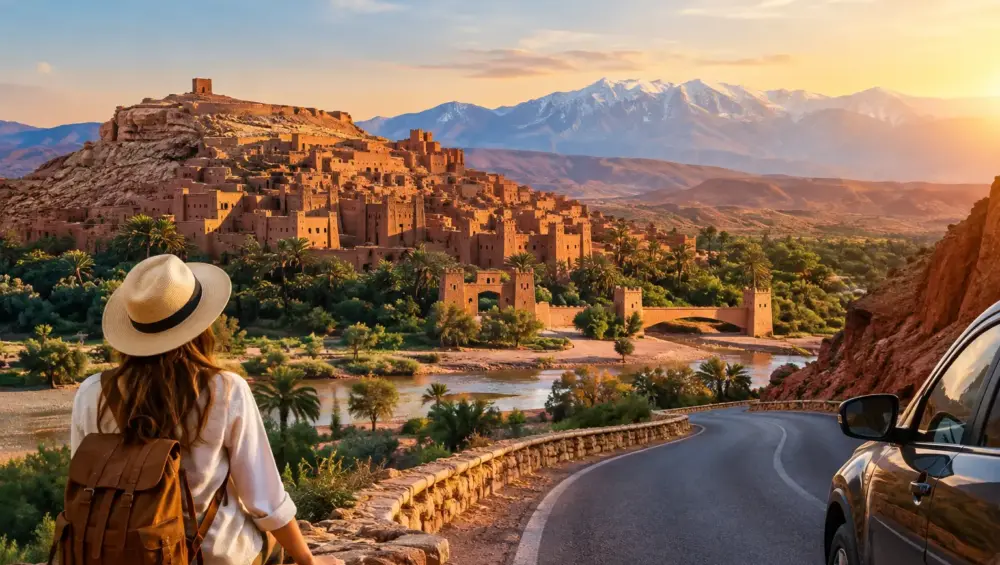
A Morocco road trip is rarely about getting from A to B. It is about the moment the road climbs out of Marrakech, the landscape turns ochre, and somebody in the car quietly says, “Wait, is this still Morocco?” The best Morocco road trip stops are not necessarily the places with the biggest name. They are the places that give the route rhythm: a palm-filled valley after a mountain pass, a kasbah at sunset, a roadside lunch you would never have found from a guidebook.
I design private journeys around what people genuinely enjoy, so I do not recommend cramming every famous stop into one holiday. Morocco is bigger, slower and more varied than it appears on a map. Choose a route with room to pause, then let these places earn their place in it.
Best Morocco road trip stops between Marrakech and the Sahara
This is Morocco’s classic overland route, and for good reason. In a relatively short distance, you move from a busy imperial city to the High Atlas, ancient fortified villages, deep valleys and the edge of the Sahara. It can be rushed in two long days. I think it is far better over three or four.
1. Tizi n’Tichka Pass
The High Atlas crossing between Marrakech and Ouarzazate is not simply a necessary transfer. It is one of the journey’s first real events. The road bends through dramatic slopes, small villages and changing rock colours, reaching over 2,200 metres at its highest point.
The pass is most enjoyable with an early start and a driver who knows when a viewpoint is actually worthwhile. Weather can alter the experience considerably, especially in winter, when snow or low cloud may affect the route. I would not plan a tight connection on the other side of the mountains. Let this be a travelling day, with time for tea, photographs and an unhurried arrival.
2. Aït Ben Haddou
Aït Ben Haddou is the famous ksar – a fortified village of earthen buildings – near Ouarzazate. Yes, it appears in plenty of films and photographs. It is still worth seeing, particularly late afternoon or early morning when the day visitors have thinned and the mud-brick walls seem to shift from gold to red.
The important distinction is between seeing it and staying near it. A brief stop can feel busy and stage-managed. An overnight nearby gives you the quiet walk across the riverbed, the changing light and the chance to understand why this valley became a natural crossing point for old caravan routes.
3. Ouarzazate and the Skoura Oasis
Ouarzazate is practical rather than romantic, but it makes sense as a pause after the mountains. The more rewarding detour is Skoura, around 40 minutes east, where palm groves surround weathered kasbahs and working villages. It has a gentler, greener mood than the open desert landscapes ahead.
Skoura suits travellers who like architecture, gardens and slower mornings. It is also a good choice for families who need a comfortable break in the driving. Do not expect a major town packed with attractions. Expect an oasis that works best when you walk, linger and look beyond the main road.
4. Dades Valley
The road through Dades Valley winds between rose-coloured cliffs, small farms and clusters of kasbah-style homes. The most photographed hairpins are high above the gorge, but the real pleasure is lower down: stopping for a simple lunch, noticing how intensely cultivated the valley floor is, and staying somewhere with a view over the rock formations.
Dades is often paired with the nearby Todra Gorge, which is sensible, though the two have different personalities. Dades feels broader and more scenic; Todra is narrower, more vertical and more dramatic. If your time is limited, I would choose based on your accommodation and preferred pace rather than trying to tick both off at speed.
5. Todra Gorge
Near Tinghir, sheer limestone walls close around a narrow river corridor. Todra Gorge is an easy place to visit, but it remains impressive even when other travellers are there. Walk beyond the busiest roadside section and the atmosphere changes quickly.
It is a particularly good stop for people who want to stretch their legs after several hours in the vehicle. Keen walkers can arrange a more meaningful local hike in the surrounding valleys, while others may be perfectly happy with a relaxed walk and mint tea. Both are valid. Not every Morocco road trip stop needs to become an expedition, habibi.
6. Nkob and the road through the Anti-Atlas
Nkob is one of the stops I suggest when travellers want a route that feels less obvious. South of the main Dades corridor, it sits among date palms and dozens of earth-coloured kasbahs, with the Anti-Atlas mountains behind it.
This is not the place for a packed sightseeing schedule. It is for a quieter overnight and a reminder that Morocco’s most memorable roads are often the ones without coaches parked outside every viewpoint. The drive from Nkob towards the desert is beautiful, but it is longer than it looks. Build in daylight and do not try to combine it with an ambitious desert arrival.
7. Erg Chebbi near Merzouga
For many travellers, the dunes of Erg Chebbi are the emotional high point of a Morocco journey. The first sight of sand rising above the flat desert plain has a properly cinematic effect, even for people who swear they are not interested in cinematic moments.
A desert stay needs thoughtful planning. A camel ride at sunset can be lovely, but it is not the only way to experience the dunes, and it is not ideal for everyone. Some travellers prefer a short walk, a 4×4 transfer, sandboarding, or simply watching the colours change from a well-positioned camp. I always ask about mobility, comfort and expectations before suggesting the format. The best desert experience is the one you can actually enjoy, not the one you think you are supposed to book.
Northern Morocco stops worth building into a route
Northern Morocco is greener, more compact and culturally distinct from the desert south. It is tempting to treat it as a quick add-on, but the drive times and mountain roads deserve respect.
8. Volubilis
The Roman ruins of Volubilis sit on a hillside amid open farmland, with views towards the Zerhoun mountains. It is one of those places that surprises travellers who imagine Morocco only in terms of medinas, kasbahs and desert.
The mosaics are a draw, but I like Volubilis because it creates contrast. After the intensity of Fes, the open space feels almost meditative. A licensed guide is useful here, not because the site is impossible to understand alone, but because its layers of history become more vivid with context.
9. Moulay Idriss Zerhoun
A few kilometres from Volubilis, Moulay Idriss rises across two green hills. It is a compact, photogenic town with narrow lanes, local life and a much more intimate feel than Morocco’s larger cities.
This is best approached respectfully and without trying to turn every corner into a photo opportunity. Stop for lunch, take in the views, and let your guide or driver advise on the best way to explore. It combines naturally with Volubilis and Fes, rather than demanding a full day of its own.
10. Chefchaouen
Chefchaouen’s blue lanes are genuinely beautiful, but the town is more than its camera-friendly corners. Set in the Rif Mountains, it has a slower tempo, excellent views and a coolness that can be very welcome after hotter parts of the country.
Stay one or two nights if you can. Arriving for a hurried afternoon and leaving after dinner misses the point. Early morning, before the lanes fill up, is when Chefchaouen feels most like itself. It also makes a fine base for light walking in the surrounding hills, although it depends on the season and how much driving your group has already done.
The Atlantic road trip stops I return to often
The Atlantic route is a different Morocco again: wind, fishing boats, whitewashed towns and long beaches. It works especially well after Marrakech or the desert, when you want the journey to exhale.
11. Essaouira
Essaouira is one of Morocco’s easiest places to enjoy. The medina is manageable, the seafood is excellent, and the ocean breeze softens the heat. Yet it should not be treated as a generic beach resort. The sea can be breezy and cool, particularly outside the height of summer, which is wonderful for walks but not always ideal for a long swim.
I recommend it to couples, families and friends who want a relaxed finale without losing Moroccan character. Spend time in the fishing harbour, wander the ramparts and leave space for a long lunch. That is the correct itinerary here.
12. Sidi Kaouki and the quieter coast south of Essaouira
A short drive south of Essaouira, Sidi Kaouki offers a wilder shoreline, broad sand and a sense of space that the city itself cannot provide. It is a strong option for travellers who want to slow down, ride horses on the beach, surf, or simply spend an afternoon doing very little.
The trade-off is simplicity. This is not where you go for a polished town experience or a dense choice of restaurants. Go for the ocean, the open horizon and the permission to have nowhere urgent to be.
Plan the route around the pauses, not just the pins
The strongest Morocco road trips have breathing room. I would rather see fewer places properly than turn a holiday into a sequence of suitcase unpacking and dashboard kilometres. A private driver makes the journey more comfortable, certainly, but the real advantage is flexibility: stopping when the light is right, adjusting for weather, or lingering somewhere that unexpectedly becomes your favourite part.
When I plan a route through Morocco Genie, I start with the question behind the itinerary. Is this a food-focused holiday, a first visit with iconic highlights, a family trip with shorter drives, or a celebration that needs beautiful stays and time to enjoy them? Your wish is my command, but a good genie also tells you when a detour is worth it and when another long driving day is not. Morocco rewards that honesty.