A road in Morocco can change the entire character of your day in less than an hour. One moment you are leaving Marrakech among red-earth villages and olive groves; soon afterwards, you are high in the Atlas, watching mule paths trace the slopes below. The best scenic drives in Morocco are not simply transport between famous places. They are often the part of the journey people remember most clearly.
I plan routes around the road as much as the destination. That does not mean cramming every dramatic pass into one holiday. It means choosing the drives that suit your pace, confidence and interests, then allowing enough daylight to stop when Morocco gives you a reason to stop.
How I choose Morocco’s most scenic drives
There is no single perfect Moroccan road trip. A couple with ten days who want riads, good food and a gentle pace may get more from the Atlantic coast and the southern valleys than from tackling every mountain pass. A family travelling in summer may prefer the cooler Middle Atlas to long days in the exposed south. And if winding roads make anyone in your party miserable, that changes the calculation immediately.
For most private journeys, I favour routes with a strong sense of progression: city to mountains, mountains to kasbah country, then palms, desert or ocean. The following roads are the ones I return to when designing that kind of journey.
9 best scenic drives in Morocco
1. Marrakech to Ait Ben Haddou via Tizi n’Tichka
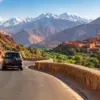
This is the classic High Atlas crossing, and it earns its reputation. Leaving Marrakech, the landscape tightens steadily until the road begins its long climb towards the Tizi n’Tichka pass. On a clear day, the view is a huge sweep of dry peaks, folded valleys and small settlements built almost the same colour as the ground beneath them.
The road has been improved considerably over the years, but it is still a full mountain day rather than a quick transfer. I would not rush it. Stop in a village for tea, admire the changing geology, and arrive at Ait Ben Haddou with enough time to see the ksar in softer late-afternoon light. Winter weather can alter conditions at higher elevations, so the route should always be checked close to travel.
2. Ouarzazate to Telouet through kasbah country
For travellers who enjoy history as much as scenery, the road towards Telouet is one of the most rewarding detours in the south. It runs through a broad, striking landscape where stony hills meet cultivated pockets of green. The destination is the old Glaoui kasbah at Telouet, whose fading decorative rooms offer a powerful contrast with its austere exterior.
I often use this route as an alternative way to experience the Atlas rather than treating it as an add-on. It suits curious travellers who are happy with a slower day and do not need every road to be perfectly straight or polished. Pair it with Ait Ben Haddou and it becomes a journey through architecture, trade-route history and mountain scenery in one go.
3. The Road of a Thousand Kasbahs, Skoura to Dades
Between Skoura and the Dades Valley, the scenery is less about high drama and more about layers. Date palms appear in dense ribbons beside dry earth. Crumbling kasbahs rise from the groves. Beyond them, the desert foothills sit in shades of copper, mauve and grey.
This is a route for stopping often, especially around Skoura’s palm oasis and the small towns along the way. It works beautifully for travellers who want to understand how southern Morocco lives, rather than simply photograph a canyon and move on. The road itself is generally approachable, but the pleasure lies in giving it time.
4. Dades Gorge and the road above the valley
The Dades Gorge has one of Morocco’s most recognisable stretches of tarmac: a series of tight hairpins climbing above the gorge, with red rock walls closing in around it. It is absolutely worth seeing, but my advice is to go beyond the postcard viewpoint if time allows. Higher up, the valley opens into quieter landscapes, with fields, stone villages and broad mountain views.
This drive is short in distance but can feel intense for anyone uneasy on bends. A private driver is particularly useful here, allowing everyone else to look out of the window instead of concentrating on the next curve. Early morning is calmer and kinder for photography than the middle of the day.
5. Tinghir to Todra Gorge
The approach from Tinghir into Todra Gorge is a wonderful example of Morocco’s sudden changes in scale. Palm groves and village streets give way to a narrow limestone corridor, where vertical cliffs rise sharply on either side of the road. It is not a long drive, but it is one of the most satisfying scenic sections to build into a route between Dades and the desert.
The gorge is popular, particularly around the central section, so I prefer to treat it as a purposeful stop rather than an all-day destination. Walk a little beyond the busiest point if you can. The sound of the river and the cool shade make a welcome contrast with the open south.
6. Agdz to Nkob via Tizi n’Tazazert
This is for the traveller who asks me for a road that feels properly remote. The Tizi n’Tazazert route links the Draa Valley area with Nkob across rugged Anti-Atlas country. It passes through high, sparsely populated terrain where the colours shift from ochre to dark volcanic rock, with distant villages tucked into unlikely folds of the hills.
It is not my default recommendation for every itinerary. The drive is long, winding and best approached with an experienced local driver who knows the route and current conditions. But for the right traveller, it is unforgettable: quiet, raw and far removed from Morocco’s headline sights.
7. Fes to Midelt via Ifrane and the Middle Atlas
Many people are surprised by this road because it does not resemble their mental picture of Morocco at all. Leaving Fes, you can pass through Ifrane, with its alpine-style streets, before entering cedar forests around Azrou. In cooler months, the air feels noticeably sharper; in winter, the landscape can even take on a snowy character.
Further south, the road opens towards Midelt and the eastern Atlas. This is an excellent transition between imperial-city Morocco and the Sahara-bound routes. It is also a sensible overnight break for travellers who would rather not force Fes to the desert into one very long day.
8. Essaouira to Safi on the Atlantic coast
Morocco’s Atlantic coast is not one continuous beach road, and that is exactly why this drive has character. Between Essaouira and Safi, sections of the route run close to wind-blown beaches and rocky shorelines, while others turn inland through farmland and small coastal settlements. The ocean appears, disappears and returns when you least expect it.
This is a good choice for travellers who prefer sea air, seafood and a less hurried rhythm after the intensity of Marrakech. Wind is part of Essaouira’s personality, so bring a layer even when the sun is out. If your time is limited, there is no need to drive all the way to Safi: a leisurely coastal section and a well-chosen lunch can be enough.
9. Tiznit to Tafraoute and Ait Mansour Valley
The Anti-Atlas around Tafraoute has a gentler, stranger beauty than the High Atlas. Rounded granite boulders sit among argan trees, pink-orange hills catch the changing light, and small Amazigh villages punctuate the valleys. From Tafraoute, the route through Ait Mansour Valley introduces an unexpectedly lush ribbon of palms beneath steep rock walls.
I particularly like this area for travellers who have already seen Marrakech, the desert and the famous valleys, and want another side of Morocco. It rewards an unhurried itinerary. The distances may look modest on a map, but the scenery invites frequent pauses and the roads are often twisty.
Making the drives enjoyable rather than exhausting
Moroccan distances are deceptive. A 200-kilometre journey on a motorway is one thing; the same distance through mountain roads, village traffic and scenic stops is another. I generally plan fewer driving hours than travellers first expect, especially when a route crosses the Atlas or includes the desert.
The practical details matter. Start mountain drives early, carry water and a light layer, and keep a little flexibility for roadworks, weather or a stop that deserves longer than planned. Avoid scheduling a major guided visit immediately after a long crossing. Arriving at a beautiful riad tired and rushed is a poor trade for seeing one more viewpoint.
For confident self-drivers, these roads can be deeply rewarding, provided you are comfortable with bends, changing surfaces and a more relaxed approach to timing. For many couples and families, a private driver makes the day far more enjoyable. You can watch the landscape, stop safely when something catches your eye, and let someone else handle the mountain curves.
When I design a journey through Morocco Genie, I do not try to put every famous road on the map. I ask which kind of scenery will stay with you: cedar forest, canyon walls, kasbah valleys, empty desert plateaux or the Atlantic. Your wish is my command, habibi, but the best route is usually the one that leaves room to look out of the window.