A train can be the cleverest part of a Morocco itinerary – or the detail that quietly makes the whole route awkward. This Morocco train guide is based on how I plan real journeys: use rail where it genuinely saves energy, then switch to a private driver when Morocco’s best scenery and smaller places begin beyond the tracks.
Morocco’s railway network is useful, comfortable on the principal lines and far better than many first-time visitors expect. But it is not a country where you should build an entire holiday around trains. The magic often happens in the Atlas Mountains, the desert, the Atlantic coast south of Casablanca and the blue lanes of Chefchaouen. None of those places are reached by rail.
Where trains work best in Morocco
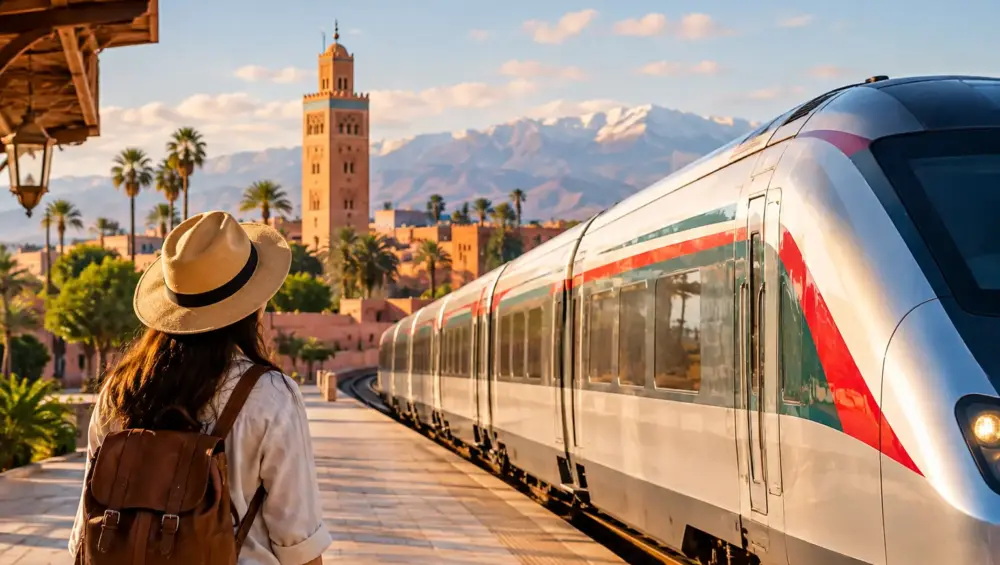
The strongest rail corridor runs between Tangier, Rabat, Casablanca and Marrakech, with connections inland towards Meknes and Fes. For a city-focused itinerary, this can be a very sensible way to travel. The high-speed service between Tangier and the Casablanca area is especially useful if you are combining northern Morocco with the imperial cities.
I often like the train for a couple arriving in Tangier who want a few nights there before continuing south. It gives them a relaxed start: no long road transfer on day one, no need to negotiate an unfamiliar station forecourt, and time to watch the landscape change from the northern hills to the urban coast.
The Fes-Meknes connection is another practical one. These cities are close enough that a train journey can work well, particularly if your main aim is time in the medinas rather than countryside stops. Rabat is also easy to include by rail for travellers interested in its calmer pace, contemporary art scene and broad, orderly avenues.
Marrakech is the southern end of the principal network. This matters when sketching your route. You cannot take a train onward to the Sahara, Essaouira, the High Atlas or Ait Ben Haddou. From Marrakech, the road becomes part of the experience.
Morocco train guide: choose the train for the journey, not the map
A common planning mistake is seeing a line between two cities and assuming it is automatically the best option. I look at the complete door-to-door day instead.
For example, a train from Casablanca to Marrakech may be easier than arranging a road transfer, especially if you are staying near the station or in a well-located riad with a straightforward transfer. On the other hand, if you are landing in Casablanca late, travelling with young children, or staying in the medina after a long flight, the train can introduce several extra steps: airport to station, station waiting time, luggage, arrival transfer and the final walk through narrow lanes.
It depends on your priorities. Travellers who enjoy independent movement and want to keep the journey simple may love the train. Those who value a softer arrival often prefer a driver waiting for them, particularly at the beginning of a holiday.
The same principle applies to a route between Fes and Marrakech. Rail is a perfectly valid option for travellers happy with a longer travel day. Yet a private route via the Middle Atlas can turn the transfer into a proper day of Morocco: cedar forests, changing landscapes, a lunch stop chosen around your preferences and no need to manage bags at either end. One is not universally better. They are different experiences.
First class or second class?
For most visitors, I recommend first class when it is available and the journey is more than short. The extra comfort is welcome on longer sectors, and seat reservations can make the day feel more predictable. This is particularly worthwhile during busy travel periods, weekends and school holidays.
Second class can still be absolutely fine for a short trip, especially for travellers who are flexible and travelling light. But it may be busier, and you have less control over where you sit. If your holiday is carefully paced and you are moving between special riads or boutique hotels, first class usually fits the overall experience better.
Neither option turns the train into a luxury experience, and that is not the point. Think clean, functional transport rather than a grand rail journey. Bring water, a small snack and something warm for strong air conditioning. If you are travelling with several large cases, be realistic about lifting and storing them. Morocco rewards a little practical preparation, habibi.
Stations, tickets and timing
Major stations are generally manageable, but I would not leave arrival until the last minute. Give yourself time to find the correct platform, especially in Casablanca where the city has more than one relevant station. Your accommodation location matters here. A station name that looks convenient on a map may not be the closest or easiest one for your hotel.
Train times and operating arrangements can change, so I always advise checking the current timetable close to travel. If you are booking independently, make sure you understand the departure station and keep your ticket details easily available on your phone, with a screenshot saved in case signal is poor.
For a carefully timed journey, I prefer not to make a tight connection between a flight and a train. Delays happen, baggage can take time, and arriving in a new country is rarely as quick as it looks on an itinerary. A buffer protects the mood of the day. It is much nicer to have time for a mint tea than to begin Morocco by sprinting through a station.
On arrival, arrange the final transfer in advance where possible. This is particularly helpful in Fes and Marrakech, where many beautiful riads sit inside pedestrian medinas. Your driver may take you to the nearest accessible point, then a hotel staff member or porter can help with the last stretch. It is a small detail, but it prevents the classic first-evening confusion of standing beside suitcases while alleyways branch in five directions.
The destinations trains cannot give you
Train travel is excellent for linking major cities. It is not the route to Morocco’s most cinematic drives.
Chefchaouen requires a road transfer from Tangier, Tetouan or Fes. Essaouira is reached by road from Marrakech, and that journey is part of its appeal: argan country, open plains and a distinct shift from red-city intensity to Atlantic air. The Sahara requires an even more deliberate road plan, usually with an overnight stop or a route designed around how much driving you are comfortable with.
This is why I rarely suggest a rail-only holiday to travellers who say they want both Morocco’s famous highlights and quieter, more local moments. You could take trains between selected city stays, then use a private driver for the sections where flexibility matters. That hybrid approach often gives you the best balance of independence, comfort and access.
A route might begin in Tangier by train, continue through Rabat or Casablanca, and finish in Marrakech. From there, a driver can take you through the Atlas Mountains and towards the desert, with days shaped around your pace rather than a fixed departure board. Or start in Fes, travel south by road through mountain landscapes, then return from Marrakech by rail if that suits your flights.
A better way to build your Morocco route
Before deciding on rail, I ask travellers a few practical questions. Do you want to see the countryside or simply arrive? Are you comfortable handling luggage and transfers? Is this a honeymoon-style journey where ease matters, a family holiday where avoiding long waits helps, or a friends’ trip where a train feels like part of the adventure?
The answers change the route. A train is often the right call for one or two city-to-city legs, but a private driver earns its place when the journey itself contains the experiences you came to Morocco for. It also gives you the freedom to pause for a viewpoint, a village market or an excellent roadside lunch without treating the day as a logistical puzzle.
When I design a tailor-made journey through Morocco Genie, I do not add a train simply because it exists, or a driver simply because it sounds more comfortable. I match each travel day to the people taking it. Your wish is my command, yes – but first I want to know what will make that wish feel genuinely easy once you arrive.
The best Morocco itinerary leaves room for the unexpected smell of orange blossom, the mountain view that deserves an extra ten minutes, and the relief of knowing you are travelling in the way that suits you. Use the train where it lightens the journey. Let the road take over where Morocco starts telling its best stories.